What a Healthcare Fax API Is and What It Does
 Zain QayyumLast Updated: Nov 23, 2026
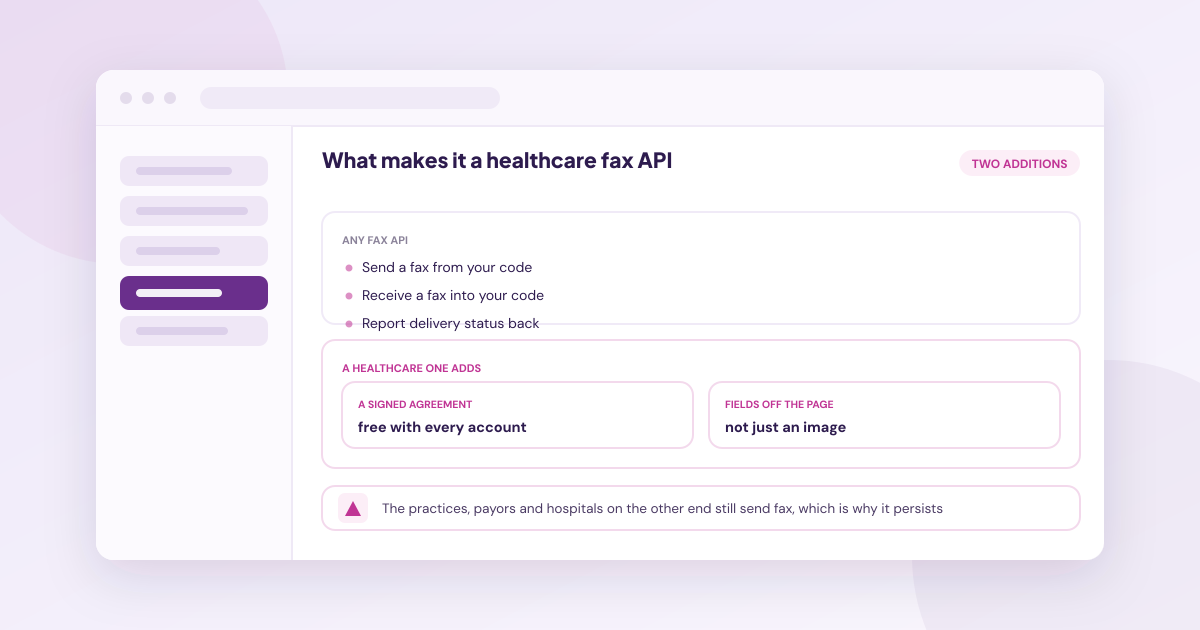
What a Healthcare Fax API Is and What It DoesA healthcare fax API is a programmable interface that lets your own software send and receive faxes, and read what arrives, without a fax machine or a fax server. The healthcare part is the contract and the handling. Medsender offers one at developer.medsender.com with self-serve signup and prepaid credits.
The application programming interface (API) is the part your engineers scope, and the business associate agreement is the part your counsel reads. Medsender includes that agreement free with every account and lets you sign it yourself on the developer portal, so neither piece waits on a sales call. Medsender publishes 34 named electronic health record (EHR) integrations and 47 on request.
TL;DR
- A healthcare fax API sends faxes, receives faxes and reports delivery status from inside your own code.
- What separates it from a general fax API is a signed business associate agreement plus fields read out of the page.
- Healthtech teams still deal with fax because the practices, payors and hospitals on the other end still send it.
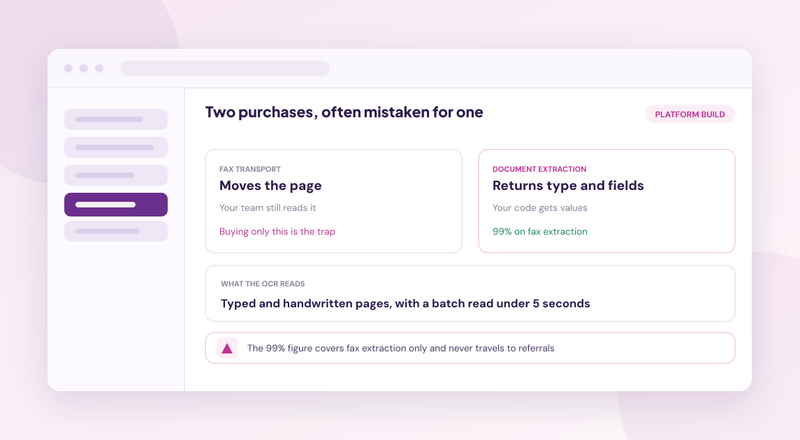
- Medsender reads a fax batch in under 5 seconds, and accuracy is 99% on fax extraction.
- Chart creation and write-back happen if your EHR supports them, and your product owns the next step where it does not.
- Medsender publishes no Fax API price and no formal service level agreement, so ask for both in writing before you build.
What a Healthcare Fax API Is
A healthcare fax API is defined by two things at once, the interface and the contract sitting behind it. Both have to be present for the term to mean anything to a buyer.
The Definition, Stated Plainly
A fax API is an interface your code calls to send a fax, receive a fax and read the status of either. A healthcare fax API is the same interface run by a vendor that will sign a business associate agreement under the Health Insurance Portability and Accountability Act (HIPAA) and handle protected health information under it.
What Separates a Healthcare Fax API From a General Fax API
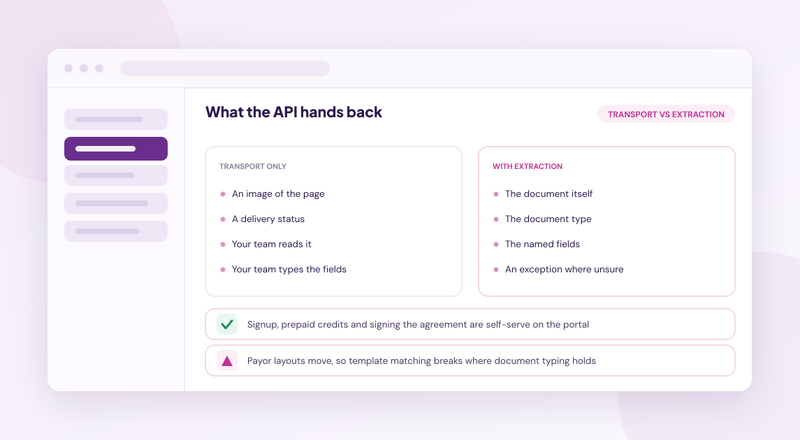
A general fax API moves a file and stops at transport. A healthcare fax API is expected to tell you what the document is, not only that it arrived. Medsender's optical character recognition (OCR) reads typed and handwritten pages, and the artificial intelligence (AI) behind it knows a referral from a result from an authorization.
Why Healthtech Companies Still Handle Faxes
Healthtech companies still handle faxes because the organisations on the other end still send them. Fax persists as a general pattern across the market rather than as anybody's stated preference.
The Sending Side Did Not Change
The practice, the payor and the hospital that send you documents chose their own channel years ago, and nothing in your product changes that choice. Your software does not get to pick the format its inbound documents arrive in. Whoever sends decides.
Fax Is the Shared Floor Between Systems That Do Not Integrate
Two organisations with no interface in common still both have a working fax number. Fax clears without either side onboarding the other, without credentials being exchanged and without a project plan.
Retiring Fax Is Not a Decision One Company Can Make
Retiring fax needs every counterparty to move at the same time, which no single vendor can arrange. A practice that stops accepting fax loses referrals to one that still does. Until the chain moves, the realistic position is to automate the fax inbox.
How a Healthcare Fax API Works, Step by Step
A healthcare fax API covers five operations, and a team should be able to name all five before it writes code. The table below splits them by who does what.
| Step | What your code does | What the API does |
|---|---|---|
| Authenticate | presents a key | opens an authorised session |
| Send | posts document and number | queues the transmission |
| Confirm | reads the job identifier | reports delivered or failed |
| Receive | registers a callback URL | pushes the inbound fax |
| Read | consumes the fields | returns document type, fields |
Send, Receive and Confirm
Sending is three calls, which authenticate, post a document with a destination number, and return a job identifier. Inbound faxes arrive against a number the vendor assigns or a number you port in, and Medsender ports your existing fax number. Delivery status comes back both directions, and our guide to fax API delivery status and webhooks covers the states in detail.
Read What Arrived
Reading is where a healthcare fax API earns its name. Medsender converts the page with OCR, including handwriting, classifies the document and pulls the fields out of it, at 99% accuracy on fax extraction. Anything unusual is flagged as an exception for the coordinator, and judgment calls stay with the team.
Hand the Result to Your System
Handing the result over is a callback or a poll, carrying the document and the extracted fields back to your product. Chart creation and write-back happen if your EHR supports them, and the condition is part of the answer rather than a caveat on it. Medsender publishes 34 named EHR integrations and 47 on request.
Where a Healthcare Fax API Stops
A healthcare fax API has a hard boundary, and scoping past it is how these projects go wrong. Two limits matter most.
A Healthcare Fax API Is Not an Interoperability Layer
A fax API does not give you a structured feed from the sending organisation, because the sender is still printing. What arrives is their paper, machine-read. Treat the extracted fields as a reading of a document rather than as a record handed over.
Capabilities to Rule Out Before You Scope
Two capabilities belong outside the scope of a fax build. Prior authorization is not automated, and Medsender does not claim insurance verification as a generally available capability. Medsender publishes no formal service level agreement and no service credit either, so do not design against one.
Who a Healthcare Fax API Is For
A healthcare fax API suits two kinds of team, and both arrive at it from a document problem rather than a telecom problem.
Product Teams That Receive Clinical Documents
An electronic health record vendor whose customers are handed faxes all day needs the fields, not the images. So does a health platform whose users expect a referral or a result to appear as data. Both are buying extraction with transport attached, and our page on the fax API for EHR vendors and health platforms sets out what each needs.
Teams Replacing a Fax Server or a Manual Inbox
An existing fax line that somebody checks by hand is a staffing cost with a queue behind it. A legacy fax server is a different problem, usually one machine that a single person understands. Either situation is a migration, and embedding a fax API in your product sets out the sequence.
Who a Healthcare Fax API Is Not For
Three buyers are poorly served by Medsender's Fax API, and saying so early saves a procurement cycle on both sides.
Buyers Who Want an On-Premise Deployment
Medsender is browser only, hosted on Google Cloud with United States servers, and there is no on-premise option. A buyer who needs the fax stack inside its own data centre is not served and should stop here.
Buyers Who Need a Contractual Uptime Guarantee
No formal service level agreement and no service credit are published for the Fax API. A buyer who needs one in writing should ask before it builds. No uptime percentage and no service credit are published.
Buyers Outside the Scope We Can Evidence
The evidenced buyers for the Fax API are healthcare technology companies, electronic health record vendors and health platforms, because that is what the published case study covers. Other segments sit outside what the evidence supports, so ask rather than assume.
What Teams Report After Automating the Fax Inbox
Published results on the fax inbox come from named practices and one named case study, and every figure below belongs to the organisation beside it. No aggregate or benchmark sits behind them.
Volume Handled Without More People
Florida Gulf Coast ENT, an ear, nose and throat (ENT) group on ModMed EMA handling up to 25,000 fax pages a month, reports a 92% reduction in triage work and a move from 3 full-time equivalents to 1.5. Medsender's published Fax API case study covers a healthcare technology company automating tens of thousands of faxes a month through the API.
Hours Returned to the Front Office
Ozark Dermatology, with 5 locations, 14 providers and 250 faxes a day, reports 40 staff hours a week reclaimed and same-day first contact on inbound documents.
How to Decide Whether a Healthcare Fax API Fits Your Product
Decide on three questions. Do your users receive clinical documents, do you need fields rather than files, and can you accept a browser-hosted vendor with no on-premise option.
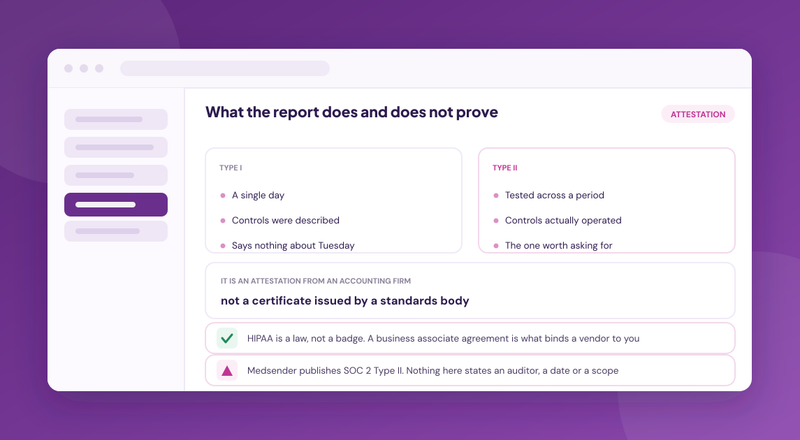
Then ask for the two things that are not published, which are the Fax API price and a written answer on availability. Medsender publishes System and Organization Controls (SOC) 2 Type II. Controls are tested continuously by an independent auditor, and the report comes via the Trust Center on request.
If you are comparing vendors rather than deciding whether to build, the fax API options for healthcare developers page carries what each vendor publishes on its own site.
FAQs
Common questions from engineering leads scoping fax work.
What Is a Fax API in Healthcare?
A fax API in healthcare is programmable fax, called from inside your product instead of from a machine, run by a vendor contracted to handle patient data. The contract is what makes it a healthcare product rather than a telecom one. Medsender's portal at developer.medsender.com carries the signup and the paperwork.
Why Do Healthtech Companies Still Handle Faxes?
Because the practices, payors and hospitals sending them documents still use fax, and no single company can retire a channel that needs every counterparty to move at once. Fax remains the shared floor between systems with no interface in common, so the practical answer is to automate the fax inbox.
Is a Healthcare Fax API HIPAA Compliant?
Compliance depends on the vendor rather than on the protocol. Medsender publishes that it is HIPAA compliant, includes a business associate agreement free with every account, and states 256-bit Secure Sockets Layer (SSL) encryption in transit with 2048-bit encryption at rest. Ask any vendor for the agreement before you write code.
Does a Fax API Read the Documents It Receives?
Some do and some stop at transport. Medsender reads a fax batch in under 5 seconds, converts typed and handwritten pages, classifies the document and returns the fields, at 99% accuracy on fax extraction. A page it cannot read with confidence is flagged as an exception for the coordinator.
Can We Keep Our Existing Fax Number?
Yes. Medsender ports your existing fax number, so the practices, payors and hospitals that already have it do not have to be told anything. No porting duration is published, and the elapsed time is gated by the carrier currently holding the number rather than by Medsender.
Does the Fax API Create the Chart in Our EHR?
Chart creation and write-back happen if your EHR supports them, and where it does not, your product receives the document and the extracted fields and decides what to do next. Medsender publishes 34 named EHR integrations and 47 on request, so confirm your own system before you scope the write path.

Zain Qayyum
Co-Founder and Co-CEO
Zain Qayyum is co-founder and co-CEO of Medsender. His work centres on the front-office problems that decide whether a referred patient is ever seen: inbound fax, referral backlogs, and phones nobody has time to answer. He argues that healthcare's hardest problems are operational rather than technical, and speaks and writes on where AI genuinely helps a practice and where it overpromises. He is based in New York.
Related Signals