How to Get Physician Owners to Approve New Practice Software
 Zain QayyumLast Updated: Oct 27, 2026
TL;DR
- The person who wants the software is almost never the person who signs for it, and that gap is where most practice software decisions stall.
- Owners are not evaluating the product. They are evaluating a recurring cost against a partnership distribution, and nobody has framed it that way for them.
- Price is where the conversation stops, and it stops late, after the champion has already spent weeks on evaluation.
- One page beats a demo recording. The champion has to be able to forward something that survives without them in the room.
- Three objections account for most refusals: we tried something like this, the staff will not use it, and what happens when it breaks.
- Bring a decision, not a discussion. Owners approve specific proposals faster than they approve directions.
Why the Person Who Wants It Is Not the Person Who Buys It
In a physician-owned practice the practice manager or the referral coordinator feels the problem daily and the owners feel it quarterly, through a number. That asymmetry shapes everything about how the approval goes.
The pattern is consistent enough to plan around. The champion is convinced early, often within the first conversation, because they are the one living with the fax inbox or the unbooked referrals. They then spend several weeks evaluating. And at the end of that, they hit the fact that they do not hold the budget, and the proposal goes to a partners' meeting where nobody has had the several weeks of context.
The friction is almost never about whether the product works. It is that the evaluation and the authority sat with different people, and the handover between them is a single meeting with an agenda item measured in minutes.
Contract terms make this worse by surfacing last. Term length, notice period and what happens at renewal tend to appear at the end of the process, at exactly the point where the champion wants to close and the owners are seeing the whole thing for the first time. A term that would have been unremarkable in week one becomes a reason to defer in week six.
The fix is not a better demo. It is to run the approval conversation as its own piece of work, in parallel with the evaluation rather than after it.
What Owners Actually Ask in the Room
Owners ask a narrow set of questions and they are not the questions a vendor prepares a champion for.
What does this cost us a year, including the parts that are not the license. Implementation, training time, and whatever internal hours go into it. A monthly figure invites the mental arithmetic to be done wrong, and an annual figure framed against something the partnership already spends is easier to place.
What are we not doing if we do this. Practice capital is finite and software competes with equipment, with a hire, and with what the partners take home. An owner who has just deferred a hire will hear a software proposal as a competing claim on the same money, and a proposal that does not acknowledge that reads as naive.
Who is accountable when it does not work. Not a support SLA. A person in the practice whose job it is to notice and fix it. Owners have been through a software purchase that quietly stopped being used, and the question behind this one is whether this will be another.
How long until we know. Not how long until value, which is unknowable and which no honest answer can promise. How long until there is a number that tells us whether this is working. That is answerable and it is the one worth answering precisely.
Building the One Page the Champion Can Forward
The deliverable is one page, because a partners' meeting will not read more and because the champion needs something that works when they are not there to narrate it.
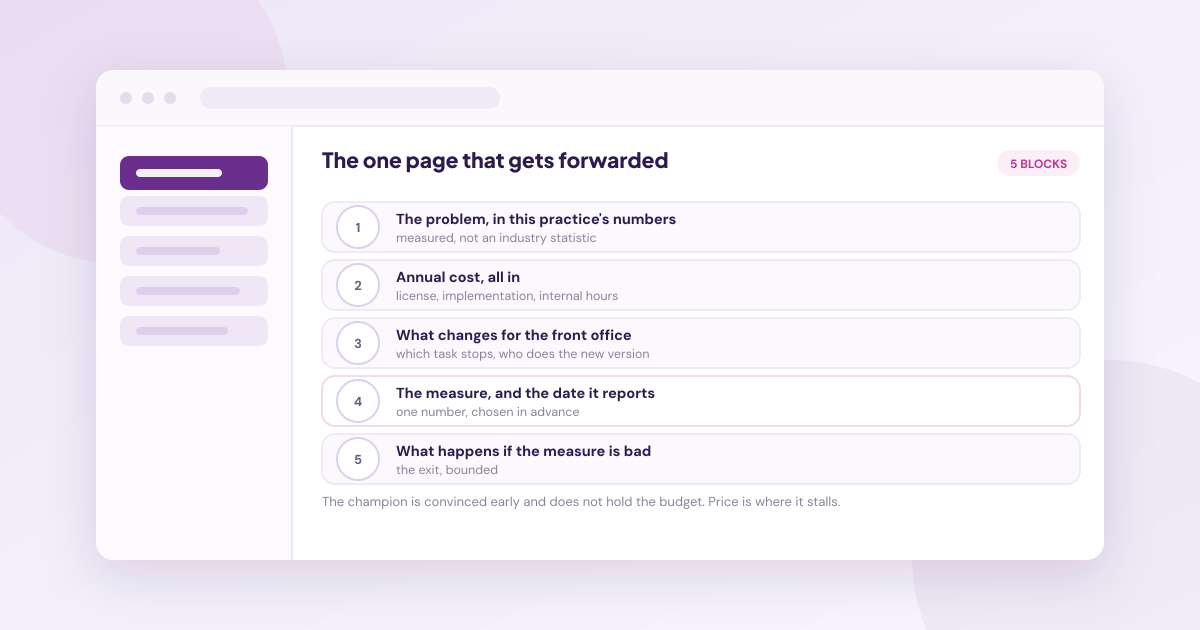
Five things belong on it.
The problem in the practice's own numbers. Not the vendor's framing and not an industry statistic. How many documents, how many unbooked referrals, how many hours, measured in this practice over a defined period. This is the part that takes the longest to assemble and it is the part that makes the rest credible.
The annual cost, all in. License, implementation, and an honest estimate of internal hours. Under-stating this is a short-term win and a long-term credibility problem, because the understated part arrives later as a surprise.
What changes for the front office on day one. Specifically. Which task stops, which task changes, and who does the new version of it. Buyers in this market ask about workflow more than twice as often as they ask about the technology, and owners are no different.
The measure, and the date it reports. One number, chosen in advance, with a date attached. This is the single most useful thing on the page because it converts an open-ended commitment into a bounded one.
What happens if the measure is bad. The exit, the notice period, and what the practice keeps. Owners approve things faster when the downside is bounded, and a champion who has already asked these questions reads as someone who has done the work.
Handling the Three Objections That Kill It
Three objections come up often enough to prepare for individually.
We tried something like this. Usually true, and usually a different thing. The useful response is specific rather than defensive: name what the previous tool did, name what this does differently, and name why the previous one stopped being used. If the answer to the last one is that nobody owned it, say so, because that is an argument for the ownership section of your page rather than against the purchase.
The staff will not use it. Also often true, and the strongest counter is not a reassurance but a pilot scope. One site, one workflow, one named owner, and a date. Adoption risk is real and an owner who hears it acknowledged trusts the rest of the proposal more than one who hears it dismissed.
What happens when it breaks. Behind this is a question about the fax line or the phone, not about software uptime in the abstract. Answer it operationally. What is the fallback, who notices, how long does the practice run in fallback, and who is responsible for the switch back. A practice that has had a fax outage will weight this heavily and will not accept an answer about availability percentages.
Deciding What to Bring to the Partners' Meeting
Bring a decision with a default, not a question with options.
A proposal that says we recommend starting at the Riverside site on the first of the month, at this annual cost, measured by this number reporting on this date, with this exit if it does not move, can be approved or amended in one meeting. A proposal that says we have looked at three vendors and wanted to discuss direction will be discussed and deferred, and the deferral is not a rejection, it is the absence of something to say yes to.
Two practical points. Send the page before the meeting rather than presenting it in the meeting, because owners who read it in advance arrive with objections you can answer rather than questions you have to absorb. And get the contract terms in front of them at the same time as the proposal, not after approval. Terms that surface after a yes turn a decision into a renegotiation, and that is where the goodwill from the approval gets spent.
FAQs
Why Does Practice Software Stall at the Approval Stage?
Because the person who wants it and the person who signs for it are different people, and the handover between them is a single meeting. The champion is convinced early, spends several weeks evaluating, and then takes it to a partners' meeting where nobody has had those weeks of context. The friction is almost never about whether the product works.
What Do Owners Actually Ask?
Four questions, and none are the ones a vendor prepares a champion for. What does this cost us a year, including implementation and internal hours. What are we not doing if we do this, since software competes with equipment and with a hire. Who is accountable when it does not work, meaning a person rather than a support agreement. And how long until we know.
What Should the Proposal Contain?
One page, because a partners' meeting will not read more. The problem in the practice's own measured numbers. The annual cost all in. What changes for the front office on day one, specifically. The measure and the date it reports. And what happens if the measure is bad, including the exit and the notice period.
How Should We Handle the Objection That We Tried This Before?
Specifically rather than defensively. Name what the previous tool did, name what this does differently, and name why the previous one stopped being used. If the answer to the last is that nobody owned it, say so, because that is an argument for the ownership section of your proposal rather than against the purchase.
When Should Contract Terms Be Raised?
At the same time as the proposal, not after approval. Term length, notice period and renewal behavior tend to surface at the end of the process, at exactly the point where the champion wants to close and the owners are seeing everything for the first time. Terms that appear after a yes turn a decision into a renegotiation.

Zain Qayyum
Co-Founder and Co-CEO
Zain Qayyum is co-founder and co-CEO of Medsender. His work centres on the front-office problems that decide whether a referred patient is ever seen: inbound fax, referral backlogs, and phones nobody has time to answer. He argues that healthcare's hardest problems are operational rather than technical, and speaks and writes on where AI genuinely helps a practice and where it overpromises. He is based in New York.
Related Signals