How to Run Automation Without Relying on Your EHR Task List
 Zain QayyumLast Updated: Nov 13, 2026
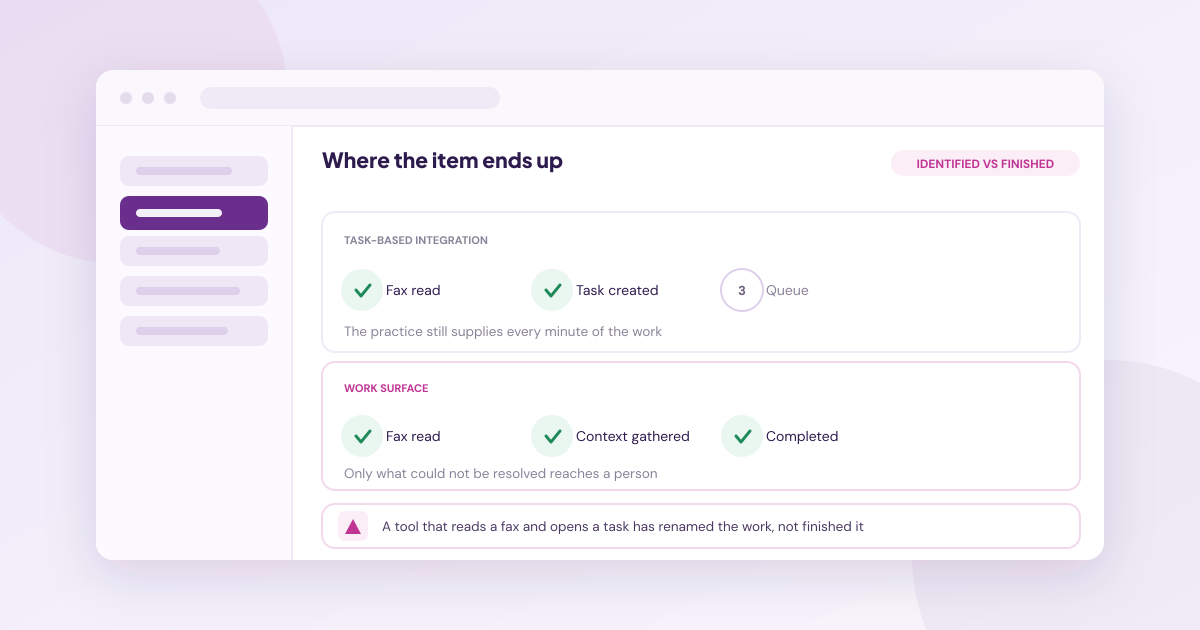
Plenty of automation integrates with an electronic health record (EHR) by creating a task. That is identification, not completion, and it moves the queue from one screen to another rather than shortening it. A tool that reads a fax and then opens a task has renamed the work.
The distinction to test is whether a vendor has its own work surface or hands everything back to a list that is already too long to read.
TL;DR
An EHR task represents work identified, not work done.
Task creation is often the only write operation an EHR exposes, which is why so many products use it.
A real work surface delivers items with context gathered and returns them in a completion state.
Among eight competitors read on 12 November 2026, one describes anything resembling one.
Working outside the task list does not mean working outside the EHR.
The demo tell is simple: watch which screen the item ends up on.
Why the Task List Is Where Work Goes to Wait
Task lists are not badly designed. They are designed for a different purpose than the one automation puts them to.
A Task Is Identified Work, Not Finished Work
Creating a task records that something needs doing and assigns no capacity to doing it. The practice still supplies every minute of the actual work, which means the automation has performed triage and stopped there.
Queues Do Not Shrink by Moving
Clearing the fax inbox into the task list looks like progress on one screen and no progress overall. The task list also competes with clinical tasks assigned to clinicians, so administrative items sink below things that carry patient risk, which is the correct prioritisation and the reason they sit there for days.
What Task-Based Integration Looks Like in Practice
Recognising it takes one question during a demo, and most buyers never ask it.
The Tell Is Where the Demo Ends
Watch where the item finishes. If the final screen is the EHR task list, the product identifies work. Ask what happens next, and who does it. The answer is usually a member of your staff, which is a legitimate product design but a different purchase than the one being described.
Why Vendors Build It This Way
Task creation is frequently the only write operation an EHR exposes to a third party, so it is the cheapest integration to ship and the one most likely to work across many systems. That is a reasonable engineering choice rather than a deception. It is simply not the same product as completion, and a buyer should know which one is on the table.
What a Real Work Surface Looks Like
Three properties distinguish a work surface from a queue, and all three are testable in a trial.
Items Arrive With Context Already Gathered
The document has been read, classified and matched to a patient before any person sees it. One vendor publishes this behaviour directly: anything unusual is flagged as an exception for the referral coordinator, items the software cannot resolve arrive with the context already gathered, and judgment calls stay with your team. Whether that holds at your volume is a trial question, but it is at least a published position to test against.
Only Exceptions Surface
A task list receives everything. An exception queue receives only what could not be resolved. The ratio between the two is the number worth asking about, because it determines whether anyone will actually read the queue by week three.
Items Leave in a Completion State
Finished means filed, routed or booked, with the result returned to the chart if your EHR supports chart creation and write-back. Ask what the vendor does with an item nobody touches for forty-eight hours, because that answer reveals whether the system has a notion of completion at all.
Where the EHR Still Has to Be Involved
None of this is an argument against the EHR, and a page that reads that way would be both off-key and wrong.
The Chart Is Still the System of Record
Working outside the task list does not mean working outside the EHR. The result still has to land in the chart, and whether that happens automatically depends on what your system supports. A vendor integrating with thirty-four systems is still writing into yours, not replacing it.
Some Work Belongs in the Task List
Clinical follow-up assigned to a named clinician belongs where clinicians already look, and moving it would be actively harmful. The argument here concerns administrative document and referral volume, which is a different category of work with a different reader.
How to Test a Vendor on This, in Five Steps
Run this during the demo rather than after signing. It takes about fifteen minutes and it is difficult for a vendor to deflect.
Ask the vendor to demonstrate one inbound referral from arrival to finished, without skipping any step
Note every screen the item appears on, and who is looking at each one
Ask what proportion of items reach a person at all, and what triggers that
Ask what state the item is in when it leaves, and whether that state is visible in the chart
Ask what happens to an item nobody touches for forty-eight hours
How to Decide What You Are Actually Buying
Answer one question before comparing features: do you want the work identified or completed. Both are legitimate purchases and they cost differently, but conflating them is how a practice ends up with a shorter fax queue, a longer task list and the same number of staff hours consumed.
Sorting, labelling and routing can run without a person. Deciding that something is an exception still needs one. Returning the result to the chart happens if your EHR supports it. Our guide toconnecting fax and referral software to your EHRcovers the integration mechanics,how fax and referral software integrates with EHRscompares what vendors actually support, andhow automation handles documents, duplicates and downtimecovers what happens when the destination system is unavailable.
FAQs
Common questions about where automated work ends up.
Can Practice Automation Work Without Using the EHR Task List?
Yes, where the vendor maintains its own work surface and only routes exceptions to a person. Several products do not, and instead create a task for every item. Ask during a demo rather than assuming, because both designs are described using similar language in marketing material.
Is Creating an EHR Task the Same as Automating the Work?
No. A task records that something needs doing and allocates no capacity to doing it. The practice still performs the work manually. That can still be useful if the task arrives correctly classified and attached to the right patient, but it is triage rather than completion.
What Is an Exception Queue?
A queue receiving only items the software could not resolve confidently, rather than everything it processed. The distinction matters because a queue receiving everything becomes a second inbox nobody opens. Ask what proportion of volume reaches it and who is assigned to work it by name.
Does Working Outside the Task List Mean Working Outside the EHR?
No, and that confusion causes unnecessary resistance internally. The chart remains the system of record and results still post to it. What changes is where staff do the intermediate work, not where the finished output lives or who can see it afterwards.
What Should You Ask About Where Work Ends Up?
Ask to see one referral travel from arrival to finished without skipping steps, then note every screen it appears on and who looks at each. That single exercise answers more than any feature list, and vendors rarely refuse it outright.
Which Administrative Tasks Should Stay in the EHR?
Anything assigned to a named clinician for clinical follow-up, because clinicians already look there and moving it introduces risk. The case for a separate work surface applies to administrative document and referral volume, which has a different reader and a different urgency profile.

Zain Qayyum
Co-Founder and Co-CEO
Zain Qayyum is co-founder and co-CEO of Medsender. His work centres on the front-office problems that decide whether a referred patient is ever seen: inbound fax, referral backlogs, and phones nobody has time to answer. He argues that healthcare's hardest problems are operational rather than technical, and speaks and writes on where AI genuinely helps a practice and where it overpromises. He is based in New York.
Related Signals