Is It HIPAA Compliant for AI to Process Patient Records?
 Zain QayyumLast Updated: Oct 27, 2026
TL;DR
- Yes, in principle. HIPAA does not prohibit automated processing of protected health information, and it does not treat AI as a special category.
- The vendor processing PHI on your behalf is a business associate. That is the entire legal frame, and it is the same frame that has applied to transcription services and clearinghouses for twenty years.
- A signed business associate agreement is the requirement. It is not the whole answer, because the agreement governs the relationship rather than the technical reality.
- The question that separates vendors is what happens to your data beyond providing the service, and specifically whether it is used to improve models. Most vendors do not state this.
- Minimum necessary still applies. A system that ingests more of the chart than the task requires is a scope problem even with a BAA in place.
- Get the answers in the agreement, not in the sales conversation. A verbal assurance about model training is not enforceable.
What HIPAA Actually Says About a Vendor Processing PHI
HIPAA is technology-neutral. It does not name artificial intelligence, it does not distinguish between a rules engine and a model, and it does not require a separate category of approval for automated processing. This surprises people who expect a specific AI provision, and the absence of one is the point.
What it does is regulate relationships. A covered entity, which is your practice, may disclose PHI to a business associate that performs a function on its behalf, provided there are satisfactory assurances in place that the information will be safeguarded. A vendor that reads your faxes, extracts data from them and files results to the chart is performing a function on your behalf. It is a business associate, and the analysis is the same as it would be for a billing company.
Three obligations follow and they are worth separating because vendors tend to answer the first and leave the others.
There must be a business associate agreement in place before PHI is disclosed. Not at go-live, not after the pilot. Before.
The use and disclosure of PHI must be limited to what the agreement permits, which in turn is limited to what is necessary to perform the service.
The minimum necessary standard applies to the disclosure. You should be giving the vendor access to what the task requires rather than to the chart in general, and that is a configuration decision at your end as much as a vendor property.
A practical note on priority. Across a large set of recorded buyer conversations in this market, security and compliance questions are strikingly rare at the evaluation stage, and they arrive later from a different person. That is not a reason to skip them. It is a reason to raise them deliberately rather than waiting for them to come up, because by the time they do the contract is usually drafted.
Where the BAA Does and Does Not Cover You
The business associate agreement is necessary and it is routinely over-read.
What it does. It binds the vendor to safeguard PHI, to limit use and disclosure to the agreed purposes, to report breaches, to flow equivalent obligations down to its own subcontractors, and to return or destroy PHI at termination. Those are meaningful commitments and they are enforceable.
What it does not do. It does not describe the architecture. It does not tell you where data is stored, who at the vendor can see it, how long it is retained, or what the vendor does with it that falls under the broad heading of providing and improving the service. A standard BAA can be fully in place while every one of those questions remains unanswered.
That gap is where the real diligence sits, and it is why a vendor saying yes, we sign a BAA answers a smaller question than most buyers think they asked.
Two specifics worth pinning down separately from the agreement.
Subcontractors. Most AI vendors use infrastructure or model providers underneath. The BAA requires equivalent obligations to flow down, and you are entitled to know who is in that chain and on what terms. A vendor that cannot name its subprocessors has either not thought about it or does not want to say.
Scope of access. What the vendor can technically reach, as distinct from what the agreement says it will use. These should match, and when they do not it is almost always because access was provisioned broadly for convenience during setup and never narrowed.
The mechanics of evaluating a BAA, what a trust center should contain, and how to read a SOC 2 report are covered separately in this library. This page is about whether the processing itself is lawful and on what conditions.
The Training Question, and Why Most Vendors Do Not Answer It
This is the question that matters most and is answered least.
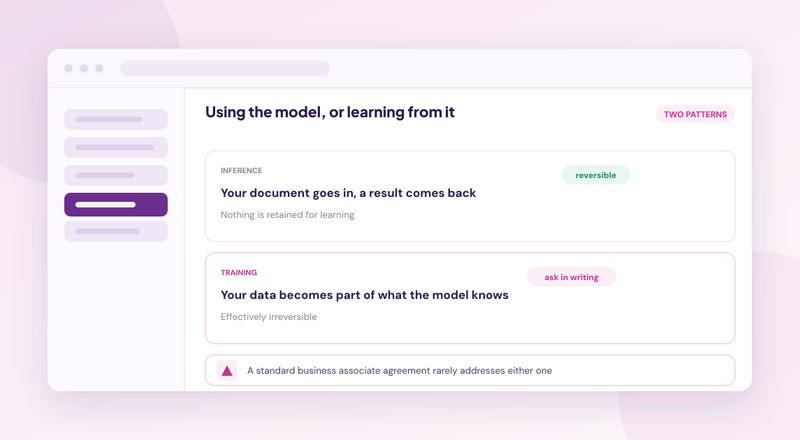
Separate two things that get conflated. A model trained on healthcare data before you became a customer is a statement about the product's history and tells you nothing about your data. A model that learns from your documents while serving you is a statement about your data, and it is a different question with different implications.
Ask the second question directly and in those terms. Is our practice's data used to train, tune or evaluate models, whether in identified, de-identified or aggregated form, and is that use limited to our own instance or shared across customers.
Three reasons vendors give vague answers, and only one of them is a problem.
Some do not know, because the answer differs across components of their stack and nobody has written it down. Some are describing a de-identified or aggregated use that they consider uncontroversial and have not thought to disclose. And some have a commercial interest in not constraining a future option.
The way to resolve all three is the same. Ask for the answer in the agreement rather than in an email. A commitment that our data is not used to train models outside our instance either goes into the contract or it does not, and the response to that request is informative regardless of which way it goes.
Note also what de-identified does and does not settle. De-identified data falls outside HIPAA, which is precisely why a vendor can truthfully say that no PHI is used for training while still using data derived from your documents. That may be entirely acceptable to you. It should be a decision you made rather than a distinction you missed.
What to Put in Writing Before Go Live
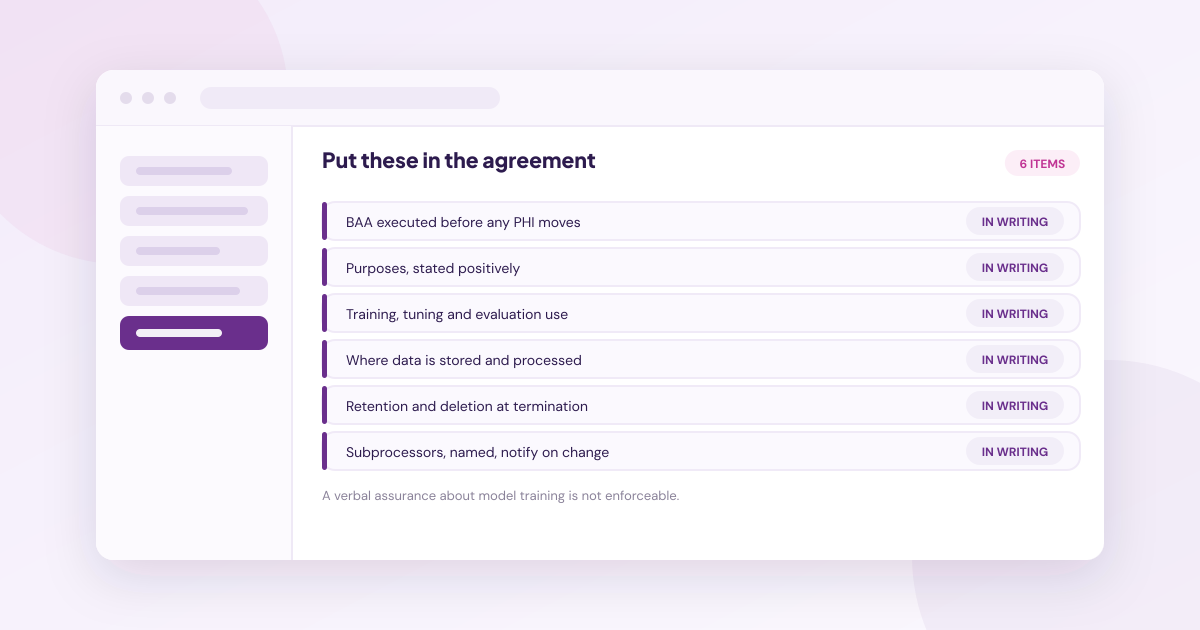
Six items, all of which belong in the agreement or an addendum to it rather than in a sales thread.
The BAA itself, executed before any PHI moves, including for a pilot.
The purposes for which data may be used, stated positively rather than by exclusion.
Whether data is used for model training, tuning or evaluation, in any form, and whether anything crosses the boundary of your instance.
Where data is stored and processed, geographically. If US-based hosting matters to your IT review, it has to be a commitment rather than a current fact.
Retention and deletion. How long data persists, what happens at termination, and whether you receive confirmation.
Subprocessors, named, with a commitment to notify on change.
If a vendor will commit to all six in writing, the processing is on a sound footing. If a vendor will commit to the BAA and treat the other five as implementation detail, you have a relationship that is legally papered and operationally unknown.
Deciding Whether a Vendor's Answer Is Good Enough
Judge the specificity, not the reassurance.
A good answer sounds narrow and slightly boring. It names components, draws boundaries, and admits where something is true of one part of the system and not another. A vendor saying our extraction runs in a dedicated tenant, documents are retained for this long, and the model is not updated from customer data, with the first two in the contract, is describing something real.
A weak answer sounds comprehensive. We are fully HIPAA compliant, your data is secure, we take privacy seriously. None of these is a claim that can be verified or breached, which is what makes them easy to say.
Two closing tests.
Ask the same question twice, once to the sales contact and once in writing to whoever owns security. Divergent answers mean the position has not been settled internally, and you will be the one who discovers where it lands.
Ask what the vendor would not agree to. A vendor that can tell you which commitments it declines and why is a vendor that understands its own architecture. One that agrees to everything in conversation has usually not checked.
FAQs
Does HIPAA Allow AI to Process Patient Records?
Yes, in principle. HIPAA is technology neutral. It does not name artificial intelligence, does not distinguish a model from a rules engine, and does not require separate approval for automated processing. What it regulates is the relationship: a vendor performing a function on your behalf is a business associate, the same analysis that has applied to billing companies for twenty years.
Is a Business Associate Agreement Enough?
It is necessary and routinely over-read. A BAA binds the vendor to safeguard protected health information, limit use to agreed purposes, report breaches, flow obligations to subcontractors and return or destroy data at termination. It does not describe the architecture. Where data is stored, who can see it, how long it is kept and what the vendor does to improve the service can all remain unanswered with a BAA fully in place.
Do AI Vendors Train Models on Patient Data?
Most do not state a position either way, which is why the question has to be asked directly and answered in the agreement rather than in an email. Separate two things: a model trained on healthcare data before you became a customer says nothing about your data, while a model that learns from your documents while serving you is a different question entirely.
Does De-Identified Data Settle the Training Question?
Not by itself. De-identified data falls outside HIPAA, which is precisely why a vendor can truthfully say no protected health information is used for training while still using data derived from your documents. That may be entirely acceptable to you. It should be a decision you made rather than a distinction you missed.
What Should Go in Writing Before Go Live?
Six things. The BAA, executed before any data moves including for a pilot. The purposes data may be used for, stated positively. Whether data is used for training, tuning or evaluation in any form. Where data is stored and processed. Retention and deletion. And named subprocessors with a commitment to notify on change.

Zain Qayyum
Co-Founder and Co-CEO
Zain Qayyum is co-founder and co-CEO of Medsender. His work centres on the front-office problems that decide whether a referred patient is ever seen: inbound fax, referral backlogs, and phones nobody has time to answer. He argues that healthcare's hardest problems are operational rather than technical, and speaks and writes on where AI genuinely helps a practice and where it overpromises. He is based in New York.
Related Signals