How to Introduce an AI Receptionist to Patients Without Losing Trust
 Zain QayyumLast Updated: Oct 27, 2026
TL;DR
- Patients rarely object to an AI answering the phone. They object to not being able to reach a person when they need one, which is a different problem with a different fix.
- Disclosure is a legal requirement in some states and a trust requirement everywhere. Treat the legal minimum as the floor, not the plan.
- The first ten seconds decide the call. A patient who knows what they are talking to and how to reach a human will stay on the line.
- Build the way out before you launch. An escape route that is advertised and staffed costs you very few calls and buys you most of the goodwill.
- Announce it to your panel before they meet it. A patient who has already read that this is coming reacts differently to the same call.
- Watch hang-up rate in the first ten seconds, not satisfaction scores. It tells you within two weeks whether the opening is working.
What Patients Actually React To, and It Is Not the AI
Practices usually expect the objection to be the technology, and prepare for a conversation about whether patients will accept talking to a machine. That is not where the friction appears.
The reactions that cause problems are narrower and more practical. A patient who cannot tell whether they have reached a person. A patient who needs something urgent and cannot find the route to a human. A patient who has explained their situation twice, once to the system and once to the person it eventually transferred them to. And a patient for whom the interaction simply did not work, because of an accent, a hearing difficulty, or a question the system was not built to handle.
None of those are objections to AI. They are objections to being stuck, and they would be objections to a phone tree too. That matters because the fixes are operational rather than persuasive. You do not need to convince patients that AI is acceptable. You need to make sure that the three or four situations where it fails have a visible and fast exit.
The practices that have a bad experience with this tend to have launched without that exit, discovered the failure cases through complaints, and then attributed the complaints to the technology.
What You Have to Say, and When
Disclosure obligations vary by state, and at least one has legislated specifically for AI in a patient-facing healthcare context. Your own counsel should set the requirement for where you operate, and we have written about what the statutes ask for separately.
The practical question is where the disclosure goes. Three placements, and they do different jobs.
At the top of the call, in the greeting itself. This is the one that satisfies a disclosure rule and the one that most affects patient reaction, because it arrives before the patient has formed an assumption. A disclosure that arrives thirty seconds in, after the patient has been speaking to what they assumed was a person, produces a worse reaction than no disclosure at all.
On the practice's own channels, before the patient ever calls. Website, patient portal, and the recorded message patients hear while on hold for the existing line. This is the one practices skip and it is the one that changes the first call most.
On request, during the call. A patient who asks whether they are talking to a person should get a direct answer immediately. This sounds obvious and it is worth confirming explicitly with whatever system you deploy, because an evasive or scripted non-answer here does more damage than the original disclosure would have.
Scripting the First Ten Seconds
The opening has four jobs and about ten seconds to do them. What this is, who it belongs to, what it can do, and how to get a person.
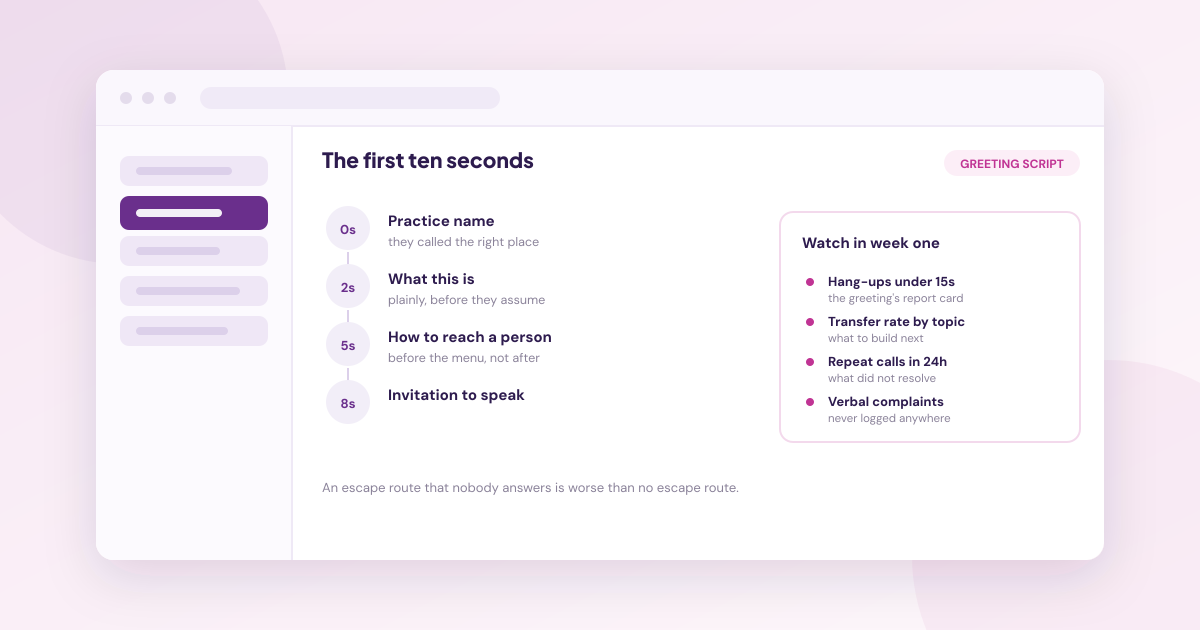
The order matters. Practice name first, because the patient needs to know they called the right place. Then the disclosure, plainly. Then the escape route, before the menu rather than after it. Then the invitation to speak.
Putting the escape route early is the single highest-value choice in the script. It costs very few calls, because most patients who hear it do not use it, and it removes the feeling of being trapped that generates the complaints. A patient who knows from the first sentence that they can say "front desk" and reach a human will try the system. A patient who suspects they cannot will start pressing zero immediately.
Two things to keep out of the opening. Do not have it apologize for being AI, which draws attention to the thing you are trying to make unremarkable. And do not have it claim capabilities it does not have, because the correction arrives thirty seconds later and the patient has already committed to explaining something it cannot take.
Keep the wording in the practice's register. A front office that is warm and brisk should not suddenly sound like a bank.
Giving Patients a Way Out, and Staffing It
An escape route that nobody answers is worse than no escape route.
That is the operational cost of this and it has to be budgeted before launch. If the opening tells patients they can reach a person, somebody has to be reachable, and in the first two weeks more patients will take that option than will take it in month three. Staffing the launch window at the level you expect to need in month three is the common mistake.
Decide in advance which calls should never go to the system at all. Most practices land on a short list: anything the caller describes as urgent, anything clinical, and any caller who has already been transferred once. Those should route straight through, and the routing should be tested with real calls before launch rather than described in a configuration screen.
Decide also what happens to the context. A patient who has explained a situation to the system and is then transferred should not have to start again. Whether that is possible depends on what your system passes to the front office and how your staff see it, and it is worth confirming in a live test rather than taking as a feature claim.
What to Watch in the First Two Weeks
Satisfaction surveys are too slow and too sparse to steer a launch. Four operational numbers tell you more, faster.
Hang-ups in the first fifteen seconds. This is the opening script's report card. A rise here means the greeting is not landing, and the greeting is the cheapest thing in the whole deployment to change.
Transfer rate, and more importantly what the transfers are about. A high transfer rate is not a failure. A high transfer rate concentrated in one category tells you exactly which workflow to either build out or route around.
Repeat calls within twenty-four hours from the same number. This is the clearest signal that something did not get resolved, and it will not appear in any satisfaction measure.
Complaints that reach the front office verbally rather than through a formal channel. These are the ones that never get logged anywhere, and in the first two weeks they are the richest source of what to fix. Ask the front office directly at the end of each day of the first week.
Deciding How to Announce It to Your Panel
Tell patients before they meet it, in the channels they already read, and frame it around what it does for them rather than what it does for the practice.
The framing that works is availability. The phone gets answered, including when the front office is with a patient, and nobody waits on hold to ask what time their appointment is. The framing that does not work is efficiency, because a patient hears that as fewer staff.
Say plainly that it is an automated system and that a person is always available. Patients who read that sentence in a portal message in advance and then hear a matching disclosure on the call experience the two as consistent, which is most of what trust is in this context.
One decision to make deliberately: whether to announce it at all for a small single-site practice where the panel is familiar and the volume is low. Some practices are better served by letting it be unremarkable and ensuring the escape route is obvious. There is no single right answer, and the one thing that is clearly wrong is announcing it in a way that promises more than the system does on day one.
FAQs
Do Patients Object to an AI Answering the Phone?
Rarely. What generates complaints is narrower and more practical: not being able to tell whether they reached a person, needing something urgent and finding no route to a human, having to explain a situation twice, or simply not being understood. Those are objections to being stuck, and they would apply to a phone tree too.
When Should the Disclosure Happen?
At the top of the call, in the greeting, before the patient has formed an assumption. A disclosure arriving thirty seconds in, after the patient believed they were speaking to a person, produces a worse reaction than none at all. Put it on your own channels too, so patients meet it before they ever call, and answer directly if a patient asks mid-call.
What Should the Greeting Say?
Four things in about ten seconds, in this order. Practice name, so the patient knows they reached the right place. The disclosure, plainly. How to reach a person, before the menu rather than after it. Then the invitation to speak. Putting the escape route early costs very few calls and removes the feeling of being trapped that generates the complaints.
Which Calls Should Never Go to the System?
Decide the list before launch. Most practices land on anything the caller describes as urgent, anything clinical, and any caller who has already been transferred once. Those should route straight through, and the routing should be tested with real calls rather than described in a configuration screen.
What Should We Measure in the First Two Weeks?
Four operational numbers, because satisfaction surveys are too slow to steer a launch. Hang-ups in the first fifteen seconds, which is the greeting's report card. Transfer rate and what the transfers are about. Repeat calls within twenty-four hours from the same number. And complaints that reach the front office verbally, which never get logged anywhere and are the richest source of what to fix.

Zain Qayyum
Co-Founder and Co-CEO
Zain Qayyum is co-founder and co-CEO of Medsender. His work centres on the front-office problems that decide whether a referred patient is ever seen: inbound fax, referral backlogs, and phones nobody has time to answer. He argues that healthcare's hardest problems are operational rather than technical, and speaks and writes on where AI genuinely helps a practice and where it overpromises. He is based in New York.
Related Signals