What Happens to Your Patient Data When You Leave a Vendor
 Zain QayyumLast Updated: Oct 27, 2026
TL;DR
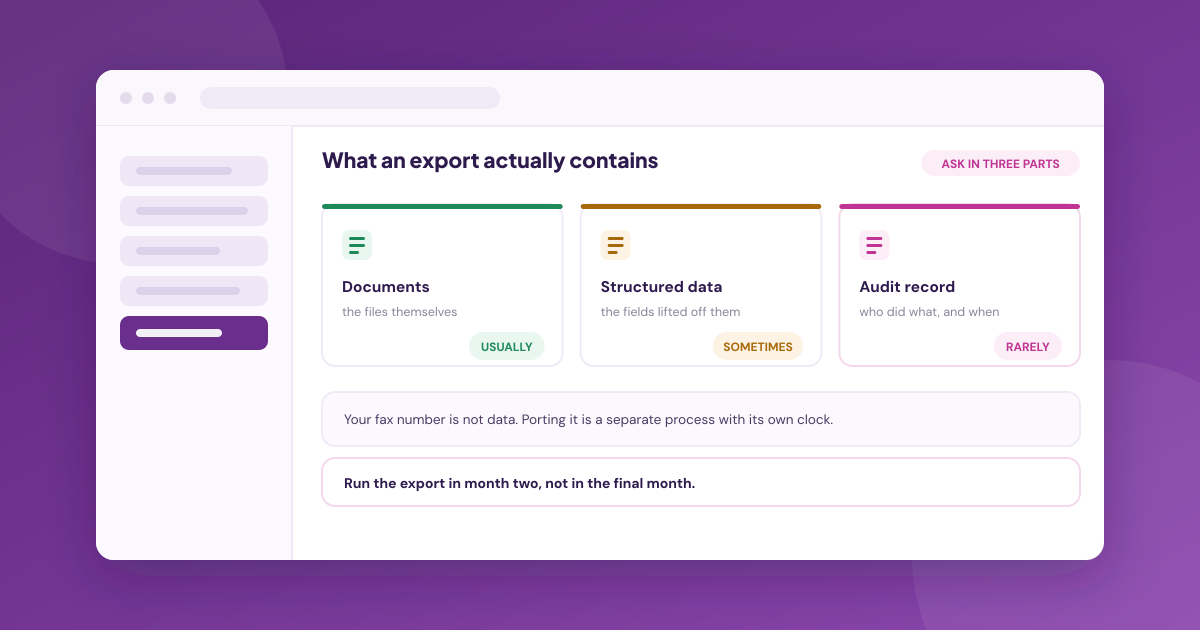
- An export is not one thing. Documents, the data extracted from them, and the record of what happened to them are three separate assets, and most exports return only the first.
- The question to ask is not whether you can export. It is what format, how complete, how long you have, and who does the work.
- Your fax number is not data and it does not come back in an export. Porting it is a separate process with its own timeline and its own failure mode.
- Terms surface late. They appear at the point of renewal or exit, long after the evaluation, and that is the worst possible moment to discover them.
- The practical test is whether the vendor will describe the exit in writing before you sign. Most will if asked, and few volunteer it.
- If the data would be unusable to the next vendor, you do not have an exit, you have a copy.
What You Are Actually Asking For When You Ask for an Export
Practices ask for their data and mean one of three things, usually without distinguishing them. The three have different answers and different costs.
The documents themselves. The scanned faxes, referrals and attachments as files. This is the part almost every vendor can provide and the part most practices have in mind. It is also the least useful on its own.
The structured data extracted from those documents. Patient name, date of birth, referring provider, document type, the date received, what it was classified as. This is what turned a stack of PDFs into something searchable, and it is the part that is frequently unavailable or available only in a format designed for a different purpose.
The record of what happened. Who reviewed what, what was corrected, when something was filed to the chart, which items were rejected and why. This is your audit trail. In a dispute, an audit, or a records request, it is the asset that matters most, and it is the one least likely to be included by default.
Ask about all three separately. A yes to the first is often delivered as a yes to the question, and the gap only becomes visible when the next vendor asks for the second.
Documents, Metadata and the Things That Do Not Come With Them
Assume that anything the vendor generated rather than received is at risk of not traveling.
Documents usually come back as files with system-generated names, which is a problem if your filing convention lived in the vendor's metadata rather than in the file name. A folder of forty thousand PDFs named by identifier is technically an export and practically a cost, because somebody has to reconcile it against patients.
The structured data, if available, typically arrives as CSV or JSON. Both are fine. The thing to establish is whether the fields map to anything the next system can ingest, and whether the identifiers in it are yours or the vendor's. An export keyed on an internal document identifier that exists nowhere else is hard to join back to anything.
Three things to ask about specifically, because they are routinely missing.
Whether the original document is retained alongside whatever was extracted from it, or discarded after extraction. If the original is gone, the extraction is now your only record of what the referring practice actually sent.
Whether items that were rejected, flagged or never filed are included. These are often held in a separate queue and excluded from an export that covers filed documents only.
Whether the audit log is exportable and what its retention period is. A log visible only inside a dashboard you are about to stop paying for is not an asset you are taking with you.
Porting the Number, and the Window Where Both Run
Your fax number is not part of any data export. It is a telecommunications asset held by a carrier, and moving it is a separate process that runs on its own clock.
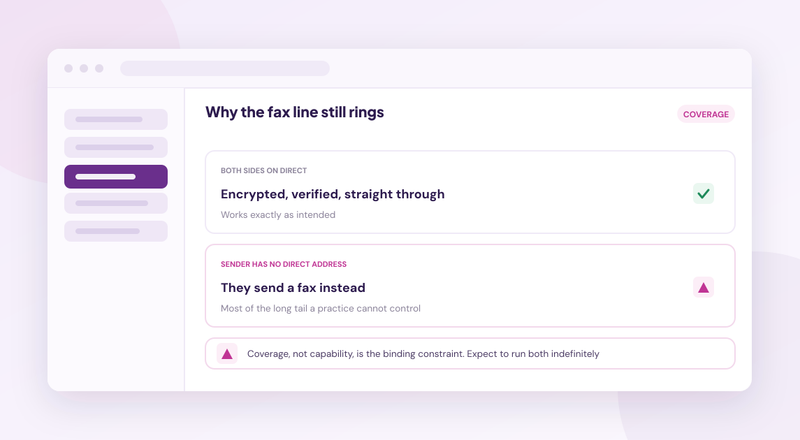
Two things make this the riskiest part of an exit. It is slower than people expect, and during the transition there is a window where documents can arrive at either end.
Plan for that window explicitly rather than hoping it is short. Somebody has to be watching the old system during the overlap, because referring practices will keep sending to whatever number is in their system regardless of what you have arranged. Referrals that land in an inbox nobody is checking are the single most expensive thing that can go wrong in a vendor change, and they go wrong quietly.
Establish before you commit to a date who is responsible for the port on each side, what the expected duration is, and what happens to documents received during the window. The answer to the last one should be operational, not contractual. Somebody checks it, daily, by name.
The arriving half of this, setting up with the incoming vendor, has its own guide. The leaving half is the one that gets planned less.
What to Agree Before You Sign, Not After You Leave
Exit terms are the clearest example of something that is cheap to settle at the start and expensive to settle at the end.
The pattern is consistent. Term length, notice period and renewal behavior are not what the evaluation is about, so they are not what gets discussed. They surface at the point of signature, or later at the point of renewal, and by then the practice has either committed emotionally or is already trying to leave. Both are bad negotiating positions, and the friction this creates arrives at exactly the moment when the relationship most needs to be straightforward.
Four things worth having in writing before signature, independent of which vendor you choose.
The notice period, and whether it runs from the notice date or from a renewal date. These are very different and the second can add most of a year.
What the export contains, in the three-part sense above, and in what format. A clause that says the customer may request their data is not an answer. A clause that names documents, extracted fields and audit records is.
How long after termination the export remains available, and whether there is a fee. A thirty-day window is workable if you know about it in advance and a problem if you discover it on day thirty-one.
What happens to the data afterward. Deletion, timeline, and whether you get confirmation. This is the part a security review will ask about later even if nobody asks about it now.
Deciding Whether an Exit Path Is Real
The test is simple and most vendors will pass it if asked directly: will they describe the exit in writing, in advance, in specifics.
A vendor that will tell you the export format, the retention window and who runs the port has thought about it, which usually means other customers have left and it worked. A vendor that answers in principles rather than mechanics has not, and the first time the process runs properly will be with you.
Two further signals worth weighting.
Whether the export is self-service or requires the vendor to perform it. Self-service is better, because it can be tested while you are still a customer, and testing it while you are still a customer is the only way to know what you actually have. Run an export in month two, not in the final month.
Whether the data would be usable to a competitor. This is the uncomfortable question and the one that separates a real exit from a formality. An export that arrives as documents with no structure and no audit trail satisfies the clause and leaves you starting over. If what comes back could not be loaded into another system without months of work, you do not have portability, you have a backup.
Neither point requires an adversarial conversation. Both are reasonable to raise during an evaluation, and how a vendor responds to them tells you something useful regardless of the answer.
FAQs
What Does a Data Export Actually Include?
Ask about three things separately, because a yes to the first is often delivered as a yes to the question. The documents themselves, which almost every vendor can provide. The structured data extracted from them, which turned a stack of files into something searchable. And the record of what happened, which is your audit trail and the asset that matters most in a dispute.
What Usually Does Not Come Back?
Anything the vendor generated rather than received. Documents typically arrive with system-generated names, which is a problem if your filing convention lived in the vendor's metadata. Items that were rejected, flagged or never filed are often held in a separate queue and excluded. And the audit log, if it is visible only inside a dashboard you are about to stop paying for, is not an asset you are taking with you.
Does Our Fax Number Come With Us?
No. It is a telecommunications asset held by a carrier and moving it is a separate process on its own clock. It is slower than people expect, and during the transition documents can arrive at either end. Somebody has to watch the old system daily through that window, because referring practices will keep sending to whatever number is in their system.
What Should Be Agreed Before Signature?
Four things. The notice period, and whether it runs from the notice date or a renewal date. What the export contains and in what format. How long after termination it remains available and whether there is a fee. And what happens to the data afterward, including deletion timeline and confirmation.
How Do We Know the Exit Is Real Rather Than a Formality?
Two tests. Whether the export is self-service, because that is the only kind you can run in month two while you are still a customer rather than discovering its shape in the final month. And whether the output would be usable to another vendor. If it could not be loaded into another system without months of work, you do not have portability, you have a backup.

Zain Qayyum
Co-Founder and Co-CEO
Zain Qayyum is co-founder and co-CEO of Medsender. His work centres on the front-office problems that decide whether a referred patient is ever seen: inbound fax, referral backlogs, and phones nobody has time to answer. He argues that healthcare's hardest problems are operational rather than technical, and speaks and writes on where AI genuinely helps a practice and where it overpromises. He is based in New York.
Related Signals