Where to Start Automating Practice Admin Work
 Zain QayyumLast Updated: Nov 23, 2026
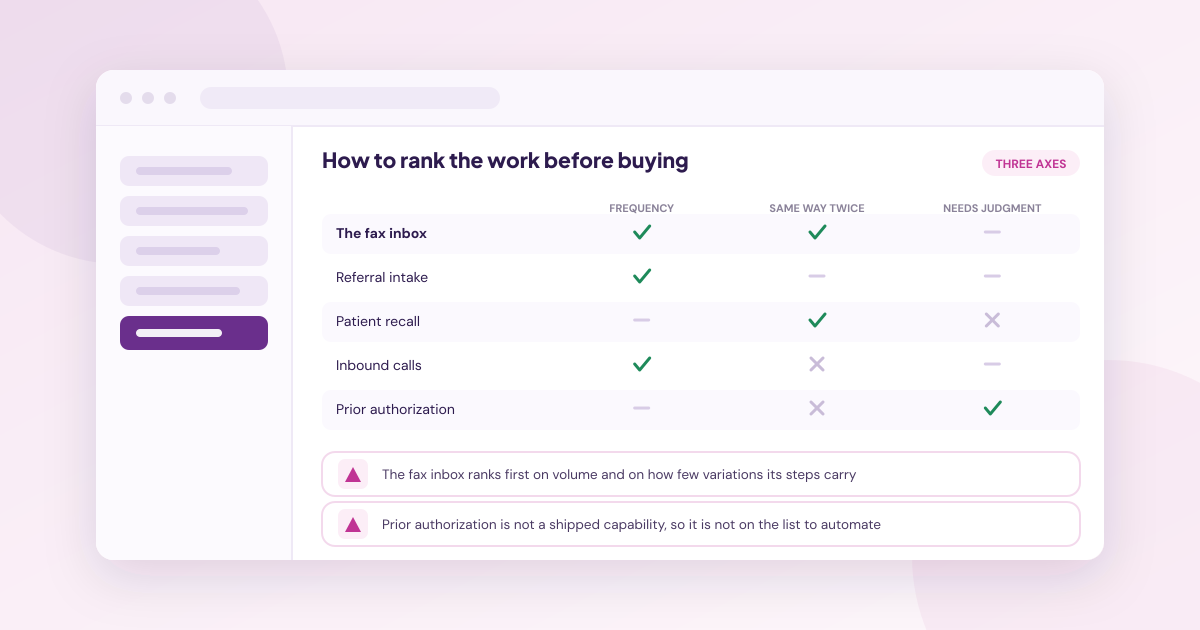
Where to Start Automating Practice Admin WorkPractice admin work should be automated in order of volume, not in order of annoyance. The fax inbox comes first, referral intake second, inbound calls third. Anything needing a clinical or financial judgment stays with a person, whatever its volume, because the cost of getting it wrong lands on a patient.
Most automation projects go wrong at the ranking step rather than the software step. A practice buys for the task that irritates the loudest person in the building, then finds out that the task happened nine times last week. Rank first, then shop.
TL;DR
- Rank practice admin work on three axes before buying anything, which are how often it happens, whether two staff would handle it the same way, and whether a mistake reaches a patient.
- The fax inbox ranks first because its volume is highest and its steps repeat with the fewest variations.
- Referral intake ranks second because each item carries more value than a fax page and the sending office notices when one is dropped.
- Inbound calls rank third, where MAIRA AI call coverage runs continuously while human support runs 9AM to 5PM EST.
- Outsourcing beats automation on low-volume work that needs a judgment call every time, and automation beats outsourcing on high-volume work with rules you could write down.
- Adoption is easiest on the task the front office already complains about, which is usually the fax inbox.
Why Front Office Staff Are Burning Out
Front office burnout at a specialty practice is a volume problem before it is a morale problem. Faxes, referrals and calls arrive at a rate set by patient volume, while the number of people at the desk is set by a budget written last year. The gap between those two numbers is where the day goes.
The Tasks That Grow With Volume
Three categories of practice admin work scale directly with patient volume, and none of them can be deferred without someone noticing.
- Inbound faxes, which arrive whether or not anyone is free to read them
- Referrals from several sources, each needing a reply to the sending office
- Inbound calls, which queue rather than wait quietly
None of the three has a natural stopping point in the day. A chart note is finished when it is written. A fax inbox is never finished. It is only current, and being current lasts about an hour.
What That Looks Like at the Desk
Desk-level triage decides what gets dropped, and the shape of it is consistent enough to describe as a general pattern. Work with somebody waiting on the other end gets done, because somebody is waiting. Work with nobody waiting slides to tomorrow.
Turnover then takes the undocumented part with it. The person who knew which of two similarly named offices sends the orthopedics referrals leaves, and that knowledge was never written down anywhere.
How to Rank Practice Admin Work Before You Automate It
Ranking practice admin work takes three questions and an afternoon with a notepad. Score every recurring task on volume, rules and judgment, then sort the list. The result is usually different from the list a practice would write from memory.
Score Each Task on Volume, Rules and Judgment
Each axis is a question with a countable answer, which is the point of using three of them rather than one impression.
- Volume is how many times a week the task happens, counted rather than estimated
- Rules is whether two staff members handling it would produce the same outcome
- Judgment is whether getting it wrong harms a patient rather than annoying somebody
Counting matters more than it sounds. A task that feels constant and turns out to happen nine times a week is a training problem rather than an automation problem.
Automate High Volume, Clear Rules, Low Judgment First
High volume, clear rules and low judgment together make a candidate. Two out of three make a maybe, worth revisiting once a first project has landed. One out of three makes a no.
Judgment works as a veto rather than a score. A task that fails it is never a candidate, whatever its volume, which is why a phone line full of clinical triage questions is a worse first project than a quiet fax inbox.
The Practice Admin Tasks to Automate First
Four practice admin tasks come out at the top of most specialty practice lists, in the order below. Each scores high on volume and rules and low on judgment, which is the combination that makes software worth paying for.
| Rank | Task | Why It Ranks Here |
|---|---|---|
| 1 | Fax intake and sorting | highest volume, clearest rules |
| 2 | Referral intake and outreach | high value per item |
| 3 | Inbound and after-hours calls | continuous coverage, no queue |
| 4 | Recall and recapture outreach | billed on completed appointments |
The Fax Inbox
The fax inbox scores well on every axis at once. Medsender reads a fax batch in under 5 seconds, and optical character recognition (OCR) reads typed and handwritten pages. The published 99% accuracy figure covers fax extraction only and should never be read as a referral figure.
Classification is the part that returns the time. The artificial intelligence (AI) knows a referral from a result from an authorization, and anything unusual is flagged as an exception for the coordinator.
Referral Intake
Referral intake carries more value per item than a fax page, and a sending office notices when one goes unanswered. Classification and routing run with no electronic health record (EHR) involved at all.
Filing is the conditional part. Chart creation and write-back happen if your EHR supports chart creation and write-back, and the filing step stays with a person when it does not. Our guide to chart creation and write-back sets out both cases.
Inbound Calls
Inbound calls rank third because coverage rather than speed is the problem. MAIRA AI call coverage runs continuously, so an evening call reaches something other than a voicemail box, while human support from Medsender runs 9AM to 5PM EST.
Booking works through patient self-service. Outreach is text and email carrying a self-booking link, and call automation also schedules through that same booking link rather than writing into your calendar.
What to Leave Alone This Year
Some practice admin work belongs with a person for this planning cycle, regardless of how much of it arrives.
- Prior authorization is not a shipped capability, so it never belongs on an automation list here
- Insurance verification is never presented as generally available, so it stays off the list too
- Anything where the right answer depends on reading the patient rather than reading a document
Patient outreach touches consent either way. Follow your practice's own consent and opt-out policy on what is sent, how often, and at what hours.
Handling Growing Patient Volume With Frozen Headcount
Frozen headcount changes the question from who to hire into which hours to buy back. Rising patient volume against a flat payroll is the normal condition in specialty practice rather than an emergency, and it is budgeted for in hours rather than in people.
Count Hours, Not Headcount
Hours are the unit that survives a hiring freeze. Ask how many staff hours a week currently go to faxes, referrals and calls, and take the answer from the people doing the work rather than from the schedule.
That figure is the budget you are working with. It is also the figure a vendor quote has to beat, and it is the only number in the conversation nobody at the practice can argue with.
Where the Hours Come Back
Three named practices publish what came back, and each figure belongs to the practice that produced it.
- Ozark Dermatology, with 5 locations, 14 providers and 250 faxes a day, reports 40 staff hours a week reclaimed and same-day first contact
- An ear, nose and throat (ENT) group, Florida Gulf Coast ENT, running up to 25,000 fax pages a month on ModMed EMA, reports a 92% reduction in triage work and a move from three full-time staff to one and a half
- Piedmont Plastic Surgery and Dermatology, with 10 locations and 50 providers, reports 50% of referred patients scheduled within minutes
No blended average sits behind those three. A practice at 30 faxes a day should not expect the Ozark Dermatology result, because the result is a function of the volume.
Automation Versus Outsourcing for Practice Admin Work
Automation and outsourcing are both real answers, and the honest version is that they win on different tasks. Outsourcing suits low-volume work needing a judgment call on every item. Automation suits high-volume work with rules somebody could write down.
| Dimension | Automating It | Outsourcing It |
|---|---|---|
| Who handles the work | software, exceptions to your staff | an offsite person |
| Cost shape | per page, per referral | per hour or seat |
| PHI exposure | one vendor, one BAA | more people, more agreements |
| After hours | MAIRA AI call coverage, continuous | depends on the contract |
| Judgment calls | flagged as exceptions | handled offsite |
| Effect of more volume | unit price slides down | you buy more hours |
Exposure to protected health information (PHI) is the row buyers skip. One vendor means one business associate agreement (BAA) to review each year, and an offsite team means several people and several agreements. Our comparison of whether to automate or hire for the front office runs the same arithmetic against a salary.
Where Outsourcing Still Makes Sense
Outsourcing earns its place in three situations, and none of them is a failure of nerve.
- Short-term cover for a vacancy or a leave
- A seasonal spike that does not justify a permanent change
- A task nobody has documented, where an offsite person can work it out while somebody writes the rules down
Work needing a judgment call on every item stays with people, offsite or in the building. Software that flags an exception is not software that resolves it.
How to Get Practice Staff to Adopt New Software
Staff adoption of new software is settled in the first fortnight, mostly by which task you picked. A tool that removes work people dislike gets used. A tool that adds a second place to look gets abandoned, politely, and nobody tells you.
Start With the Task They Already Resent
Resented tasks are the easiest place to start. The fax inbox is usually that task, because nobody at the front office has ever described renaming scanned pages as the interesting part of the job.
Keep the Judgment With the Team
Judgment staying with the team is the sentence to say out loud in training. Anything unusual is flagged as an exception for the coordinator, and judgment calls stay with the team rather than being made by software.
One Clinic First, Then the Rest
One location, one coordinator, one task is the shape of a sensible first project. A single site gives you a comparison group and a person who can answer questions for everyone else afterwards.
No timeline for going live appears on this page on purpose, because the published figures vary. Ask the vendor for theirs in writing and hold the written version.
Try It Before You Sign
A free trial exists and is deliberately limited. It covers basic non-AI fax only, with no referral processing and no electronic medical record (EMR) integration, so it cannot answer an integration question.
Its length is not stated here, because the published figures conflict. Ask for the trial terms in writing alongside the contract terms you have not seen yet.
Where This Leaves a Practice Deciding What to Automate First
Ranking beats shopping, and the ranking takes an afternoon. Count how often each recurring task happens, check whether two staff would handle it identically, and strike out anything where a mistake reaches a patient. What survives, sorted by volume, is the project list.
The fax inbox usually sits at the top of that list, which is convenient, because it is also the cheapest thing to measure. Our guide to one vendor for fax, referrals and calls covers what changes if you buy all three together, and finding overdue and lapsed patients in your EHR covers the recall end of the list.
FAQs
Common questions from practice owners and administrators working out what to automate first.
Which Practice Admin Tasks Should a Practice Automate First?
Start with the fax inbox, then referral intake, then inbound calls. That order follows volume rather than irritation. Rank every recurring task on how often it happens, whether two staff would handle it identically, and whether a mistake reaches a patient. Anything failing the last test stays with a person.
How Do You Handle Growing Patient Volume With Frozen Headcount?
Buy hours back instead of trying to buy headcount. Count the staff hours a week going to faxes, referrals and calls, then price automation against that figure. Ozark Dermatology, with 5 locations, 14 providers and 250 faxes a day, reports 40 staff hours a week reclaimed and same-day first contact.
Is Automation or Outsourcing Better for Practice Admin Work?
Neither wins outright. Automation suits high-volume work with rules you could write down, and it prices per page or per referral, so the unit cost falls as volume rises. Outsourcing suits low-volume work needing a judgment call on every item, and it prices per hour, so more volume means buying more hours.
How Do You Get Front Office Staff to Adopt New Software?
Pick the task the front office already complains about, usually the fax inbox, and start at one location with one coordinator. Say in training that anything unusual is flagged as an exception for the coordinator and that judgment calls stay with the team, because that is the worry people actually have.
Why Are Medical Front Office Staff Burning Out?
Faxes, referrals and calls arrive at a rate set by patient volume, while the number of people at the desk is set by a budget. None of the three has a natural stopping point in the day, so the work with nobody waiting on the other end is what slides.
What Does Practice Admin Automation Cost?
Medsender publishes $0.08 per fax page at low volume, sliding to $0.056, and $1.20 per referral sliding to $1.00. Patient Recapture is billed on outcomes, so you only pay for completed appointments, not activity. Ask whether connecting your EHR is priced separately, because that is not published.
Does Automating the Front Office Mean Cutting Staff?
Not necessarily, and the published results differ. Ozark Dermatology reports 40 staff hours a week reclaimed and same-day first contact, while Florida Gulf Coast ENT reports a 92% reduction in triage work and a move from three full-time staff to one and a half. Both figures cover fax triage, and what a practice does with the hours it gets back is its own decision.

Zain Qayyum
Co-Founder and Co-CEO
Zain Qayyum is co-founder and co-CEO of Medsender. His work centres on the front-office problems that decide whether a referred patient is ever seen: inbound fax, referral backlogs, and phones nobody has time to answer. He argues that healthcare's hardest problems are operational rather than technical, and speaks and writes on where AI genuinely helps a practice and where it overpromises. He is based in New York.
Related Signals