
Automate or Hire? Replacing Front-Office Headcount With AI
 Zain QayyumLast Updated: Sep 29, 2026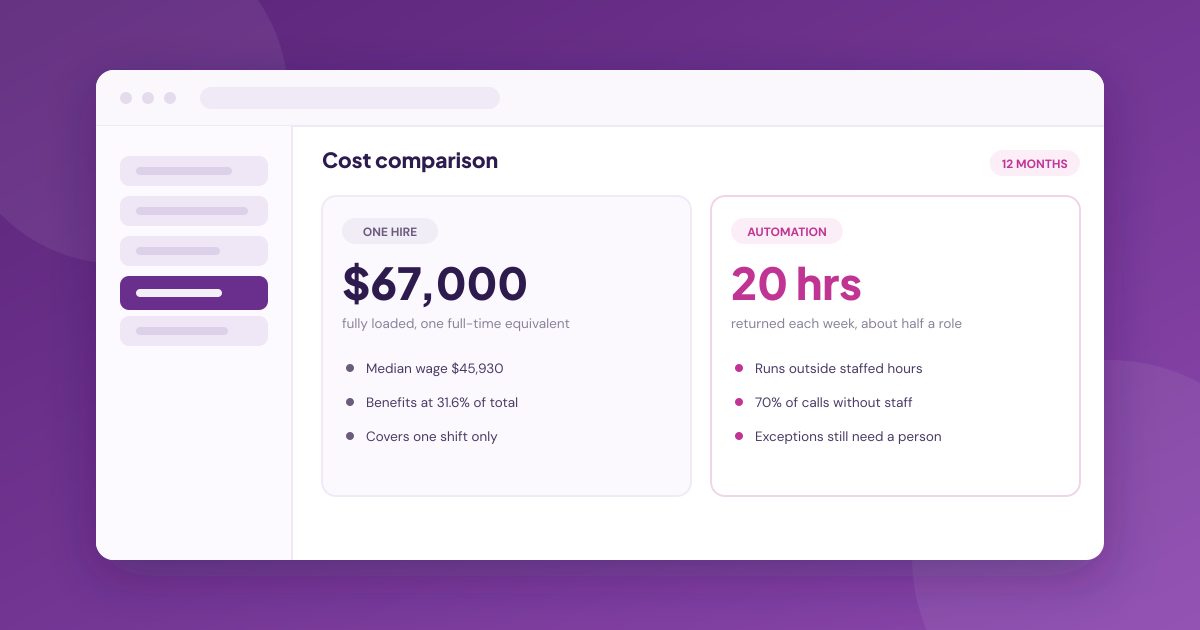
TL;DR
- Establish whether your bottleneck is repeatable volume or judgement before deciding what to buy, because the two call for different answers.
- High-volume, low-variance work absorbs into software; judgement, escalation and distressed callers still need a person.
- A medical administrative hire costs roughly $67,000 fully loaded, not the $45,930 median wage.
- Some automation platforms cover the whole calendar including nights and weekends, while one hire covers a single shift.
- Neither option removes the need for a named person to own the exception queue, with hours actually allocated to it.
- Measure the decision in staff hours returned, not in licences or salaries.
Automation and hiring solve different problems at the front office. Repeatable, high-volume work such as reading faxes and calling patients to book absorbs well into software. Judgement, escalation and anything unusual still needs a person. Most practices end up doing both, with automation taking the volume so staff can handle the exceptions.
What Each Option Actually Covers
The question is rarely whether software can do a receptionist's job. It is which parts of that job are repeatable enough to hand over, and what is left for the person you either keep or hire.
What Software Absorbs Well
Three categories. Reading and filing inbound documents, where the same decisions repeat hundreds of times a day. Calling and texting patients to book, where the script is stable and the outcome is measurable. And after-hours coverage, where the alternative is voicemail nobody hears until morning.
These share a property. The work is high volume, low variance, and each instance is independent of the last. That is the profile software handles well and the profile that burns out a competent front-desk employee fastest.
What Still Needs a Person
Judgement calls, clinical nuance, distressed or complex callers, and anything the system itself flags as unusual. Medsender states the division directly on its referral management page: "Anything unusual is flagged for your referral coordinator. Judgment calls stay with your team."
A vendor promising no human review is describing a risk, not a feature. The realistic outcome is that the coordinator stops keying data and starts handling exceptions, which is both a better use of the role and a harder one to fill badly.
What One Front-Office Hire Actually Costs
The salary is not the cost. The Bureau of Labor Statistics puts the median annual wage for medical secretaries and administrative assistants at $45,930 as of May 2025.
Employer burden sits on top of that. The Bureau of Labor Statistics (BLS) Employer Costs for Employee Compensation release for June 2026 puts benefits at 31.6% of total compensation for civilian workers, with wages and salaries the remaining 68.4%. Dividing the median wage by 0.684 gives a fully loaded cost of roughly $67,000 a year for one full-time equivalent, before recruiting, training or cover.
That figure is the honest denominator for this decision. It is also why comparing a software subscription against a salary understates the gap, because the salary line in your budget is about two thirds of what the person costs.
Comparing the Two on Coverage, Not Cost Alone
Cost is the easiest axis and the least decisive. Three others separate the options more usefully.
Hours Covered
A hire covers a shift. Automation covers the calendar. Medsender's voice agent MAIRA answers around the clock, which is coverage no single hire provides and a second hire only partially does.
For a practice whose missed calls cluster at lunch, at 8am and after close, that difference is the entire argument. For a practice whose calls arrive evenly between nine and five, it is worth much less.
Ramp Time
A hire needs recruiting, onboarding and supervised training, and is rarely productive on day one. Software needs configuration and a review period, and is rarely correct on day one either.
The difference is what the ramp produces. Training produces knowledge held by one person. Configuration produces a rule the practice keeps. Both take weeks; only one survives a resignation.
What Happens When Somebody Leaves
Institutional knowledge walks out with a person. The way referrals from a particular practice are handled, which fax numbers are junk, which referring office always calls to chase, all of it is usually undocumented.
Configuration stays. That is not an argument for replacing people, but it is a real argument for encoding the repeatable parts of what they know before the resignation rather than after it.
Where Outsourcing Fits
The third option is neither. An answering service takes a message; automation completes the task and records it. A service that hands you a list of callbacks has moved work to tomorrow morning rather than removed it.
The compliance point applies to all three. Any third party handling patient information is a business associate under the Health Insurance Portability and Accountability Act (HIPAA) and needs a signed business associate agreement (BAA) before a single call is routed to them. That applies as much to an offshore answering service as to an artificial intelligence (AI) vendor.
What One Practice Measured
Zara Medical published its numbers, which makes them checkable instead of illustrative. Before automating, the practice was missing around 60% of incoming calls.
After implementing MAIRA as first point of contact, the practice reports more than 20 hours saved every week on calls and documents, split roughly evenly between call automation and document handling, with 70% of calls automated without human intervention and communication costs down 75%.
Read against a $67,000 loaded full-time equivalent (FTE) cost, 20 hours a week is roughly half a full-time role. That is the shape of the realistic answer: automation displaced the marginal hire and freed existing staff, and not replacing the front office.
How to Decide With Your Own Numbers
Log a fortnight. Count inbound calls, how many are missed, how many are routine, and how many pages of inbound fax arrive. Then classify: what share is repeatable, and what share needs judgement?
If the repeatable share is large and your missed calls cluster outside staffed hours, automation addresses the bottleneck a hire would not. If most of your queue is exceptions, escalations and unhappy callers, hire.
FAQs
Is Automation Cheaper Than Hiring Another Front-Office Employee?
Often, but the comparison is only fair when loaded. BLS puts the median medical administrative wage at $45,930 for May 2025, and benefits at 31.6% of total compensation, giving roughly $67,000 a year per full-time equivalent. Compare automation against that figure, and against staff hours returned.
Can AI Replace a Referral Coordinator?
Not the role, only part of the work. Medsender automates referral intake and patient outreach, and states that anything unusual is flagged for the referral coordinator, with judgment calls staying with the team. The coordinator moves from data entry to exceptions, which is a change in the job, not its removal.
How Does AI Phone Answering Compare With Hiring a Receptionist?
MAIRA answers around the clock and transfers calls needing a live conversation right away, with a summary saved in the voice inbox. A receptionist covers a shift and handles nuance software should not attempt. In most practices the two are complements instead of substitutes.
What About Outsourcing to an Answering Service?
An answering service takes a message; automation completes the task and records it. Either way, any third party handling patient information is a business associate under HIPAA and needs a signed BAA before calls are routed to them. Ask for that document before the pilot, not after.
How Much Time Does Automation Actually Return?
Zara Medical reports more than 20 hours saved weekly across calls and documents, with 70% of calls handled without human intervention and communication costs down 75%. Against a roughly $67,000 loaded role, that is about half a full-time equivalent, which is why automation usually displaces the next hire, not a current one.
How Do We Work Out Which We Need?
Log two weeks of inbound calls and faxes, then split them into repeatable and judgement-based. A large repeatable share, or missed calls clustering outside staffed hours, points to automation. A queue dominated by exceptions and complex callers points to a hire. Most practices find they need some of both.

Zain Qayyum
Chief Executive Officer
Zain Qayyum is co-founder and co-CEO of Medsender. He started the company in 2015 and has spent the decade since on the front-office work that decides whether a referred patient is ever seen: inbound fax, referral backlogs, and phones nobody has time to answer. He argues that healthcare's hardest problems are operational rather than technical, and speaks and writes on where AI genuinely helps a practice and where it overpromises. He is based in New York.
Related Signals
Which Fax and Referral Software Integrates With the Most EHRs
Zain QayyumWed, Aug 19, 2026
7 Best Referral Management Software Platforms for Specialty Practices
Zain QayyumWed, Sep 23, 2026
How Practice Automation Is Priced: Per Page, Per Call, Per Clinician or Per Referral
Zain QayyumMon, Sep 21, 2026