Best HIPAA Compliant Patient Texting Platforms for Medical Practices (2026)
 Zain QayyumLast Updated: Oct 27, 2026
TL;DR
- Every platform here can send a compliant text. That is not the differentiator and it has not been for several years.
- The differentiators are what the text can carry, whether the reply reaches the chart, and whether the platform reaches patients who never log into anything.
- HIPAA is not the only regime involved. Automated patient texts also sit under telephone consumer protection rules, and that obligation stays with the practice.
- Pricing in this category is mostly quote-based. Where rates are published they are per user, which is predictable for a small practice and expensive across a large front office.
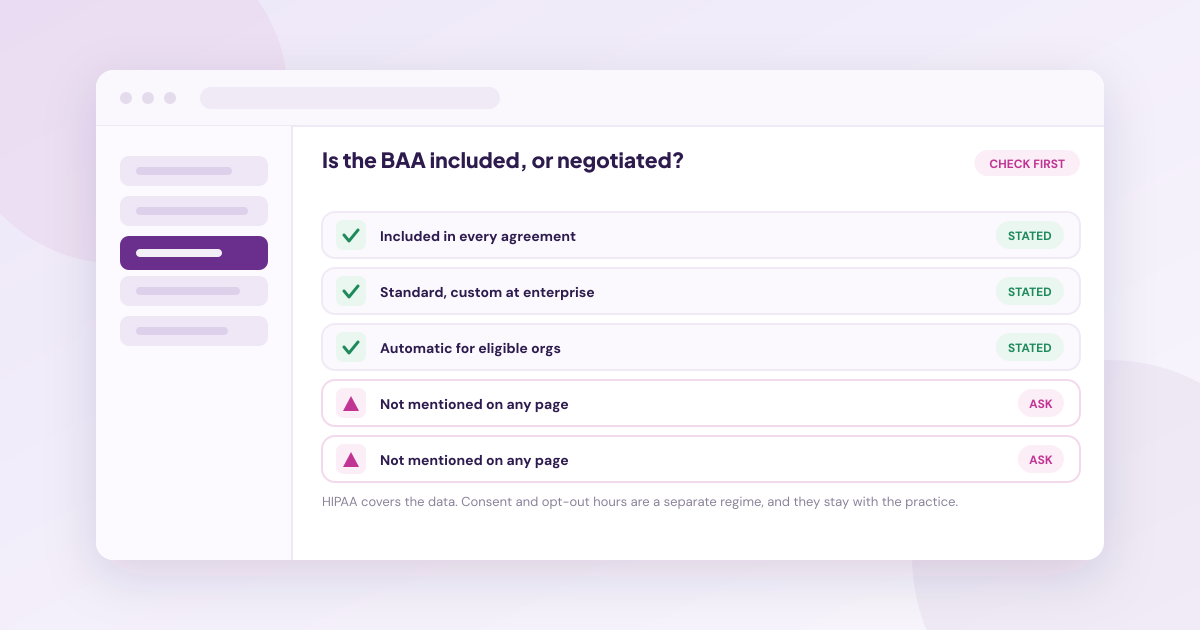
- A business associate agreement (BAA) should be included by default rather than negotiated. Check that it is stated plainly, because in this category many vendors do not mention one at all.
- If the platform cannot propagate an opt-out to every system that might message that patient, you are operating the compliance control yourself.
What Makes a Patient Text Lawful, and What Makes It Unwelcome
Two separate questions get merged into one, and the merge is where practices get into trouble.
The HIPAA question is whether protected health information (PHI) can be sent by text. It can, to a patient, with appropriate safeguards, and the vendor carrying it is a business associate requiring a BAA. This is settled and every vendor in this list operates on that basis.
The consent question is different law entirely. Automated texts to a patient's mobile fall under telephone consumer protection rules, which concern consent, opt-out and the hours during which you may send. HIPAA says nothing about any of that, and a vendor's HIPAA compliance does not address it.
That second obligation sits with the practice. Three things have to exist on your side before the first send, regardless of platform.
Recorded consent to contact by text, with a date, tied to the specific number you are sending to.
A working opt-out that is honored across every system that might message that patient, not only the one that sent the last message. A practice running a reminder platform, a recall platform and a billing platform has three places an opt-out has to land.
Sending hours you have decided deliberately rather than discovered through a complaint.
No vendor relieves you of those. When evaluating, ask specifically what each platform documents about consent capture, opt-out propagation across systems, and configurable send windows. Treat anything undocumented as a control your practice operates manually.
How These Platforms Were Chosen
Seven platforms, assessed only against what each publishes on its own site, read on October 26, 2026.
Inclusion required two-way patient texting as a core product rather than a feature of something unrelated, and enough published detail to compare.
Published vendor roundups in this category are unusually unreliable, because several of the highest-ranking comparisons are written by vendors who appear in them. Nothing in the table below comes from a competitor's comparison page.
"Not stated" means the vendor does not publish it on the pages read. In this category that is common and it is itself a finding, particularly for the BAA.
Patient Texting Platforms at a Glance
| Platform | Best for | EHR integrations | Compliance stated | BAA | Pricing |
|---|---|---|---|---|---|
| Medsender | Practices wanting outreach tied to a completed visit | 6 named, more on request | HIPAA, SOC 2 Type II, Google Cloud US servers | Included at no additional cost | Not published |
| OhMD | Practices wanting the widest EHR reach | "85 EHR and PM systems", none named | HIPAA, SOC 2 | "Standard BAA included in all agreements" | Not published |
| Spruce Health | Solo and small practices wanting a published price | Not named | HIPAA | Automatic for every eligible organization | $24 and $49 per user per month |
| Artera | Large organizations and health systems | "Major EHRs", none named | HIPAA, SOC 2 Type 2, HITRUST, FedRAMP | Not stated | Not published |
| Klara | Practices already running ModMed | ModMed patient engagement | See note below | Not stated | Not published |
| Curogram | Multi-site groups wanting month-to-month terms | "Virtually any EMR", none named | HIPAA, SOC badge only | Not stated | Not published |
| Weave | Small practices wanting phones and texting together | "Qualified PMS", none named | Not stated on the main page | Not stated | Not published |
The Platforms, One Section Each
Medsender: Best for Outreach Tied to a Completed Visit
Medsender's patient messaging sits inside Patient Recapture, which identifies lapsed patients and contacts them until they rebook. Outreach runs by text and email, with phone calls optional.
What distinguishes it in this list is the commercial model rather than the messaging. The page states that you pay only when a contacted patient completes a visit, with no setup fees and no per-message charges, and that cancellations and no-shows cost nothing.
Key features
- Text and email outreach, with calls available.
- Triggers include lapsed visits over a year old, unscheduled follow-ups that are due, and canceled or no-show appointments never rebooked, plus rules the practice defines.
- Each message carries a self-scheduling link requiring no app or login.
- In supported EHRs, each contact attempt and outcome is written back to the patient's chart.
- Six named EHR integrations, with more supported on request.
Pricing Not published. Billed on completed visits.
Pros The only outcome-linked commercial model in this list, which moves the risk of an unanswered campaign to the vendor. The most completely published compliance posture of the seven: HIPAA, SOC 2 Type II described as independently audited, a BAA at no additional cost with BAAs enforced down to subprocessors, Google Cloud hosting on US-based servers, role-based permissions, and an audit trail.
Cons This is outreach rather than a general two-way inbox, so a practice wanting staff-to-patient conversational messaging across all topics is buying for a narrower job. No published pricing. Write-back is conditional on EHR support, as it is everywhere.
OhMD: Best for the Widest EHR Reach
OhMD describes itself as an AI patient communication platform covering two-way HIPAA-compliant texting, AI voice and text agents, and scheduled outreach.
Its distinguishing published claim is reach: "Integrates with 85 EHR and PM systems". It names none of them, which is a limitation, but the breadth claim is the largest in this list.
Key features
- Two-way texting plus AI voice and text agents.
- Scheduled outreach.
- Stated integration with 85 EHR and practice management systems.
- Compliance stated under a "HIPAA & SOC 2 Compliant" heading, with the company describing itself as a leader in HIPAA compliant texting since 2016.
Pricing Not published.
Pros The clearest BAA language of the seven: "Standard BAA included in all agreements. Custom BAA included in our Enterprise package." Breadth of integration is the strongest argument for it, particularly for a group running more than one system.
Cons No named integrations, so the 85 figure cannot be checked against your own EHR without asking. SOC 2 appears only as a heading with no audit detail. The site's own consent language is a conditional: texting is compliant "with the appropriate patient consent for each use case", which is accurate and underlines that consent is your obligation.
Spruce Health: Best for a Published Price at Small Scale
Spruce is the only platform here publishing its rates, which makes it the only one a practice can evaluate without a sales conversation.
It is also the broadest in channel terms, describing itself as "the all-in-one platform for HIPAA-compliant healthcare communication" across phone, text, fax, video and secure messaging.
Key features
- Phone, texting, fax, video and secure patient and team messaging in one product.
- Workflow automation and phone trees.
- A 14-day free trial with no credit card required.
Pricing Published. Basic at $24 per user per month and Communicator at $49 per user per month, plus a one-time $19.50 fee to enable outbound text messaging.
Pros The only published pricing, and per-user pricing is predictable at small scale. The BAA language is unambiguous: "Every eligible Spruce organization automatically receives a HIPAA Business Associate Agreement (BAA)", included in every plan. The fax channel in the same product is unusual and useful for a practice consolidating vendors.
Cons No named EHR integrations, which for a practice that wants replies in the chart is the central question. SOC 2 appears only in image filenames rather than as a written claim, so treat it as unverified until asked. Per-user pricing scales linearly, so it becomes the expensive option for a large front office.
Artera: Best for Large Organizations
Artera is positioned at scale and its published credentials reflect that. It describes an agentic platform with AI service squads building custom solutions, across voice, rich text and email.
It publishes the strongest security set in this list, and it is the only vendor here with a published position on model training.
Key features
- Voice, rich text and email channels.
- AI solutions for scheduling, intake and payments, referrals, care gap closure and custom workflows.
- Compliance stated as "HIPAA Compliant", "SOC 2 Type 2", "HITRUST Certified" and FedRAMP High.
- A stated position on training: "We do not use identifiable PHI/PII to train our models."
Pricing Not published.
Pros The most complete published compliance set of the seven. The training statement is the only one of its kind here and it is the question most practices forget to ask. Case studies describe organizations with 10 or more locations and 120 or more providers, so the scale claim is supported.
Cons No BAA statement on the pages read, which is a notable omission given everything else it publishes. No named EHR integrations. Note also what the training statement does and does not say: it covers identifiable PHI and personally identifiable information, which leaves de-identified or aggregated use unaddressed. That may be entirely acceptable, and it should be a question you asked rather than a distinction you missed.
Klara: Best for Practices Already Running ModMed
Klara is now ModMed's patient engagement product. Its former domain redirects to ModMed's patient engagement page.
That makes the evaluation different in kind from the others here. For a practice already on ModMed, Klara is the option that arrives without a second vendor relationship or a second integration project. For a practice on another system, the calculus is the ordinary one.
Key features
- Patient engagement messaging within ModMed's platform.
- Positioned for specialty practices already running ModMed.
Pricing Not published.
Pros For an existing ModMed practice, the integration question largely answers itself, and that is a genuine advantage rather than a marketing one. Vendor consolidation has real operational value when the alternative is maintaining a separate interface.
Cons The product is now tied to one EHR platform, which narrows it considerably for everyone else. Published compliance detail specific to the messaging product was not available on the pages read, so HIPAA, SOC 2 and BAA status should be confirmed directly rather than assumed from the parent platform.
Curogram: Best for Multi-Site Groups Wanting Month-to-Month Terms
Curogram describes an all-in-one HIPAA-compliant communication platform covering two-way texting from the practice's main number, reminders, online forms, telemedicine, mass texting, text-to-pay and review requests.
It is explicit about multi-site suitability, listing multi-location and large group practices among its named segments.
Key features
- Two-way texting from the practice's existing main phone number.
- Mass texting, online forms, telemedicine and text-to-pay.
- Stated suitability for single and multi-location practices.
- Month-to-month terms with no long-term contract requirement.
Pricing Not published, though the absence of a long-term contract requirement is stated.
Pros Texting from the practice's existing main number removes the most common patient confusion in this category. The multi-location positioning is explicit rather than inferred. Month-to-month terms lower the commitment, and contract terms are where practice software decisions most often stall.
Cons No BAA mention anywhere on the pages read, which for a healthcare vendor is the single most important omission in this list. SOC 2 appears only as a badge image. No named EHR integrations behind "works with virtually any EMR". Be aware also that Curogram's own blog publishes many of the highest-ranking comparison articles in this category, in which it ranks itself first.
Weave: Best for Small Practices Wanting Phones and Texting Together
Weave is an all-in-one small business communication platform rather than a healthcare-specific one, bundling a phone system with texting, reminders, payments, forms, scheduling, reviews and an AI receptionist.
Key features
- Phone system, texting, reminders, digital forms, scheduling, payments and reviews in one product.
- AI receptionist and call intelligence.
- Appointment booking described against a qualified practice management system.
Pricing Not published.
Pros The broadest functional bundle here for a practice that wants to replace a phone system at the same time. For a small single-site office, consolidating phones and messaging with one vendor removes real administrative overhead.
Cons The main page states no HIPAA compliance, no SOC 2 and no BAA. A security page exists and was not read, so these should be confirmed directly, but a healthcare buyer should note that the competitors here lead with those claims and Weave does not. No named integrations. The product is positioned at small business generally rather than at medical practices specifically.
What to Confirm Before the First Send
Six questions, in this order. The first three are yours to answer and the last three belong to the vendor.
Do you have recorded consent, with a date, tied to the number you are sending to.
Where does an opt-out land, and does it reach every system that might message that patient.
What are your sending hours, and who decided them.
Does the platform propagate an opt-out received in one channel to the others, and does it document this.
Do replies reach the chart, and as what. A reply that lands only in the vendor's inbox creates a record your EHR does not have.
Is the BAA included by default or negotiated. Three of these seven state it plainly, two do not mention it at all, and the difference matters more than any feature in the comparison table.
Deciding Which Platform Fits Your Outreach
Work from the job rather than the feature list.
If the job is bringing lapsed patients back, Medsender is the only outcome-linked option, and the commercial model is the argument rather than the messaging.
If the job is conversational messaging across the widest EHR estate, OhMD publishes the largest integration claim and the clearest BAA language.
If you are small and want to start this week at a known price, Spruce is the only one you can, and the fax channel in the same product is a real bonus.
If you are an enterprise with a security review ahead of you, Artera publishes the credentials that review will ask for, including the only training statement here.
If you are on ModMed, Klara removes an integration project, and that is worth more than most feature differences.
If you are a multi-site group that wants out easily, Curogram's month-to-month terms address the thing that most often stalls these decisions, provided you get the BAA question answered first.
If you are replacing a phone system anyway, Weave is the broadest bundle, provided you confirm the compliance posture its main page does not state.
Two closing points that apply whichever you choose. Compliance claims that appear only as badge images are not claims, and should be asked about in writing. And the obligations around consent, opt-out and sending hours remain yours no matter how good the platform is.
FAQs
Is HIPAA the Only Rule That Applies to Patient Texting?
No, and this is where practices get caught. HIPAA governs whether protected health information can be sent. Automated texts to a patient's mobile also fall under telephone consumer protection rules, which govern consent, opt-out and the hours you may send. A vendor's HIPAA compliance says nothing about the second regime.
Should the Business Associate Agreement Be Included or Negotiated?
Included by default. Some platforms state plainly that a BAA comes with every agreement, and others do not mention one anywhere. That difference matters more than any feature in the comparison, because a healthcare vendor that has not addressed the BAA in public has probably not addressed it internally either.
What Has to Be in Place Before the First Message Goes Out?
Three things, all of them yours rather than the platform's. Recorded consent to contact by text, with a date, tied to the specific number. A working opt-out honored across every system that might message that patient. And sending hours you decided deliberately rather than discovered through a complaint.
Do Replies Reach the Patient Chart?
That depends on the platform and on your EHR. A reply that lands only in the vendor's inbox creates a record your chart does not have, which matters for anything clinical and for anything you may later need to evidence. Confirm it rather than assuming it, and confirm it for your own system.
How Much Does Patient Texting Cost?
Pricing in this category is mostly quote-based. Where rates are published they are per user per month, which is predictable for a small practice and becomes the expensive option across a large front office. Platforms built for enterprise do not publish rates at all.

Zain Qayyum
Co-Founder and Co-CEO
Zain Qayyum is co-founder and co-CEO of Medsender. His work centres on the front-office problems that decide whether a referred patient is ever seen: inbound fax, referral backlogs, and phones nobody has time to answer. He argues that healthcare's hardest problems are operational rather than technical, and speaks and writes on where AI genuinely helps a practice and where it overpromises. He is based in New York.
Related Signals