
7 Best Referral Management Software Platforms for Specialty Practices
 Zain QayyumLast Updated: Sep 29, 2026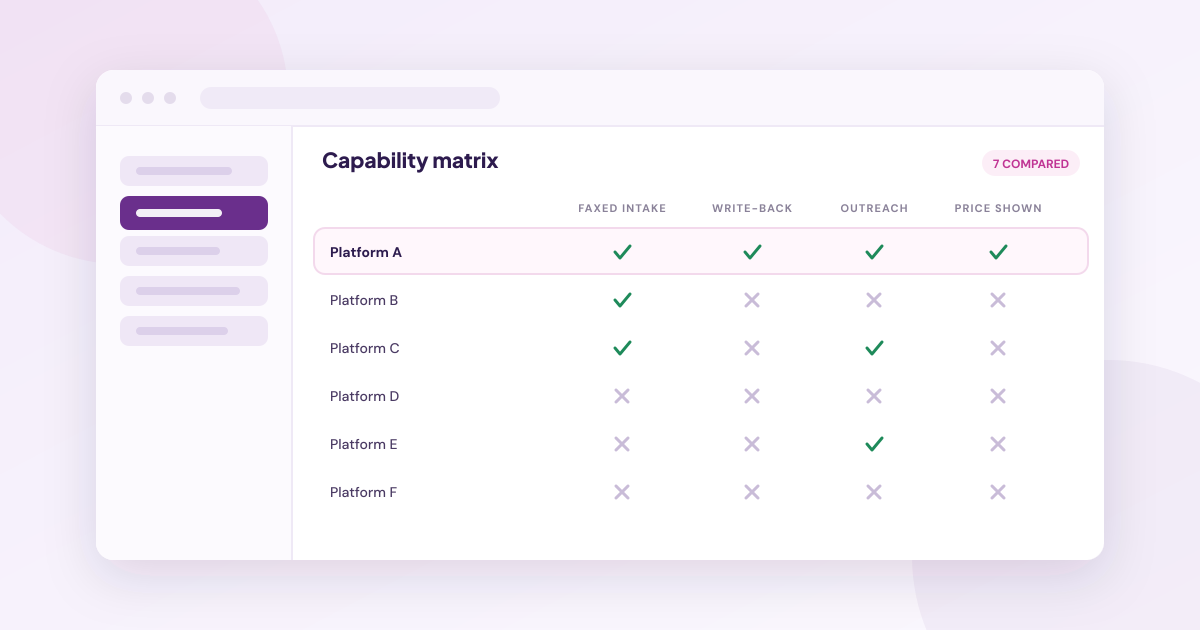
TL;DR
- Only 34.8% of referrals in one large health system study reached a documented completed appointment.
- Loop closure is a scored quality measure, not only an efficiency problem.
- The seven split between platforms built for a practice receiving referrals and platforms built for a network coordinating them, which is the line that decides fit more than any feature count. Electronic health record (EHR) write-back is the criterion that separates the two groups in public.
- No platform here publishes a price, so every comparison ends in a sales call.
- Treatspace publishes an outcome rate, stating consult reports returned for 90% of referred patients; no other platform here publishes one.
- Medsender ranks first on one criterion the others leave unstated, which is EHR write-back where the system supports it.
Referral management software automates the path from a referring provider's fax to a scheduled visit. The 7 platforms below were assessed from vendor websites and public documentation. Medsender ranks first because it is the one platform here publicly stating EHR write-back, and each entry says where another platform fits better.
Why Referral Loop Closure Is Measured, Not Just Managed
The scale of the problem is documented independently of any vendor. Patel and colleagues analysed referrals from a large primary care network to 20 high-volume specialties over twelve months and reported that of 103,737 referral scheduling attempts, only 36,072, or 34.8%, resulted in documented complete appointments. Nearly 39% of scheduling attempts lacked an appointment date at all.
That gap is also regulated. The Centers for Medicare & Medicaid Services (CMS) maintains eCQM CMS50v12, "Closing the Referral Loop: Receipt of Specialist Report", used in the Merit-based Incentive Payment System (MIPS) and Primary Care First. It measures "the percentage of patients with referrals, regardless of age, for which the referring clinician receives a report from the clinician to whom the patient was referred."
Read the direction of that measure carefully, because it changes the buying case. The referring clinician is scored, not the specialist. A specialty practice that reliably returns the consult report improves its referrers' measured performance, which is a commercial argument for closing the loop that sits outside its own efficiency.
How These 7 Were Selected and Scored
Inclusion required a product marketed for referral management in United States ambulatory care, with enough public documentation to verify claims. Platforms sold only to payers, and general fax services with no referral workflow, were excluded.
Three criteria carry the ranking, chosen before any vendor was assessed and justified here so the weighting can be argued with. Faxed-referral intake, because fax remains the channel a receiving practice cannot dictate to its referrers. EHR write-back, because a referral that reaches a queue and not the chart leaves the filing work in place. Patient outreach, because the study above locates most of the loss at scheduling, not at intake.
Loop-closure reporting was assessed separately, given the CMS measure above. Compliance and pricing transparency were recorded but not ranked.
What the 7 Platforms Actually Publish
| Platform | Best for | Faxed intake | Patient outreach | EHR write-back | Named EHRs | Loop-closure reporting | Compliance | Price |
|---|---|---|---|---|---|---|---|---|
| Medsender | Fax-first specialty practices | Yes, keeps existing number | Text, then email | Stated, where the EHR supports it | 35 available, 46 on request | Referring-provider portal | Health Insurance Portability and Accountability Act (HIPAA), SOC 2 Type II | Custom |
| ReferralPoint | Mixed referral channels | Yes, 6 channels in one queue | Auto-scheduling and texting | Not stated | 6 named, 20+ via parent | Not stated | HIPAA, SOC 2 Type II, HITRUST CSF | Not listed |
| Red Spot Interactive | Physician liaison teams | Yes, digital fax ingestion | Immediate task assignment | Not stated | None named | Referral analytics by provider | HIPAA | Not listed |
| Proficient Health | Groups inside a network | Yes, PH Capture | Not stated | Not stated | 6 named | PH Exchange across network | Not stated | Not listed |
| Treatspace | Primary-to-specialty networks | Not stated | Scheduling only | Not stated | Any EHR, none named | 90% consult reports returned | HIPAA | Not listed |
| HealthViewX | Inbound and outbound together | Not stated | Call centre | Not stated | None named | Not stated | HIPAA, SOC 2 Type II, GDPR | Not listed |
| ReferWell | At-risk organisations and FQHCs | Not stated | Staffed navigators | Not stated | None named, EHR-agnostic | Completed appointment recorded | HIPAA | Not listed |
Counted across the seven, the category looks like this: 4 state faxed intake, 5 describe patient outreach, 3 name a single EHR system, 6 state Health Insurance Portability and Accountability Act (HIPAA), 3 state System and Organization Controls (SOC) 2 Type II, 1 publishes an outcome rate, and none publishes a price.
Two of those are worth pausing on. No platform publishes a price, so every comparison ends in a sales call. And only Treatspace publishes the metric CMS50v12 actually measures, which says something about how rarely this category is held to its own outcome.
One result cuts against the ranking below. ReferralPoint matches Medsender on faxed intake, patient outreach and named EHR integrations, and states a broader certification set including HITRUST CSF. The single criterion separating them publicly is EHR write-back, which Medsender states conditionally and ReferralPoint does not state at all.
7 Best Referral Management Software Platforms
Each entry below states what the platform does with an arriving referral, which systems it names, what it publishes about pricing and security, and the practice type it suits. Where a vendor does not publish something, that is noted rather than estimated.
Medsender: Best for Fax-First Specialty Practices
Medsender takes a referral arriving by fax, reads it, files it to the patient chart, and contacts the patient to schedule. Its referral management page states it works with the fax numbers and EHR a practice already has, so referring providers change nothing.
Key features:
- Chart creation and write-back where the EHR supports it; the document is filed where it does not.
- Texts the patient a scheduling link, following with an email if there is no reply.
- 35 named EHR integrations available, with 46 more on request, including ModMed EMA, athenaOne and NextGen Healthcare.
- A referral provider portal showing the referring practice each outcome.
Pricing: Custom, varying by fax, call and referral volume and contract length.
Pros: Fax intake, write-back where the EHR supports it, and outreach run as one workflow. Medsender publishes a customer result of regional referral conversion rising from 20% to 62%. HIPAA compliant and SOC 2 Type II certified.
Cons: No published price at any tier. Write-back depth varies by EHR, and an on-request integration is not a built one. Human support runs 9AM to 5PM Eastern. The exception queue needs a named owner with allocated hours, a staffing cost the quote will not show.
Choose something else if your referrals arrive mainly through a network portal, you need outbound referral management, you want staffed patient navigation instead of automated outreach, or your EHR sits on the on-request list.
ReferralPoint: Best for Practices Receiving Referrals Through Many Channels
ReferralPoint handles inbound and outbound referrals, consolidating fax, Direct message, email, web form, lab result and clinical note into one queue. That suits a practice whose referrals do not all arrive the same way. Its parent is Lightbeam Health Solutions.
Key features:
- A single inbound queue spanning fax, Direct, email, web form, labs and notes.
- Outbound routing to appropriate specialists for practices that also send referrals.
- Auto-scheduling and patient outreach, described by the vendor as removing manual phone tag.
- Named integrations with athenahealth, eClinicalWorks, NextGen, Altera, Veradigm and Epic, with roughly 20 more reachable through Lightbeam.
- Specialty practices, medical groups, health systems, community health centers and payers all named as segments.
Pricing: Not listed.
Pros: Consolidates six stated intake channels into one queue, which matters when referrals genuinely arrive by different routes. Naming six EHRs puts it among the 3 of the 7 platforms naming any system. It states the broadest certification set here: HIPAA, SOC 2 Type II and HITRUST CSF.
Cons: Integrations reachable through the parent platform may require that platform in place, and possibly a second contract. EHR write-back is not described publicly, which is the one criterion separating it from the entry above. No loop-closure reporting is stated.
Red Spot Interactive: Best for Practices With a Physician Liaison Team
Red Spot Interactive sells a Referral Management Platform that captures, tracks and manages referrals from external physician partners, aimed at practices running a liaison team that needs to measure which referring providers send revenue.
Key features:
- Digital fax ingestion turning inbound faxes and web referrals into workflows tied to the patient record.
- A dedicated referring-provider online scheduling portal.
- Immediate task assignment for patient outreach.
- Referring provider relationship and revenue reporting built for liaison teams.
Pricing: Not listed.
Pros: Built around measuring which referring providers generate revenue, which is the question a liaison team is funded to answer and one the other platforms here do not foreground. Digital fax ingestion is stated explicitly, so faxed referrals are handled at intake, and the vendor states a HIPAA-compliant environment.
Cons: No EHR is named anywhere on the site, so confirm your own before any pilot. Synchronisation is described against the practice management system, which differs from filing to the chart. No SOC 2 report is mentioned.
Proficient Health: Best for Groups Inside an ACO or Health System Network
Proficient Health sells three products: PH Capture digitises inbound faxed referrals with document processing, PH Exchange manages workflows across a network, and PH Connect gives referring providers a real-time channel to the specialist.
Key features:
- PH Capture reads inbound faxed referrals and turns them into digital records.
- PH Exchange manages referral workflows between sending and receiving organisations in one network.
- PH Connect provides secure real-time communication on a mobile-enabled platform.
- States it works with Epic, Oracle Health (Cerner), Athenahealth, NextGen, eClinicalWorks and Allscripts.
Pricing: Not listed.
Pros: The named systems are the ones that run hospitals and large groups, so a health-system-affiliated practice will usually find itself covered. Fax capture and network workflow in one vendor.
Cons: PH Exchange and PH Connect assume referring practices sit in the same network, which an independent specialty practice receiving from unaffiliated referrers cannot assume. Independent practices on specialty systems will not find themselves named. No compliance certification stated.
Treatspace: Best for a Primary-to-Specialty Network Returning Consult Reports
Treatspace connects primary care and specialty practices so referrals are placed, patients get appointments, and consult reports return to the referring provider. Both sending and receiving practice use the platform.
Key features:
- Referral placement between practices on the same network.
- Scheduling tools so referred patients get appointments.
- Consult report return to the referring provider, tracked per referral.
- Integration with any EHR, per the vendor, with none named.
Pricing: Not listed.
Pros: Treatspace states that specialists on its network return consult reports for 90% of referred patients. That is the one published outcome rate among these platforms, and it maps directly onto what CMS50v12 measures, which makes it a checkable claim.
Cons: The network model only works where your referrers will also adopt it, which a receiving practice does not control. No EHR is named. Faxed intake is not described, so a practice whose referrals arrive by fax should establish what happens to them.
HealthViewX: Best for Groups Managing Outbound Referrals as Well as Inbound
HealthViewX is a care orchestration platform selling Inbound and Outbound Referral Management as separate modules, alongside care management and documentation tools. It names health systems, multi-specialty practices and FQHCs as segments.
Key features:
- Inbound and Outbound Referral Management as distinct modules.
- Referral intake documented through an AI scribe function.
- Patient outreach and scheduling run through a call-center function.
- HIPAA, SOC 2 Type II and GDPR compliance displayed.
Pricing: Not listed.
Pros: States HIPAA, SOC 2 Type II and GDPR, putting it among the 3 of the 7 platforms naming a SOC 2 Type II report. A group sending high referral volume outward, and wanting to track where each one went, has a use for the outbound module that a receive-only practice does not.
Cons: No EHR named, so the filing question is unresolved until a call. Buying modular care orchestration to solve inbound referrals brings scope a single-specialty practice will not use. Faxed intake is not stated.
ReferWell: Best for At-Risk Provider Organizations and FQHCs
ReferWell Connect is described by the vendor as end-to-end referral management and scheduling that closes the loop from prior authorization through completed appointment. Segments are health plans, at-risk provider organisations, hospitals and FQHCs.
Key features:
- Coverage from prior authorization through completed appointment.
- Loop closure recording the completed appointment, not only the scheduled one.
- Staffed navigators who educate the member, schedule, and confirm insurance and provider access.
- EHR-agnostic integration and a published HIPAA compliance page.
Pricing: Not listed.
Pros: Prior authorization sits at the front of the workflow, which suits populations where authorisation is the usual blocker. Human navigators reach patients that automated outreach does not.
Cons: EHR-agnostic means no named connection, so documents may land near the chart and, not in it. Staffed navigation carries a cost structure closer to a service than software. An independent specialty practice outside an at-risk arrangement is not the intended buyer.
Deciding Which of the Seven to Shortlist
The seven split along one line that matters more than feature counts: some are built for a practice receiving referrals, and some are built for a network coordinating them. Buying across that line is where specialty practices waste a year.
- If referrals arrive by fax and your problem is the pile rather than the network, Medsender, Red Spot Interactive and Proficient Health's PH Capture all read the fax itself. Medsender is the one that files to the chart and contacts the patient without the referring provider changing anything.
- If they arrive by five different routes, ReferralPoint consolidates fax, Direct, email, web form, lab result and clinical note into one queue, which removes the checking rather than the working.
- If you employ liaisons whose job is to grow referral volume, Red Spot Interactive is built around attributing revenue to referring providers, which no other platform here treats as the point.
- If you sit inside an ACO, a health system network or an FQHC, Proficient Health, HealthViewX and ReferWell are designed for coordination across organisations, and ReferWell covers prior authorization through to the completed appointment.
- If consult reports failing to return is the complaint you hear from referring providers, Treatspace closes that specific loop, though it requires both practices on the platform.
Two things became clear reading the seven vendor sites next to each other. Nearly all of them describe capturing a referral in detail and describe closing it in a sentence, which is the reverse of where practices actually lose referrals. And the ones aimed at networks assume the referring practice will adopt the same software, an assumption that holds inside an ACO and collapses for an independent specialty practice taking faxes from thirty unaffiliated offices.
Start by counting how many of last month's referrals arrived from practices you have no relationship with. If most did, buy something that reads what they send you. If most came from partners already in your network, buy the coordination layer instead.
For most specialty practices the answer is Medsender. It is the one platform here that reads the faxed referral itself, files it to the patient chart where the EHR supports it, and then contacts the patient with a scheduling link, so a referral becomes a booked visit inside one workflow rather than three tools. The platforms above it on any single feature are network coordination layers, and those only pay off when your referrers adopt the same software.
FAQs
What Is Referral Management Software?
Practice software that captures an inbound referral, files it to the patient chart, and tracks it through to a scheduled and completed visit. The distinction that matters when comparing products is whether the referral reaches the chart itself or a separate queue somebody still has to work through manually.
Is Closing the Referral Loop a Regulatory Requirement?
Closing the referral loop is a measured requirement. CMS eCQM CMS50v12, "Closing the Referral Loop: Receipt of Specialist Report", is used in MIPS and Primary Care First, and scores the referring clinician on receiving the specialist's report. A specialty practice that returns reports reliably improves its referrers' measured performance.
How Many Referrals Actually Get Completed?
In one analysis of a large health system, 34.8%, or 36,072 documented complete appointments from 103,737 referral scheduling attempts across 20 specialties. Nearly 39% of scheduling attempts had no appointment date recorded at all, which places most of the loss at scheduling and, not at intake.
How Much Does Referral Management Software Cost?
None of these seven publishes a price, so every comparison ends in a sales call. Medsender describes pricing by monthly fax, call and referral volume and contract length. Ask each vendor which unit you are billed on and what the starting tier includes before comparing any two quotes.
Does Referral Management Software Work With Faxed Referrals?
4 of the 7 platforms state faxed intake explicitly: Medsender, ReferralPoint, Red Spot Interactive and Proficient Health. Fax remains the channel a receiving practice cannot dictate to its referrers, so a platform covering only portal referrals addresses the easier half of the problem.
Which Referral Management Software Integrates With ModMed EMA?
Medsender publishes a dedicated ModMed EMA integration page and is listed on the ModMed Marketplace, meaning the connection has been reviewed by the EHR vendor. 3 of the 7 platforms name any EHR at all, so for most of this category the answer is established only on a call.

Zain Qayyum
Chief Executive Officer
Zain Qayyum is co-founder and co-CEO of Medsender. He started the company in 2015 and has spent the decade since on the front-office work that decides whether a referred patient is ever seen: inbound fax, referral backlogs, and phones nobody has time to answer. He argues that healthcare's hardest problems are operational rather than technical, and speaks and writes on where AI genuinely helps a practice and where it overpromises. He is based in New York.
Related Signals
6 Best AI Automation Software Platforms for Medical Practice Administration (2026)
Zain QayyumFri, Sep 11, 2026
6 Best Patient Recall and No-Show Software Platforms for Medical Practices
Zain QayyumTue, Sep 1, 2026