Recall Software That Writes Back, Where Your EHR Supports It
 Zain QayyumLast Updated: Nov 23, 2026
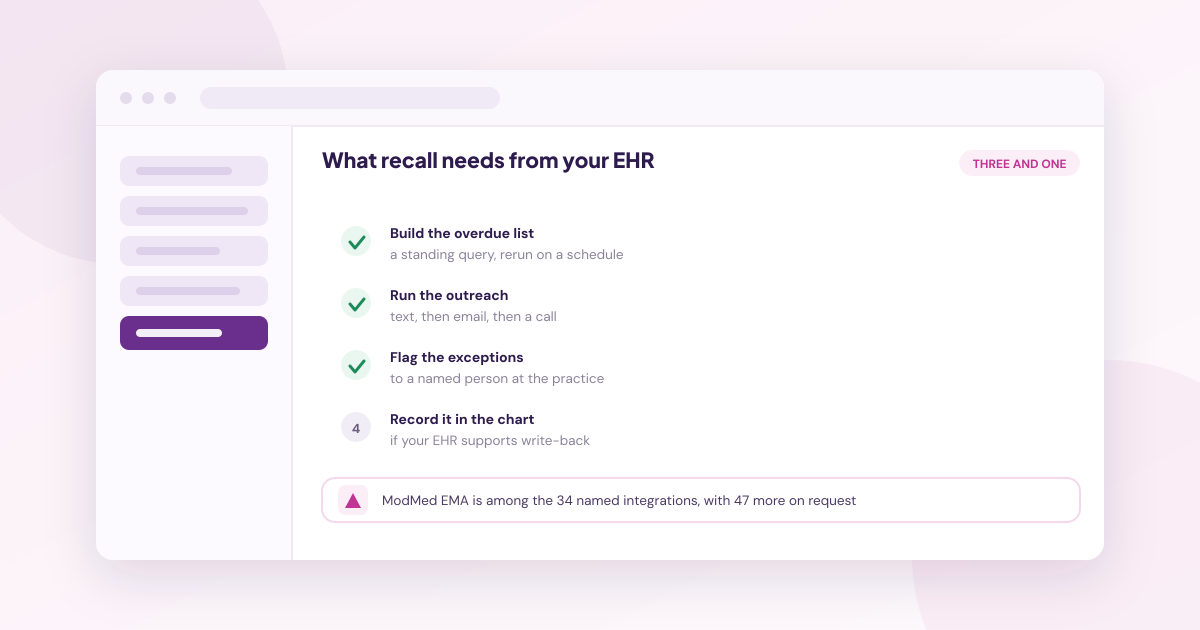
Recall Software That Writes Back, Where Your EHR Supports ItMedsender builds your overdue and no-show list from your electronic health record (EHR), then reaches each patient by text and email carrying a self-booking link they use to book. If your EHR supports chart creation and write-back, both happen automatically. If it does not, the list and the outreach still run and the filing step stays manual.
Recall software therefore has two halves. One half always runs, and the other depends entirely on what your own EHR will accept from a third party.
TL;DR
- Recall software builds the overdue list, runs the outreach and flags exceptions, and none of those three depend on writing anything back.
- Chart creation and write-back happen if your EHR supports them, which is the condition sitting on the filing step.
- Medsender lists 34 named EHR integrations and 47 more on request, and ModMed EMA is among the named ones.
- Outreach is text and email carrying a self-booking link, and the patient books through that link.
- Where your EHR will not accept the record, the list and the outreach still run and the filing step stays manual.
- Patient Recapture is billed on outcomes, so you only pay for completed appointments, not activity.
How Recall Software Works With Your EHR
Six steps make up the sequence, and only three of them need the EHR at all. The last row is the one worth reading twice.
| Step | What happens | Needs the EHR? |
|---|---|---|
| List built | overdue, lapsed, cancelled, no-showed | yes, read access |
| Rules applied | interval and eligibility per provider | yes, read access |
| Patient contacted | text and email with a self-booking link | no |
| Patient books | through the self-booking link | no |
| Exception raised | anything unusual flagged for the staff owner | no |
| Chart created or updated | happens if your EHR supports chart creation and write-back | yes |
What Recall Software Does in a Supported EHR
Chart creation and write-back happen if your EHR supports them, and a supported EHR is the case described here. Everything in the table runs, including the last row.
ModMed EMA
ModMed EMA is a named integration, and Medsender is listed on the ModMed Marketplace. Ask which operations the integration performs against your own instance, because read access and write access are different permissions.
Florida Gulf Coast ENT, an ear, nose and throat (ENT) practice, runs on ModMed EMA and is a published Medsender case study. Its figure measures fax triage, so it is never a recall result.
The Rest of the Integration List
Medsender lists 34 named available integrations, with 47 more on request. The named list is the one to check against your own system, because a vendor's logo wall is not a mechanism.
Our comparison of fax and referral software EHR integrations sets out which questions separate a named integration from a logo.
What Read Access Alone Buys You
Read access is the lower bar, and it is enough for the two steps that decide whether a program exists at all. The list and the per-provider rules both need nothing more than read access.
A practice with read access only still gets the overdue list and the outreach that follows it. Our guide to what a patient recall program involves covers the parts the practice owns.
What Recall Software Does When Your EHR Does Not Support Chart Write-Back
Chart creation and write-back happen if your EHR supports them, and this section describes the case where your EHR does not support them. Five steps keep running and one becomes manual.
What Keeps Working
The list, the per-provider rules, the outreach, the self-booking link and the exception queue all keep running. None of those five steps writes anything into your system, so none of them depends on the integration.
What Becomes Manual
Creating the chart and recording the completed visit against it become a person's job, because chart creation and write-back happen only if your EHR supports them. Say so plainly during an evaluation, since a records manager finds out in week one either way.
The manual step is short, because the patient, the date and the provider are all already known by the time anybody opens the queue.
How Recall Software Fills Gaps in the Clinic Schedule
Gaps in a clinic schedule come from two places and need two different sequences. A standing gap and a slot that empties this morning have almost nothing in common.
The Standing Gap
Providers whose overdue list is long enough to fill a recurring block have a standing gap. Run the list on a schedule rather than as a one-off project, because a project stops when the person running it goes on leave.
The Same-Day Cancellation
A slot that empties at 9AM needs a short list of patients who already said yes to an earlier date. The outreach is the same text and email carrying a self-booking link, so the patient takes the slot themselves.
Keep that short list separate from the twelve-month overdue list, because the two are worked on completely different clocks.
What Nobody Should Promise
A gap the practice cannot staff is not a gap recall software should fill. Set the attempt count and the quiet dates per provider before going live, and keep consent and opt-out under the practice's own policy.
This page takes no position on what patient outreach is permitted, how often, or at what hours. Those answers belong to the practice and its counsel.
Who Recall Software Is For
Recall software fits practices with a predictable due interval and somebody who owns the list. The six named served specialties are Dermatology, ear, nose and throat (ENT), Gastroenterology, Ophthalmology, Orthopedics and Primary Care.
Dermatology Practices
Annual and semi-annual skin checks produce a large and predictable overdue list, which is the easiest kind of list to run a rule against. ModMed EMA is common in Dermatology and is a named integration.
Gastroenterology Practices
Surveillance intervals in Gastroenterology run long, measured in years rather than months, so the overdue list is where patients quietly disappear. The provider sets the interval and the software applies it, never the other way round.
Ophthalmology Practices
Recurring exam and pressure-check intervals in Ophthalmology repeat often and frequently span several locations. Multi-location groups need the rule set per provider rather than per practice, because one site's capacity is not another's.
The Operational Fit
Groups where one staff member owns recall across several providers run a rule-based list well, because somebody is there to work the exception queue. Practices on a named integration fit, and so do practices willing to keep the filing step manual. Our list of patient recall and no-show software covers how the rest of the category is scoped.
Who Recall Software Is Not For
Six exclusions are worth stating plainly, because a page that only lists strengths is harder to trust.
- Practices wanting prior authorization automated. Prior authorization is not a shipped capability, and Medsender never presents it as one.
- Practices wanting insurance verification, which is never presented here as generally available.
- Practices wanting on-premise software, because Medsender runs in the browser only, hosted on Google Cloud with United States servers.
- Practices on an EHR with no interface and no appetite for a manual filing step, because chart creation and write-back happen only if your EHR supports them.
- Anyone needing a contractual availability commitment, because Medsender publishes no service level agreement.
- Practices in specialties outside the six named ones, which should be told so rather than sold to.
Which Outcomes Are Attributed to Named Practices
No recall-specific outcome figure is published, so the figures below are fax and referral results attributed to named practices and have to be read that way.
- Ozark Dermatology, 5 locations, 14 providers and 250 faxes a day, reports 40 staff hours a week reclaimed and same-day first contact. That is a fax result.
- Florida Gulf Coast ENT, on ModMed EMA and handling up to 25,000 fax pages a month, reports a 92% reduction in triage work and a move from three full-time staff to one and a half. That is a fax triage result.
- Piedmont Plastic Surgery and Dermatology, 10 locations and 50 providers, reports 50% of referred patients scheduled within minutes. That is a referral result.
- None of the three measures recall, and none of them should be relabelled as a recall outcome.
For the money side of the decision, our guide to patient recall pricing and outcome billing sets out what each pricing model costs a practice with a long list.
FAQs
Common questions from practices shortlisting recall vendors against their own EHR.
Does Recall Software Integrate With the EHR?
Yes, through a named integration. Medsender lists 34 named EHR integrations with 47 more on request, and the integration is what supplies the overdue list and the per-provider rules. Read access alone covers the list and the outreach. Chart creation and write-back happen if your EHR supports them.
Does Recall Software Work With ModMed EMA?
Yes. ModMed EMA is a named Medsender integration, and Medsender is listed on the ModMed Marketplace. Treat the integration as a mechanism and ask which operations it performs against your own instance, because chart creation and write-back happen if your EHR supports them.
What Happens If Our EHR Does Not Support Chart Write-Back?
The list, the per-provider rules, the outreach, the self-booking link and the exception queue all keep running, because none of them writes anything into your system. Creating the chart and recording the completed visit become manual, since chart creation and write-back happen only if your EHR supports them.
Can Recall Software Fill Gaps in Our Clinic Schedule?
Yes, within limits. Overdue, lapsed, cancelled and no-showed patients are the pool a recall program draws from, and rules per provider decide who is eligible. Outreach goes out as text and email carrying a self-booking link, so patients choose their own slot. A gap the practice cannot staff is not a gap to fill.
Does Recall Software Book the Appointment for the Patient?
No, the patient books. Outreach is text and email carrying a self-booking link, and the patient uses that link to take a slot, so nothing is written into a calendar on their behalf. Call automation also schedules, because MAIRA answers inbound patient calls and books on the call.
Which Specialties Does Recall Software Cover?
Six named specialties, which are Dermatology, ear, nose and throat, Gastroenterology, Ophthalmology, Orthopedics and Primary Care. Long due intervals make Dermatology, Gastroenterology and Ophthalmology the three where an overdue list matters most to revenue. Practices outside the six should be told so rather than sold to.
How Is Recall Software Billed?
Patient Recapture is billed on outcomes, so you only pay for completed appointments, not activity. The unit is a completed appointment rather than a message, a reply, or a booking that later cancels. Get the definition of completed, the treatment of cancellations and the attribution window in writing before signature.

Zain Qayyum
Co-Founder and Co-CEO
Zain Qayyum is co-founder and co-CEO of Medsender. His work centres on the front-office problems that decide whether a referred patient is ever seen: inbound fax, referral backlogs, and phones nobody has time to answer. He argues that healthcare's hardest problems are operational rather than technical, and speaks and writes on where AI genuinely helps a practice and where it overpromises. He is based in New York.
Related Signals