How Patient Recall Is Priced, and Why Outcome Billing Matters
 Zain QayyumLast Updated: Nov 23, 2026
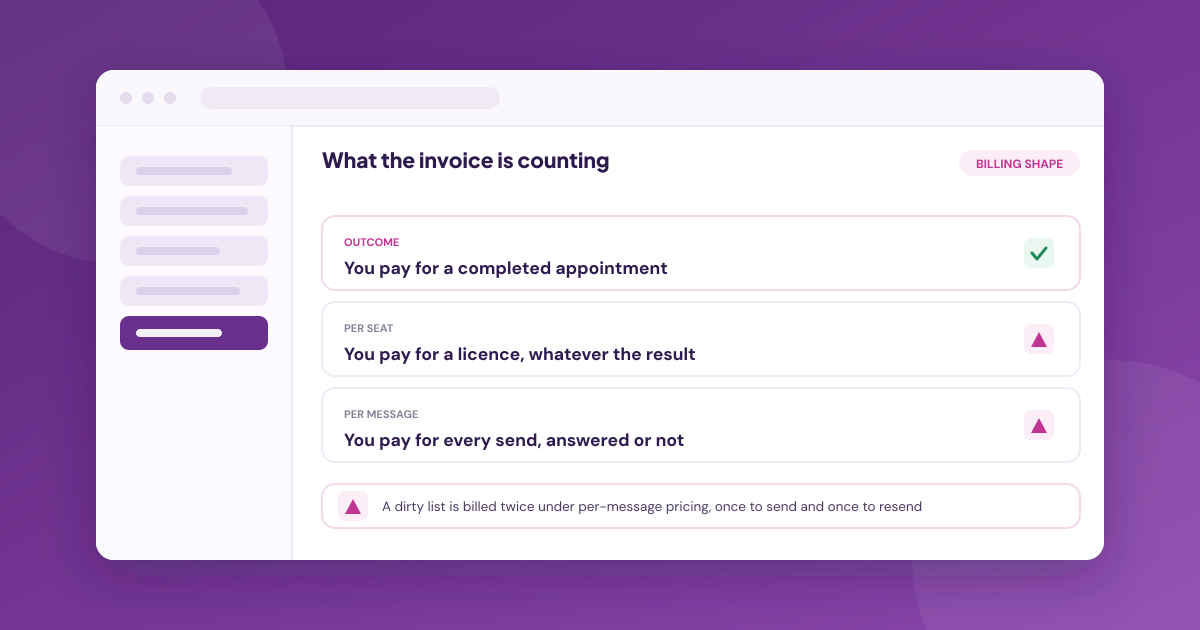
How Patient Recall Is Priced, and Why Outcome Billing MattersOutcome billing means the vendor is paid when a recalled patient actually comes in, not when a text goes out. Medsender bills Patient Recapture that way, so you only pay for completed appointments, not activity. The two common alternatives charge the same whether anyone books or not.
Three units are in play across the category, which makes quotes hard to compare until each one is converted. The unit also decides who carries the risk of a dirty list pulled from your electronic health record (EHR).
TL;DR
- Outcome billing means the vendor is paid when a recalled patient comes in, not when a message goes out.
- Medsender bills Patient Recapture on outcomes, so you only pay for completed appointments, not activity.
- Per provider per month charges for seats regardless of result, and per message charges for every send.
- Under outcome billing the vendor carries the risk of a dirty list, because sends are not billable.
- Medsender publishes fax at $0.08 per page sliding to $0.056, and referrals at $1.20 each sliding to $1.00.
- Linear Health publishes a readable price, and Brevium, the reactivation-scoped vendor, publishes none.
Patient Recall Pricing, Challenge Versus Solution
Six problems come up in every recall quote comparison, and the pricing unit answers all six differently.
| Challenge | What outcome billing does |
|---|---|
| Quotes use different units | prices one unit, a completed appointment |
| Dirty overdue list inflates sends | sends are not billable |
| Seat pricing ignores results | no seats, no minimum per provider |
| Vendor has no stake in bookings | vendor paid only on kept visits |
| Long interval delays any return | cost arrives with the revenue |
| Pilot is hard to size | cost scales with completed visits |
What Outcome Billing Means for Patient Recall
Outcome billing means you only pay for completed appointments, not activity, which is the sentence worth holding a vendor to. The rest of this block is what that sentence has to define.
The Unit Is a Completed Appointment
A completed appointment is not a message, not a reply, and not a booking that later cancels. The unit is the visit that actually happened.
The completed visit is recorded in the chart, and chart creation and write-back happen if your EHR supports them. Our guide to recall software that writes back covers that case, because chart creation and write-back happen if your EHR supports them.
What You Are Not Billed For
Under outcome billing, texts and emails to patients who never respond are not billable. Neither are patients already on the schedule, duplicate records, and people who should never have been on the list at all.
The vendor therefore carries the cost of list quality, which is the practical reason the model is worth asking for.
What Has to Be Defined in Writing
Three definitions decide what you actually pay. What counts as completed, how a same-day cancellation is treated, and how long the attribution window runs.
Ask for all three in writing before signature. Medsender's contract terms are not published, so ask for all three definitions in writing before signature.
The Three Ways Recall Vendors Price
Recall vendors price by seat, by message or by completed appointment. Naming the model by its unit rather than by its vendor is what makes three quotes comparable.
Per Provider Per Month
A per-provider monthly fee is predictable, and a practice with ten providers pays for ten whether the lists are worked or not. The fee is cheap for a busy provider and expensive for a part-time one.
Run the arithmetic provider by provider before signing, because the average hides the part-timers. Our comparison of whether to automate or hire in the front office covers the same seat-versus-result question for staffing.
Per Message or Per Contact
Cost under per-message pricing rises with list size, so a dirty list is billed twice, once in money and once in the staff time spent handling replies. Deduplication is worth real money under this model.
Ask whether a retry counts as a new message, because attempt counts multiply faster than list sizes do. Our list of patient recall and no-show software covers which vendors state a unit at all.
Per Completed Appointment
Cost under outcome billing rises only with revenue, which is what makes a pilot easy to size. The definition of completed is where the whole model lives.
Get that definition in writing, because it decides whether a visit that was booked and then cancelled is billable.
What Medsender Publishes About Price
Medsender publishes two per-unit prices and one billing basis. Whatever is not published is labelled as such here rather than estimated.
The Published Per-Unit Prices
Patient Recapture is billed on outcomes, so you only pay for completed appointments, not activity. Medsender publishes fax at $0.08 per page at low volume, sliding to $0.056 at higher volume.
Medsender publishes referrals at $1.20 each, sliding to $1.00 at higher volume.
What Medsender Does Not Publish
Contract terms are not published, so ask for them in writing before signature. No implementation timeline and no setup duration appears on this page either.
A free trial exists and is basic non-AI fax only, with no referral processing and no integration with your electronic health record. Its length is not stated here, so confirm it before you plan around it.
How Recall Vendors Price, Medsender Included
Eight vendors in and around this category were checked on 12 November 2026, and one of them publishes a readable figure. LeadingReach publishes per-physician monthly pricing, but every page returned a bot-verification block on that date and again on 23 November 2026, so no figure is reported here. Linear Health publishes from $2,000 a month, described on its own page as a flat monthly fee per workflow sized to volume.
LeadingReach and Linear Health are both scoped to referrals rather than to patient reactivation, so neither is a like-for-like recall quote. Where a vendor publishes nothing, the entry below says not published, which means they do not state it publicly rather than that the capability is absent.
How Medsender Is Placed
Medsender publishes a billing basis for recall and per-unit prices for fax and referrals, and it does not publish contract terms. Medsender publishes a billing basis and per-unit rates, and not the contract terms, which is why the three definitions below belong in writing.
Medsender is listed first, and the other vendors follow alphabetically. The unit each one bills is the comparison that decides a quote.
Brevium
Brevium is scoped to patient reactivation, which its own site calls patient reactivation software, and it does not do fax or referrals. Brevium publishes no price, read on 12 November 2026, and its pricing path redirects to a specialties page.
A demo request is the route to a figure, so a buyer comparing Brevium against an outcome-billed quote has to ask which unit is billed before anything else.
Where Nothing Is Published
Seven of the eight publish no readable price and no unit. Assort Health, Valerie Health and Tennr read as demo-request pages on 12 November 2026, and none of the three is scoped to patient reactivation. Plena Health returned an empty document on that date, so nothing about its pricing is recorded here.
ReferralMD publishes no price on its homepage, read on 12 November 2026, and its pricing page returned a server error. This page records that gap rather than filling it, because an unread figure is not a quote you can hold a vendor to.
How to Compare Recall Quotes and Decide Without a Benchmark
No published response-rate benchmark is worth quoting, so the comparison has to be built from the practice's own numbers. Three steps get there.
Normalise Every Quote to One Unit
Convert each quote to a cost per completed appointment using your own overdue list size. A seat price and a message price both convert once you assume a completion count.
Use the same assumed count for every quote, or the exercise proves nothing at all.
Ask the Three Questions That Change the Answer
What counts as completed, what happens to a cancellation, and how long the attribution window runs. Those three change the arithmetic far more than the headline rate does.
A vendor who will not answer them in writing has answered them.
Size the Pilot on One Provider
One provider's overdue list for one month produces a real cost per completed appointment. That figure, rather than a benchmark, is what the next quote gets compared against.
Our guide to what a patient recall program involves covers how to run that month by hand.
FAQs
Common questions from practices comparing recall quotes.
Do Recall Vendors Charge Per Completed Patient Visit?
Some do. Medsender bills Patient Recapture on outcomes, so you only pay for completed appointments, not activity. Of eight vendors checked on 12 November 2026, one publishes a readable price, and it prices by workflow per month rather than by visit. Ask each vendor which unit it bills.
How Is Medsender's Patient Recapture Priced?
On outcomes. Patient Recapture is billed so that you only pay for completed appointments, not activity, which means sends to patients who never respond are not billable. Medsender does not publish contract terms for it, so get the definition of a completed appointment and the attribution window in writing.
What Counts as a Completed Appointment?
Whatever the contract says, which is exactly why the definition belongs in writing before signature. A completed appointment should mean a visit that happened, not a booking that later cancelled and not a reply to a text. Ask specifically how a same-day cancellation and a reschedule are each treated.
Does Outcome Billing Cost More Than a Monthly Subscription?
Outcome billing costs more only when a lot of patients come back, and nothing at all when nobody does. A flat monthly fee is cheaper once a long list converts well, so the two models cross over at a volume you can calculate. Convert both quotes to cost per completed appointment using your own list.
Is There a Free Trial for Patient Recall?
No. Recall is not covered by the trial. The trial on offer is a basic fax account without artificial intelligence, and it excludes referral processing and any link to the chart, so it cannot be used to test a recall sequence. Budget for a small paid pilot on a single provider's overdue list instead.
What Does Medsender Charge for Fax and for Referrals?
Medsender publishes fax at $0.08 per page at low volume, sliding to $0.056 at higher volume, and referrals at $1.20 each, sliding to $1.00. Those are the published per-unit prices. Nothing beyond them is published, so treat any other figure as a quote rather than a price.

Zain Qayyum
Co-Founder and Co-CEO
Zain Qayyum is co-founder and co-CEO of Medsender. His work centres on the front-office problems that decide whether a referred patient is ever seen: inbound fax, referral backlogs, and phones nobody has time to answer. He argues that healthcare's hardest problems are operational rather than technical, and speaks and writes on where AI genuinely helps a practice and where it overpromises. He is based in New York.
Related Signals