
Agentic AI in Healthcare Administration: Scope, Limits and Disclosure
 Zain QayyumLast Updated: Sep 29, 2026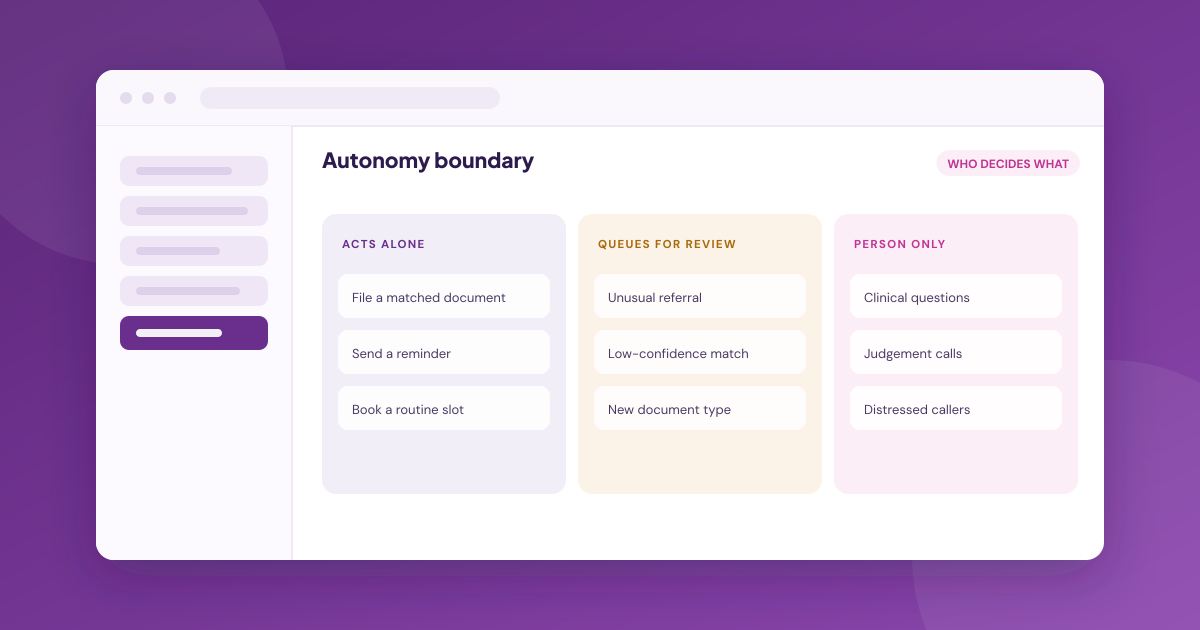
TL;DR
- Agentic means the system takes the action itself, filing a document or booking a slot, instead of drafting output for staff to carry out.
- Set the boundary at judgement rather than difficulty. A complex task with a stable rule automates safely, and a simple one needing context does not.
- California's AB 3030 requires a disclaimer on generative AI patient communications about clinical information, plus a route to a human.
- AB 3030 exempts communications reviewed and approved by a licensed human provider, which makes human-in-the-loop design a compliance position.
- Purely administrative messages may fall outside that rule, though disclosing anyway avoids arguing later over whether a message counted as clinical.
- Write scope, escalation and disclosure into the contract rather than the pilot plan.
Agentic artificial intelligence (AI) in healthcare administration means software that takes actions on the practice's behalf, such as filing a document or booking an appointment, rather than drafting output for a person to act on. Scope, escalation and disclosure are what make that safe.
What Makes a System Agentic Rather Than Assistive
The distinction is whether the system acts or suggests. An assistive tool extracts data from a fax and presents it for a staff member to file. An agentic one files it, and the record changes without anybody clicking.
That difference is the entire governance question. A suggestion that is wrong wastes a moment; an action that is wrong has to be found, undone and explained. Everything else in this guide follows from that asymmetry.
Most healthcare administrative products sit somewhere between the two, and the useful question for a buyer is which specific actions the system takes unsupervised. Ask for that list explicitly, because vendors describe capability more readily than autonomy.
Where the Scope Boundary Belongs
At judgement, not at difficulty. A task can be complex and still be safely automated if the decision rule is stable, and a task can be trivial and still need a person if the decision depends on context the system cannot see.
Matching a faxed referral to an existing patient is complex and repeatable, so it automates well. Deciding whether an unusual referral should be accepted is simple to state and depends on clinical and commercial context, so it does not.
Medsender draws the line in that place on its referral management page: "Anything unusual is flagged for your referral coordinator. Judgment calls stay with your team." That is the pattern to look for, and its absence in a vendor's own materials is informative.
What Disclosure Law Actually Requires
California was first to legislate specifically here. Assembly Bill 3030, effective 1 January 2025, requires health facilities, clinics and physician practices using generative AI to produce written or verbal patient communications about patient clinical information to include a disclaimer stating the communication was AI-generated, plus clear instructions for reaching a human.
The placement rules are specific. For letters, emails and similar messages the disclaimer appears prominently at the start. For continuous online interactions such as chat-based telehealth it is displayed throughout. For audio, it is given verbally at both the start and the end of the interaction.
There is a significant exemption. The requirement does not apply to AI-generated communications reviewed and approved by a licensed or certified human healthcare provider. That exemption is what makes a human-in-the-loop design a compliance position as well as a safety one.
What Falls Outside the Rule and Still Needs Care
AB 3030 is scoped to communications about patient clinical information. A call confirming opening hours, giving directions or capturing a refill request may sit outside it, and rules differ by state in any case, so treat this as a matter for your own counsel rather than a settled question.
A more conservative operational position is broader than the statute: tell patients when they are speaking to an automated system, and make reaching a person easy. That costs nothing, avoids the argument about whether a particular message was clinical, and is what patients say they want when asked.
The operational requirement underneath both is the same. There must be a route to a human that works, and the system must take it when it should. Medsender states that calls needing a live conversation are transferred right away, with a summary saved in the voice inbox.
Limits Worth Writing Into the Contract
Four, and they belong in the agreement, not in a pilot plan that nobody re-reads after go-live.
First, the list of actions the system may take without review, and who can change that list. Second, the escalation path and the expected time to reach a person. Third, whether patient data is used to train or evaluate models, in writing. Fourth, audit logging of automated actions at record level, exportable, with stated retention.
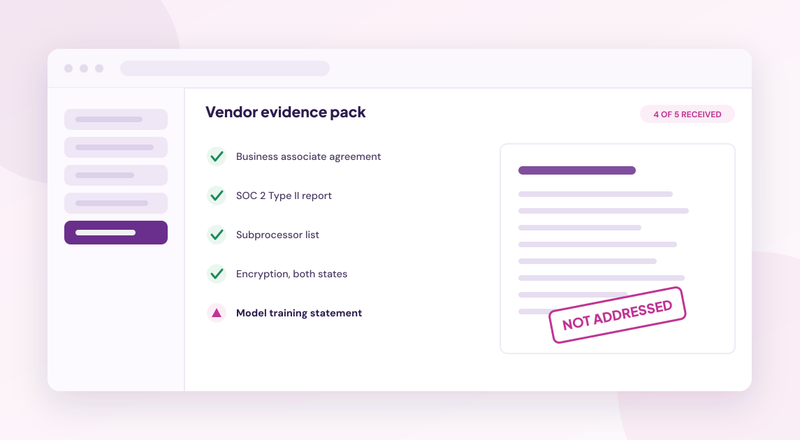
The third is the one most often absent from vendor security documentation, including from otherwise thorough pages, so silence should not be read as a denial.
How to Scope an Agentic Deployment
Start narrow and widen on evidence. Pick one document type or one call category, set the autonomy boundary deliberately rather than accepting a default, and review the exception queue weekly for the first month.
Widen only where the error rate and the exception volume are both known. A system given broad scope on day one produces a queue nobody has capacity to review, which is how automation becomes unsupervised by accident, not by decision.
Deciding Where Agentic AI Belongs in Your Practice
Agentic systems are worth deploying where the action is repetitive and the mistake is cheap to catch, and worth refusing where either half of that is untrue.
- Filing a recognised document type to a chart, placing a routine reminder call, creating a task from an inbound request. In each the action is bounded, and a wrong one is visible and reversible.
- Anything that changes a clinical record's meaning, commits the practice to a patient, or is hard to see once done belongs behind review, however reliable the system appears.
- Anything a patient could reasonably mistake for a clinician needs the disclosure handled deliberately, because that obligation sits with the practice and not the vendor.
Two things are consistent across this category. Vendors describe what their systems can do far more precisely than what those systems will not do, and the boundary is the part you are actually buying. And the exception queue is the true measure of a deployment. A narrow scope produces a queue somebody can work, and a broad one produces a queue that quietly stops being read, which is how oversight lapses without anyone deciding to drop it.
Choose one document type or one call category, set the boundary yourself, and widen only when you know the error rate and the exception volume. A practice that can name who reads the exception queue on a Friday afternoon is ready; one that cannot is buying supervision it has not staffed.
FAQs
What Does Agentic AI Mean in Healthcare Administration?
Software that takes actions on the practice's behalf rather than drafting output for staff to action. Filing a document to a chart or booking an appointment is agentic; extracting data and presenting it for review is assistive. Ask any vendor which specific actions its system takes without human review.
Do We Have to Tell Patients They Are Talking to AI?
In California, AB 3030 requires a disclaimer on generative AI communications about patient clinical information, with instructions for reaching a human. Rules differ by state, so check with your own counsel. Many practices disclose more broadly than required, which avoids arguing about whether a message was clinical.
Does Human Review Change the Disclosure Requirement?
Under AB 3030, yes. The requirement does not apply to AI-generated communications reviewed and approved by a licensed or certified human healthcare provider. That exemption is one reason a human-in-the-loop design is worth adopting as a compliance position and, not only as a safety measure.
Where Should the Automation Boundary Sit?
At judgement, not at difficulty. Complex but repeatable work with a stable decision rule automates safely; simple decisions that depend on context the system cannot see do not. Medsender states that anything unusual is flagged for the referral coordinator and judgment calls stay with the practice team.
What Should Be in the Contract?
Four things: the list of actions permitted without review and who may change it, the escalation path and expected time to reach a person, a written statement on whether your data trains or evaluates models, and record-level audit logging that is exportable with stated retention.
How Should We Scope a First Deployment?
Narrowly, and with a named reviewer before a start date. Pick the work where a wrong action is visible and reversible, agree in writing what the system may do without asking, and give one person protected time to read the exception queue. Practices that skip the reviewer widen scope on the assumption the queue is empty, which is the assumption the queue exists to test.

Zain Qayyum
Chief Executive Officer
Zain Qayyum is co-founder and co-CEO of Medsender. He started the company in 2015 and has spent the decade since on the front-office work that decides whether a referred patient is ever seen: inbound fax, referral backlogs, and phones nobody has time to answer. He argues that healthcare's hardest problems are operational rather than technical, and speaks and writes on where AI genuinely helps a practice and where it overpromises. He is based in New York.
Related Signals
How to Vet a Healthcare AI Vendor: BAA, Trust Center and Audit Trail
Zain QayyumTue, Sep 15, 2026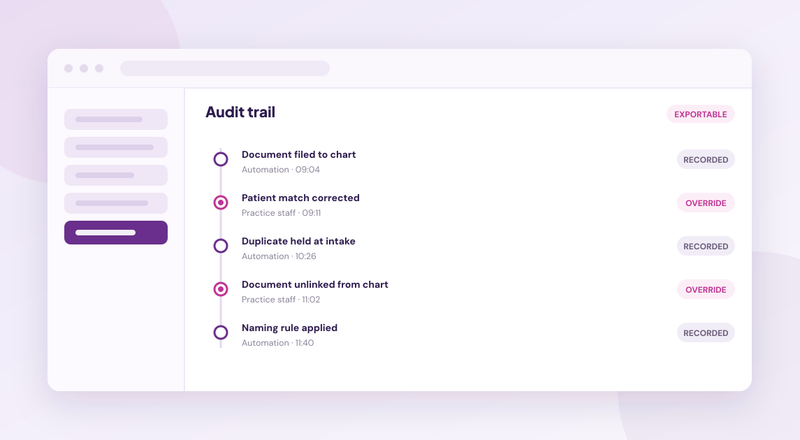
How to Verify and Override What Healthcare AI Does to a Patient Chart
Zain QayyumTue, Sep 8, 2026
Connecting Fax and Referral Software to Your EHR: What IT Actually Has to Do
Zain QayyumWed, Aug 26, 2026