
How to Verify and Override What Healthcare AI Does to a Patient Chart
 Zain QayyumLast Updated: Sep 29, 2026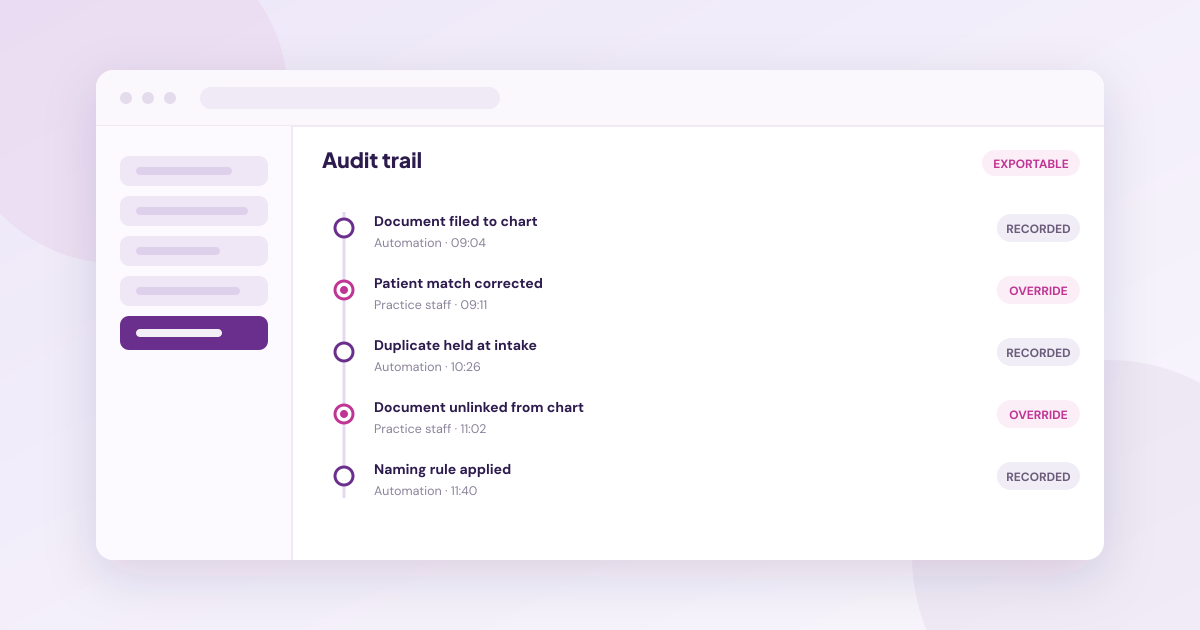
TL;DR
- Every automated action should be attributable in the audit log, same as a staff action.
- Keep the original document viewable beside whatever was extracted, so staff can check a name or a date without leaving the screen.
- Review before filing beats correcting afterwards, because some EHRs will not fully remove a document once it has been filed.
- Corrections should teach the system, not just fix one record, or staff stop trusting a queue that repeats the same mistake weekly.
- A confidence score tells you how certain the system is, not whether it is right, so it does not constitute a review process.
- A named person needs allocated hours for the exception queue, or automation drifts into being unsupervised by accident.
Verifying healthcare artificial intelligence (AI) means being able to see what it did, compare it against the source document, and change it. Overriding means a member of staff can correct or reject an action, with the correction recorded and ideally learned from.
How Do We See What the AI Actually Did?
Through an audit trail that records actions at record level rather than system level. It should show who or what accessed a record, when, and what changed as a result, and an automated action should appear with the same attribution a staff action carries.
Ask whether the log is exportable and what its retention period is. A trail visible only in a dashboard is of limited use to a compliance officer, and one with undocumented retention may not reach back as far as an investigation requires.
Medsender states that compliance controls are monitored in real time through Vanta rather than reviewed annually, and provides role-based user permissions, session timeouts on inactivity and centralised user management on its security page. Those access controls are what determine who could have made a change in the first place.
Can Staff See the Original Document?
Staff should see the original, side by side with whatever was extracted from it. That single control resolves most verification questions in seconds, because checking a name or a date against the source is faster than investigating why a field looks wrong.
The failure mode to ask about is what happens when a page cannot be read confidently. A page routed to a reviewer with its source alongside it is safe. A page filed with fields missing, or dropped without anybody being told, is not.
Confirm that the original is retained and viewable after filing instead of discarded once extraction completes. Verification is not only a day-one activity.
Where Should Review Happen, Before or After Filing?
Before, wherever the stakes justify it. Cleaning an incorrect document out of a chart is considerably harder than stopping it at the door, and in some EHRs a filed document cannot be fully removed at all.
A workable pattern is confidence-based routing: high-certainty actions proceed, uncertain ones queue for review. The judgement is where you set the threshold, and that is a clinical and operational decision and not a vendor default to accept unexamined.
Medsender describes the division explicitly on its referral management page: "Anything unusual is flagged for your referral coordinator. Judgment calls stay with your team."
How Does Somebody Override an Action?
Three capabilities are worth confirming separately, because vendors often have one and not the others. Can staff reject an item before it files? Can they correct a field and refile? Can they merge or unlink a document attached to the wrong patient?
The third is often missing and carries the highest stakes, because a document on the wrong chart is both a clinical risk and a privacy incident. Ask to see the workflow demonstrated, not described.
Ask also who can perform each action. Override rights usually belong with a defined role, not with everyone, and that mapping should exist before go-live instead of being worked out after the first mistake.
Does a Correction Teach the System Anything?
A correction should teach the system something. A system that repeats the same misclassification every week after being corrected is generating work not absorbing it, and staff stop trusting the queue.
Ask how corrections are incorporated, how long that takes, and whether it happens for your practice specifically or only in a general model update. The distinction matters, because the errors that annoy a practice most are usually local: a particular referring office's fax header, a document type peculiar to one specialty.
Who Owns the Exception Queue?
A named person, with time allocated. This is the control that fails quietly in real deployments: automation works, the exception queue grows, and nobody has been given the hours to work it.
Set an expectation for how quickly exceptions are cleared and review it monthly for the first quarter. If the queue is consistently longer than the reviewer's capacity, the threshold is set wrong, not the staffing.
What to Ask Before Go-Live
Five questions, answered by the vendor in writing. Is every automated action in the audit log with attribution? Is the original retained and viewable? Can items be rejected before filing? Can a misfiled document be unlinked? And are corrections incorporated, on what timescale?
Deciding Whether the Oversight Is Real
Every vendor will say a human stays in the loop. The difference between platforms is whether that loop is a feature somebody built or a sentence somebody wrote.
- Oversight is real when the audit log names who or what took each action, and staff can open the original document beside what was filed from it.
- It is real when a document can be stopped before it reaches the chart, and when one that reached it by mistake can be unlinked without a support ticket.
- It is real when a named person owns the exception queue and has protected time for it, which is the part no software supplies.
Two things separate vendors quickly here. Reviewing before filing and correcting after filing are described interchangeably in most marketing, and they are not the same control; one prevents the error, the other cleans it up. And almost every vendor says corrections improve the system, while very few will say on what timescale or whether the improvement reaches your instance or only the next release.
Ask to see the workflow demonstrated on a document the system gets wrong. A vendor who can show you that has built the oversight; a vendor who redirects to accuracy figures has described it.
FAQs
How Do We Check What Healthcare AI Wrote to a Chart?
Through a record-level audit trail showing what was accessed, when, and what changed, with automated actions attributed the same way staff actions are. Confirm the log is exportable and that its retention period is documented, since a dashboard view alone will not satisfy a compliance review after an incident.
Can Staff Override What the AI Filed?
Staff should be able to do three separate things: reject an item before it files, correct a field and refile it, and unlink a document attached to the wrong patient. The third is most often missing and matters most, since a misfiled document is both a clinical risk and a privacy incident.
Should Review Happen Before or After Filing?
Before, wherever stakes justify it, because removing a document from a chart is harder than stopping it at intake and some EHRs will not fully remove one. Confidence-based routing works well, but the threshold is an operational decision instead of a vendor default to accept unexamined.
Is a Confidence Score Enough?
No. A score tells you how certain the system is, not whether it is right, and it does not constitute a review process. What matters is what happens below the threshold: whether the item queues for a person, and whether that person has been given time to work the queue.
Do Corrections Stop the Same Mistake Recurring?
Corrections should stop a mistake recurring, and that is worth confirming rather than assuming. Ask how corrections are incorporated and on what timescale, and whether learning applies to your practice specifically or only to general model updates. Local errors, such as one referring office's fax header, are the ones that recur most.
Who Should Own the Exception Queue?
A named person with allocated hours, usually the referral coordinator or practice manager. This control fails quietly more than any other. The automation works, the queue grows, and nobody was given time to clear it. Review clearance rates monthly for the first quarter after go-live.

Zain Qayyum
Chief Executive Officer
Zain Qayyum is co-founder and co-CEO of Medsender. He started the company in 2015 and has spent the decade since on the front-office work that decides whether a referred patient is ever seen: inbound fax, referral backlogs, and phones nobody has time to answer. He argues that healthcare's hardest problems are operational rather than technical, and speaks and writes on where AI genuinely helps a practice and where it overpromises. He is based in New York.
Related Signals
How to Vet a Healthcare AI Vendor: BAA, Trust Center and Audit Trail
Zain QayyumTue, Sep 15, 2026
Connecting Fax and Referral Software to Your EHR: What IT Actually Has to Do
Zain QayyumWed, Aug 26, 2026
Agentic AI in Healthcare Administration: Scope, Limits and Disclosure
Zain QayyumThu, Aug 6, 2026