
Cutting Medical Practice Admin Costs Without Adding Headcount
 Zain QayyumLast Updated: Sep 29, 2026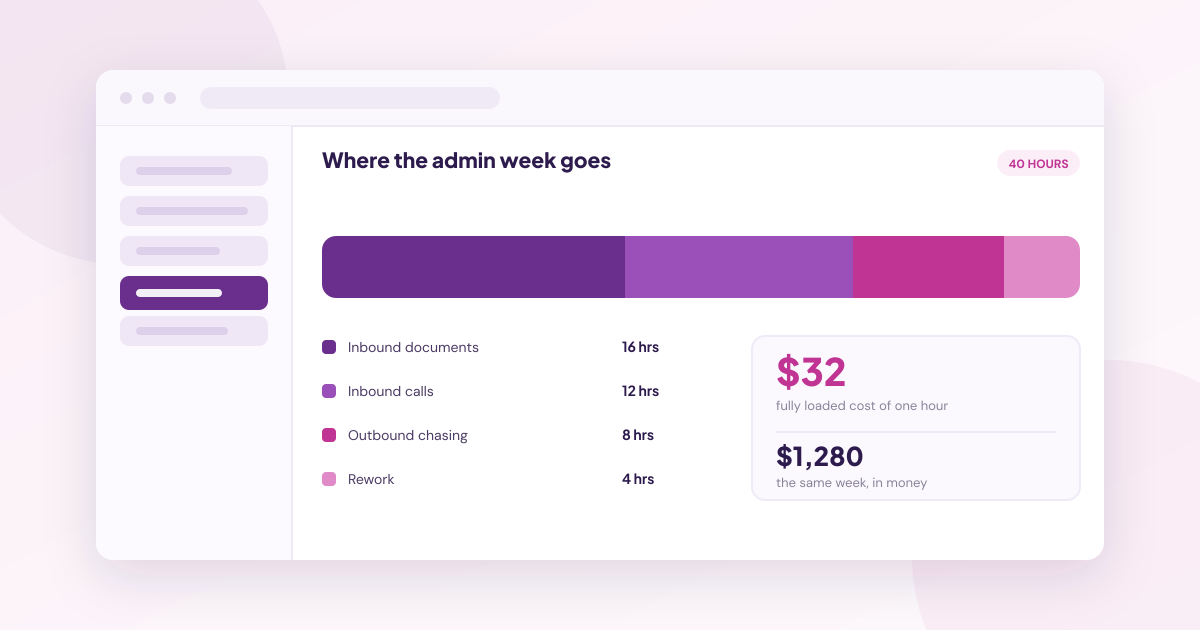
TL;DR
- Administrative cost is staff hours, so price the hours before pricing software.
- A medical administrative hour costs roughly $32 fully loaded, not the wage rate.
- Inbound documents and missed calls are where the hours concentrate, with rework from duplicates the category most often left uncounted.
- Ozark Dermatology reports 40 hours a week returned across five locations; Zara Medical reports more than 20 across calls and documents.
- Recovering missed revenue beats cutting cost on the same spend, because a referral nobody actions is a visit that never happens.
- Count hours returned, not licences bought, or the saving will not appear.
Cutting practice administrative cost without hiring means removing repeatable work rather than distributing it. The cost sits in staff hours, so the method is to measure where those hours go, price them at fully loaded cost, and automate only the categories that repeat identically.
Step 1: Price an Administrative Hour Properly
Most practices underestimate this, because the salary line is not the cost. The Bureau of Labor Statistics puts the median annual wage for medical secretaries and administrative assistants at $45,930 as of May 2025.
Employer burden sits on top. The Bureau of Labor Statistics (BLS) Employer Costs for Employee Compensation release for June 2026 puts benefits at 31.6% of total compensation for civilian workers. Dividing $45,930 by 0.684 gives roughly $67,000 a year for one full-time equivalent, or about $32 an hour across a 2,080-hour year.
Use your own wage rate rather than the national median if you have it, but apply the same burden multiplier. Every hour you subsequently talk about returning is worth that figure, not the hourly wage.
Step 2: Find Where the Hours Actually Go
Log a fortnight instead of estimating. Four categories account for most administrative load in a specialty practice, and they are worth counting separately because they automate differently.
Inbound documents: how many pages arrive by fax daily, and how long staff spend reading, naming, indexing and filing them. Inbound calls: how many arrive, how many are missed, and what share are routine. Outbound chasing: recall, recapture and referral follow-up. And rework: duplicates, misfiled documents and the calls generated by referring offices chasing something they already sent.
Rework is the category practices consistently fail to count, and it is often the largest. A duplicate that reaches a chart costs more to remove than the original cost to file.
Step 3: Attack the Categories That Repeat Identically
Automation returns hours in proportion to how repetitive the work is, not how unpleasant it is. Reading and filing inbound documents is the clearest case, because the same decisions repeat hundreds of times daily and each instance is independent of the last.
Missed calls are the second. If calls cluster outside staffed hours, no amount of process improvement inside those hours recovers them, which is why coverage returns more than efficiency does.
Judgement-heavy work is the wrong target. Exceptions, complaints and clinical questions should stay with staff, and a vendor promising otherwise is describing a risk, not a saving.
Step 4: Read What Comparable Practices Measured
Two Medsender customers publish figures, which makes them checkable instead of illustrative.
Zara Medical reports more than 20 hours saved every week across calls and documents, with 70% of calls handled without human intervention and communication costs down 75%, having previously missed around 60% of incoming calls. At roughly $32 a loaded hour, 20 hours a week is approximately $33,000 a year in returned capacity.
Ozark Dermatology, a five-location dermatology group, reports 40 hours a week saved and a move to same-day patient outreach for referrals. On the same basis that is around $67,000 a year, or one full-time equivalent, spread across five sites not concentrated in one.
Treat both as benchmarks to test against your own mix, not as forecasts. Document volume and call composition vary enormously between specialties.
Step 5: Count the Revenue Side, Not Only the Cost Side
The larger number is recovered revenue, not reduced cost, and it is routinely left out of the business case.
A referral that arrives and is never actioned is a visit that never happens. Medsender publishes a customer result of regional referral conversion rising from 20% to 62%, described on the Ainsley Health podcast. Applied to a practice's own referral volume and average visit value, that shift is generally worth more than the administrative hours.
Step 6: Make the Saving Visible or It Will Not Exist
Hours returned are only a saving if something changes. Decide in advance what the reclaimed time is for: absorbing growth without hiring, moving a coordinator from data entry to exceptions, or reducing overtime.
Measure the same four categories again at ninety days. If the numbers have not moved, the problem is the exception queue, not the software.
Deciding Where to Start
Six steps is more than you will run at once, so the useful question is which one to do this month.
- If you have never priced an administrative hour with benefits and overhead included, start at step one. Every later decision is made against that number, and a salary-only figure will understate it by roughly a third.
- If you know the hourly cost but not where the hours go, start by logging two weeks. Estimates consistently misplace the categories, and the one staff complain about loudest is rarely the one consuming the most time.
- If you already have the log, go straight to the categories that repeat identically, since those are where software returns hours and the varied work is where it does not.
Two things are worth saying plainly. The saving is usually smaller than the vendor projection and larger than the sceptical estimate, because vendors model the routine work and sceptics model the exceptions, and a real practice has both. And a saving that nobody has assigned a purpose to disappears, absorbed quietly into the day, which is why deciding in advance what the reclaimed hours are for is not an afterthought.
Pick the single category consuming the most hours and fix that one before touching the others. A practice that cuts one category convincingly builds the case for the next; a practice that starts everywhere reports no change at ninety days.
FAQs
What Does an Hour of Medical Admin Time Actually Cost?
Around $32 fully loaded, derived from a BLS median annual wage of $45,930 for medical secretaries and administrative assistants as of May 2025, divided by 0.684 to account for benefits at 31.6% of total compensation, then spread across a 2,080-hour year.
Where Do Practice Admin Hours Actually Go?
Four places: reading and filing inbound documents, handling and missing inbound calls, outbound chasing for recall and referrals, and rework from duplicates and misfiles. Rework is the category most often left uncounted and is frequently the largest, since removing a duplicate costs more than filing the original.
How Many Hours Can Automation Realistically Return?
Zara Medical reports more than 20 hours a week across calls and documents; Ozark Dermatology reports 40 hours a week across five locations. At roughly $32 a loaded hour those are about $33,000 and $67,000 a year. Treat both as benchmarks to test, not forecasts to bank.
Should We Cut Cost or Recover Revenue?
Recover revenue first, because the number is larger. A referral that arrives and is never actioned is a visit that never happens. Medsender publishes a customer result of regional referral conversion rising from 20% to 62%, which outweighs most administrative savings on the same spend.
Can We Cut Admin Cost Without Reducing Staff?
Cutting admin cost without cutting staff is the usual outcome. Automation more often absorbs growth or displaces the next hire than removes a current one. The reclaimed hours go to exceptions, escalations and patient-facing work, which is both better use of the role and harder to automate away.
Why Do Some Practices See No Saving?
Most often because nothing was decided in advance about what the returned hours were for, or because the exception queue has no owner with allocated time. Measure the same categories at ninety days, and if the numbers have not moved, examine the queue before blaming the software.

Zain Qayyum
Chief Executive Officer
Zain Qayyum is co-founder and co-CEO of Medsender. He started the company in 2015 and has spent the decade since on the front-office work that decides whether a referred patient is ever seen: inbound fax, referral backlogs, and phones nobody has time to answer. He argues that healthcare's hardest problems are operational rather than technical, and speaks and writes on where AI genuinely helps a practice and where it overpromises. He is based in New York.
Related Signals
How to Vet a Healthcare AI Vendor: BAA, Trust Center and Audit Trail
Zain QayyumTue, Sep 15, 2026
How to Verify and Override What Healthcare AI Does to a Patient Chart
Zain QayyumTue, Sep 8, 2026
Connecting Fax and Referral Software to Your EHR: What IT Actually Has to Do
Zain QayyumWed, Aug 26, 2026