
AI Voice Agent or Patient Portal: Where Refill Requests Should Land
 Zain QayyumLast Updated: Oct 27, 2026
TL;DR
- Refills arrive by phone because the phone is what patients reach for, not because the portal failed. Both channels will carry refills for the foreseeable future.
- The decision is not which channel wins. It is which channel is the front door, and what the other one does with what it receives.
- A voice agent is good at capture and triage. It is not the place to approve anything, and approval is where the clinical line sits.
- The portal produces better structured requests and reaches a smaller share of your panel. Those two facts trade off directly.
- The handover is the whole design. A refill that arrives in two formats, into two queues, with two owners, is worse than either channel alone.
- Measure how many refills still reach a human and what they have in common. That is the list of what to build next.
Why Refills End Up on the Phone
Refill requests are high volume, low complexity and time-sensitive from the patient's point of view, which is the exact profile of work that lands on the phone regardless of what else is available.
Three reasons the portal does not absorb them, and only one is a technology problem.
Enrollment. Portal adoption is uneven across a panel and skews by age, by language and by how recently the patient was onboarded. A practice with strong portal numbers overall can still have whole cohorts who have never logged in, and those cohorts call.
Urgency perception. A patient who has run out of a medication does not experience that as an administrative task. The phone feels faster and in their experience often is, because a message in a portal queue has no visible response time.
Habit. The number is on the bottle, on the discharge paper and in their contacts. The portal is a password they have forgotten.
The operational consequence is that refills are an interrupt load on the front office. They arrive during clinic hours, they are individually quick, and collectively they are one of the largest categories of call volume in most primary care and chronic-care practices. That is what makes them a candidate for automation and also what makes a bad automation painful.
Worth noting the thing buyers in this market consistently ask about first. It is not how the model works. It is what their staff will be doing differently on Tuesday. For refills that question has a precise answer, and it is the right place to start the evaluation.
What a Voice Agent Can Take, and What It Must Hand Over
A voice agent is well suited to the front half of a refill and unsuited to the back half.
The front half is capture and triage. Identifying the patient, establishing which medication, confirming the pharmacy, noting whether this is a routine continuation or something has changed, and getting all of that into a structured record rather than a voicemail. That is genuine work, it is currently done by a person, and it is repetitive enough to automate without controversy.
The back half is the decision. Whether this refill should be issued, whether the patient is due for review, whether the prescription is controlled, whether something in the chart means this needs a clinician's eye. None of that belongs to an automated system, and a deployment that blurs it is making a scope error rather than a technology error.
Four things to confirm specifically before deploying, because they are where implementations go wrong.
How the request reaches the chart. If the system writes a structured request rather than a transcript, the clinical review is faster and the record is cleaner. Chart creation and write-back happen if your EHR supports them, so this is a question about your specific integration rather than about the product in general.
What happens with controlled substances. These should be routed out, not handled, and the rule should be explicit in configuration rather than implied.
What happens when identification fails. A patient the system cannot verify must reach a person, quickly, without having to repeat everything.
What happens when the patient says something unexpected. A refill call that turns into a symptom report is the case that matters most, and the system needs a defined behavior for it rather than a best effort.
What the Portal Does Better
The portal's advantages are structural and they are not about patient preference.
The request arrives already structured. The patient selects a medication from their own list rather than describing it, which removes the single largest source of error in a phoned refill. Nobody mishears a drug name that was selected from a list.
It is asynchronous, so it does not consume staff attention at the moment it arrives. A queue of thirty portal refills can be worked in one block. Thirty phone calls cannot.
It carries an audit trail by default. Who requested, when, what was asked, what was sent back.
And it is free at the margin. There is no per-call or per-minute cost.
The limitations are equally structural. It reaches only enrolled and active patients. It has no urgency signal, so a patient who needs something today looks identical to one who does not. And it generates its own failure mode, the unanswered portal message, which produces a phone call anyway and a patient who is now annoyed.
The practices that get the most out of the portal for refills do one unglamorous thing: they publish a response time and meet it. A patient who knows a portal refill is handled within one business day stops calling to check.
The Handover Point, and Who Owns the Exception
This is where the design is won or lost, and it is independent of which channel you favor.
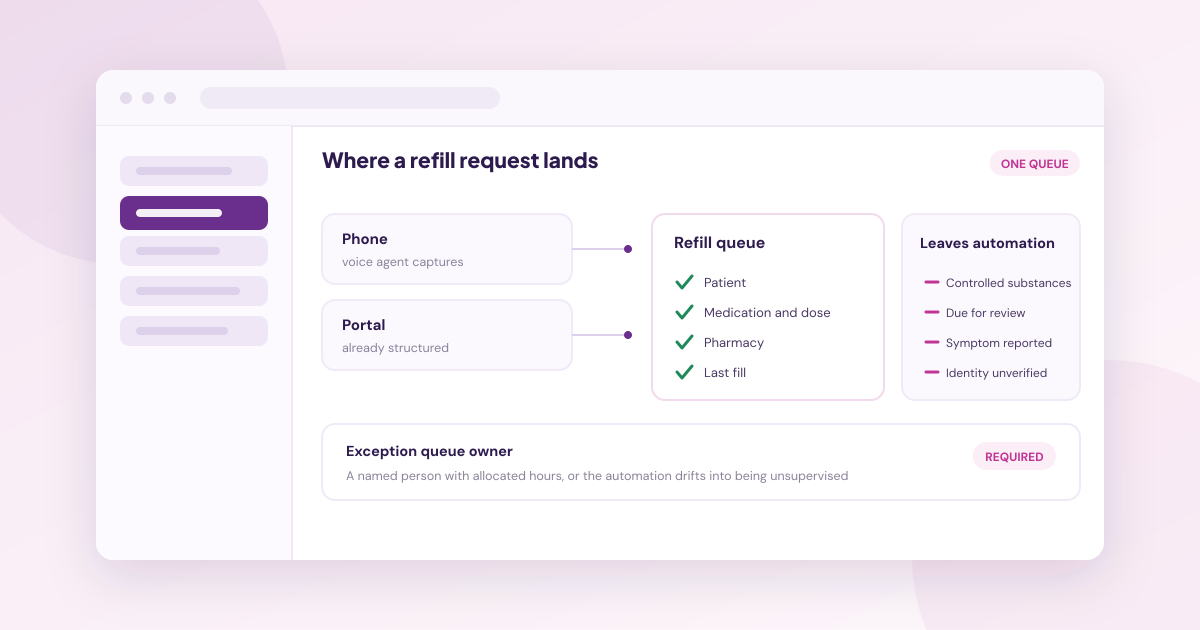
Decide on one queue. Whatever the channel of origin, refill requests should converge into a single place that one role works. Two queues produce duplicates, because a patient who messages and then calls has created two requests, and nobody notices until the pharmacy does.
Decide what a request must contain to be workable, and make both channels produce it. Patient, medication, dose, pharmacy, last fill where available, and a flag for anything unusual. A voice agent that captures four of those six is handing the front office a partial record and the gap will be filled by a callback.
Name the owner of the exception queue, with allocated hours. Anything the automation could not complete lands somewhere, and automation drifts into being unsupervised by accident when that somewhere has no name attached to it.
Decide the escalation path and test it with real calls. The patient who reports a symptom mid-refill is the case that justifies the whole design, and it should be exercised before launch rather than discovered in production.
Deciding Where Refills Should Land in Your Practice
Work through four questions in order. The answers point clearly in most practices.
What share of your panel uses the portal actively. Not enrolled. Logged in within the last quarter. If that number is high and your refill call volume is still significant, the problem is probably response time rather than channel, and the fix is operational rather than a purchase.
What is the refill share of your call volume. If refills are a small fraction of calls, a voice agent justified on refills alone is unlikely to pay for itself, though it may still be justified on the whole call mix.
What does your EHR support. Whether a structured refill request can be written back, and under what conditions, decides how much of the benefit you can actually realize. This is worth establishing before an evaluation rather than during one.
Who will own the exception queue. If the answer is nobody, or everybody, stop here. That role has to exist before any automation is deployed, because it is the thing that keeps the automation honest.
The pattern most practices land on: the voice agent is the front door for phoned refills, because that is where the volume and the interrupt cost are. The portal stays open, promoted and answered to a published response time. Both feed one queue, one role works it, and anything clinical or controlled leaves the automation entirely. Then watch what still reaches a human, and build the next thing from that list rather than from a roadmap.
FAQs
Why Do Refill Requests Keep Coming by Phone?
Three reasons, and only one is a technology problem. Portal adoption is uneven across a panel and skews by age and language, so whole cohorts have never logged in. A patient who has run out of a medication experiences it as urgent rather than administrative, and the phone feels faster. And the number is on the bottle while the portal is a password they have forgotten.
What Can a Voice Agent Safely Handle?
The front half. Identifying the patient, establishing which medication, confirming the pharmacy, noting whether anything has changed, and getting that into a structured record rather than a voicemail. The back half is the decision about whether the refill should be issued, and that belongs with a clinician. A deployment that blurs the two is making a scope error rather than a technology error.
What Should Never Reach the Automation?
Controlled substances should be routed out rather than handled, and the rule should be explicit in configuration rather than implied. So should any patient the system cannot verify, and any call where the patient reports a symptom. That last case is the one that justifies the whole design and it should be tested with real calls before launch.
Is the Portal Better for Refills?
For the requests it receives, yes. The patient selects a medication from their own list rather than describing it, which removes the largest source of error in a phoned refill. It is asynchronous so a queue of thirty can be worked in one block, it carries an audit trail by default, and it is free at the margin. It only reaches enrolled and active patients, and it has no urgency signal.
Should Both Channels Feed One Queue?
Yes. Whatever the channel of origin, refill requests should converge into a single place that one role works, because two queues produce duplicates when a patient messages and then calls. Define what a request must contain to be workable, make both channels produce it, and name the owner of the exception queue with allocated hours.

Zain Qayyum
Co-Founder and Co-CEO
Zain Qayyum is co-founder and co-CEO of Medsender. His work centres on the front-office problems that decide whether a referred patient is ever seen: inbound fax, referral backlogs, and phones nobody has time to answer. He argues that healthcare's hardest problems are operational rather than technical, and speaks and writes on where AI genuinely helps a practice and where it overpromises. He is based in New York.
Related Signals
Patient Reactivation or New Patient Marketing: Which Costs Less per Visit
Zain QayyumWed, Sep 30, 2026
Texting or Emailing Patients to Rebook: Which Gets the Appointment
Zain QayyumTue, Sep 29, 2026
Your EHR's Fax Module or Dedicated Fax Software: How Practices Decide
Zain QayyumFri, Sep 25, 2026