
Patient Reactivation or New Patient Marketing: Which Costs Less per Visit
 Zain QayyumLast Updated: Oct 27, 2026
TL;DR
- Reactivation is almost always cheaper per visit. The patient is already in your chart, already has a record, and has already chosen you once.
- The reason practices still buy new-patient marketing is that reactivation has a ceiling and acquisition does not. They answer different questions.
- Compare them on cost per kept visit, not cost per lead and not cost per message. Those two favor whichever channel is cheapest to operate rather than whichever works.
- Reactivation stops working when the list runs out, when the lapse reason was dissatisfaction, or when the schedule has no room.
- The right split is usually reactivation first until the list is worked, then acquisition for growth beyond it.
- Most practices have never measured either properly, which makes the first honest calculation more valuable than the decision it informs.
What a New Patient Actually Costs to Acquire
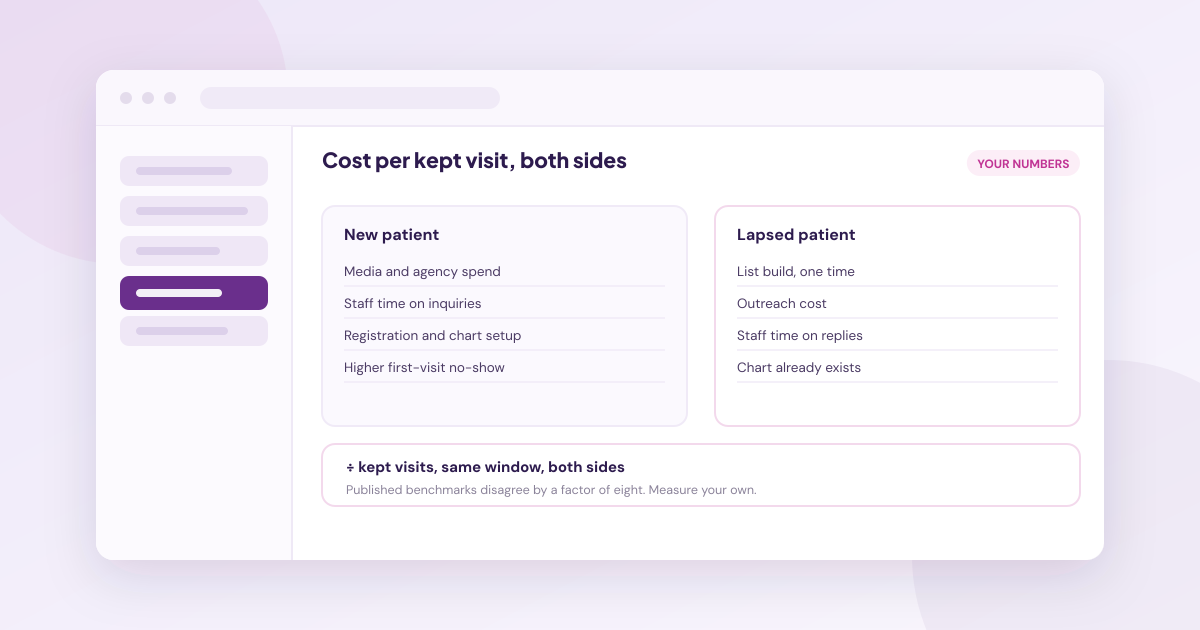
Acquisition cost is the total spend on getting new patients divided by the number who arrive and are seen. It is a simple formula and it is almost never calculated honestly, because most practices leave things out.
Four items that belong in it and are usually missing.
Agency or platform fees, not just the ad spend. The management layer is frequently half the cost.
Staff time handling inquiries. A new patient inquiry takes longer than a rebooking, because there is registration, insurance verification and chart creation involved.
The no-show differential. New patients fail to attend at a higher rate than established ones in most practices. If you count the booking rather than the kept visit, you are overstating the yield of acquisition specifically.
Everything that is not paid media. Referral relationships, directory listings, the website, the time the practice spends on community presence. These produce patients and they cost money, and excluding them makes paid channels look worse than they are relative to the real mix.
The useful output is a single number: what does it cost this practice to get one new patient into a chair. Most practices who calculate it properly find it is higher than they assumed, and the gap is usually the staff time and the no-show differential.
A note on published benchmarks, because you will be offered them. Acquisition cost figures circulate widely for this market and they do not survive inspection. Searching the current material returns primary care ranges of $50 to $150, $100 to $280 and $150 to $400 from three different sources describing the same metric, with specialty figures spread from roughly $155 to $1,000. Almost all of it is published by marketing agencies, none of it is peer reviewed, and several pages appear to recycle one underlying dataset.
That spread is wider than the decision you are trying to make, which makes the benchmarks useless as a planning input. They are not a substitute for four weeks of your own data, and a number taken from one of them will be quoted back at you in a partners' meeting as though it were measured.
Calculate your own. The formula is in the preceding paragraphs and the inputs are all in systems you already have.
What a Lapsed Patient Costs to Bring Back
The cost structure is different in kind, not just in size.
There is no acquisition spend. There is the cost of building and maintaining the list, the cost of the outreach itself, and the staff time to handle replies. For a practice already running recall software, the marginal cost of a reactivation campaign is close to the outreach cost alone.
The patient also arrives cheaper to serve. The chart exists, the history is there, insurance is on file even if it needs re-verifying, and registration is a confirmation rather than a creation. That is real front-office time that does not appear in a marketing budget and does appear in capacity.
Three costs that are genuinely attributable and get forgotten.
Building the list the first time. This is a real project in most practices, measured in days rather than hours, and it is a one-time cost that should be amortized rather than charged against the first campaign.
List maintenance. A list that is not rebuilt regularly decays, and the decay produces the complaint that patients are being contacted about appointments they already have.
Handling replies. Outreach that generates responses into an unowned inbox has moved work rather than removed it.
The number to produce is the same shape as the acquisition one: what does it cost to get one lapsed patient back into a chair, counting the kept visit.
Putting Both on a Cost per Completed Visit Basis
The comparison only works if both sides are measured the same way, and the two places it usually breaks are the denominator and the window.
Use kept visits on both sides. Not leads, not bookings, not responses. A channel that books well and shows poorly is a channel that looks good on the wrong metric, and new-patient acquisition and reactivation differ exactly here.
Use the same window on both sides. Reactivation produces a burst and then declines as the list is worked. Acquisition produces a steadier flow. Measuring reactivation over its first month against acquisition over a year flatters reactivation, and measuring annual reactivation against a single acquisition campaign does the reverse.
Count the second visit separately. A reactivated patient who returns to a normal recall cycle is worth more than one visit, and a new patient who attends once and disappears is worth less than their acquisition cost suggests. If you can only measure one thing, measure whether they came back.
Pricing structures differ between the two and that affects the comparison directly. Some recall and reactivation vendors price per completed visit rather than per message, which moves the risk and changes the arithmetic. The pricing units used across practice automation, and how to read each one, have their own guide.
Where Reactivation Stops Working
Reactivation has a ceiling and three failure modes, and the ceiling is the important one.
The ceiling is the list. A practice with four thousand lapsed patients can reactivate from that pool once, properly, and after that the pool refills only as fast as patients lapse. Reactivation is therefore a one-time recovery plus an ongoing trickle, and a practice that needs sustained growth cannot get it from the back catalog alone. This is the structural reason acquisition does not go away no matter how good the recall program is.
The first failure mode is the lapse reason. Patients who stopped coming because of a bad experience, a billing dispute or a move are not going to respond to a reminder, and contacting them can make things worse. If a meaningful share of lapses are dissatisfaction-driven, the fix is not outreach.
The second is capacity. Reactivation is the fastest way to fill a schedule, which means it is also the fastest way to overfill one. A campaign that books three hundred patients into a practice with room for forty converts a marketing success into a service failure and an access complaint.
The third is interval error. If the recall interval is wrong, reactivation contacts people who are not actually due, and the response rate collapses in a way that looks like channel failure. The list has to be right before the comparison means anything, and building it correctly is its own problem.
Deciding the Split With Your Own Numbers
Three questions, in order, and the answers are specific to the practice.
How many genuinely reachable lapsed patients do you have. Not the raw count. The count after removing transfers, deceased patients, those already booked elsewhere in the practice, and those who asked not to be contacted. In most practices this is substantially smaller than the first number and it is the only one worth planning against.
What is your capacity over the next quarter. This caps the whole exercise. If there is room for sixty additional visits a month, a campaign sized for four hundred is a plan to disappoint people.
What is your cost per kept visit on each side. Run both for one quarter, measured identically, before committing a budget. The first honest calculation is usually worth more than the decision it informs, because most practices discover their acquisition cost is higher and their reactivation yield is better than either was assumed to be.
The common landing point: work the reactivation list first, because it is cheaper and the patients are already yours, and keep acquisition running at whatever level sustains growth once the list is exhausted. Treat them as sequential rather than competing, and revisit the split when the list has been worked rather than on a calendar.
FAQs
Is Reactivation Cheaper Than New Patient Marketing?
Almost always, per kept visit. There is no acquisition spend, the chart already exists, insurance is on file, and registration is a confirmation rather than a creation. That is real front-office time that never appears in a marketing budget. The reason acquisition does not go away is that reactivation has a ceiling and acquisition does not.
How Should the Two Be Compared?
On cost per kept visit, measured the same way on both sides and over the same window. Use kept visits rather than leads or bookings, because the two diverge most in exactly the cohorts recall targets. Reactivation produces a burst and then declines as the list is worked, so measuring its first month against a year of acquisition flatters it.
Can We Use Published Acquisition Cost Benchmarks?
Not usefully. Current published figures give primary care ranges of $50 to $150, $100 to $280 and $150 to $400 from three different sources describing the same metric, with specialty figures spread from roughly $155 to $1,000. Almost all of it is agency-published, none peer reviewed, and several pages recycle one dataset. That spread is wider than the decision.
When Does Reactivation Stop Working?
Three failure modes and one ceiling. The ceiling is the list, which refills only as fast as patients lapse. Patients who left because of a bad experience or a billing dispute will not respond to a reminder. Capacity caps the whole exercise, since a campaign that books three hundred patients into room for forty creates a different problem. And if the recall interval is wrong, response rate collapses in a way that looks like channel failure.
What Is the Right Split Between the Two?
Usually sequential rather than competing. Work the reactivation list first because it is cheaper and the patients are already yours, then keep acquisition running at whatever level sustains growth once the list is exhausted. Revisit the split when the list has been worked rather than on a calendar.

Zain Qayyum
Co-Founder and Co-CEO
Zain Qayyum is co-founder and co-CEO of Medsender. His work centres on the front-office problems that decide whether a referred patient is ever seen: inbound fax, referral backlogs, and phones nobody has time to answer. He argues that healthcare's hardest problems are operational rather than technical, and speaks and writes on where AI genuinely helps a practice and where it overpromises. He is based in New York.
Related Signals
AI Voice Agent or Patient Portal: Where Refill Requests Should Land
Zain QayyumThu, Oct 1, 2026
Texting or Emailing Patients to Rebook: Which Gets the Appointment
Zain QayyumTue, Sep 29, 2026
Your EHR's Fax Module or Dedicated Fax Software: How Practices Decide
Zain QayyumFri, Sep 25, 2026