
Texting or Emailing Patients to Rebook: Which Gets the Appointment
 Zain QayyumLast Updated: Oct 27, 2026
TL;DR
- Text wins on speed. Email wins on length and on anything the patient needs to keep. No controlled study has compared the two for healthcare response, so treat any published head-to-head figure as vendor data.
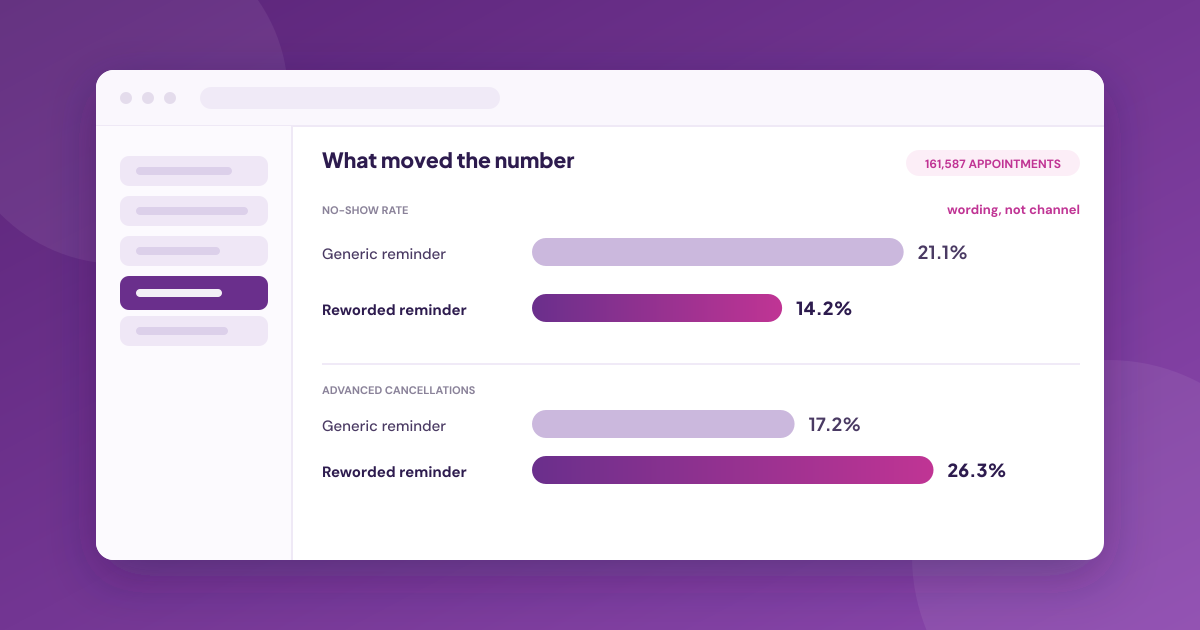
- What you say moves the number more than which channel you say it in. A randomized study of 161,587 appointments cut no-shows from 21.1% to 14.2% by changing the wording alone.
- Text carries a consent and timing obligation that email largely does not. That obligation sits with the practice, not with the software.
- Most practices should run both, with text as the first touch for time-sensitive slots and email as the follow-up that carries the detail.
- If neither channel is converting, the channel is not the problem. Check the list, the offer and whether there is room on the schedule.
- Measure by cohort, not in aggregate. A recently lapsed patient and a two-year-lapsed patient behave differently enough that a blended number tells you nothing.
What Each Channel Is Actually Good At
Text is an interrupt. It arrives, it is seen within minutes, and it is read in full because it is short. That makes it the right instrument when the window is short, which is exactly the case for a slot that opened this morning or a recall that is already overdue.
The constraints that come with it are real. You have very little room, so a text can carry one idea and one action. It is a poor container for anything the patient needs to refer back to later, because it will be buried under other messages by the afternoon. And it is intrusive by design, which is the source of its power and of its risk.
Email is a container. It holds preparation instructions, a map, an insurance note, a link to a portal, and the reason the appointment matters. It is cheap to send at volume and it costs the patient nothing to ignore, which is both its weakness and the reason it generates very few complaints.
The failure mode is latency. An email about a slot that opens at two o'clock is a message the patient reads at six. For time-bound outreach that is not a lower conversion rate, it is a structurally wrong instrument.
There is also a reachability difference worth checking against your own panel rather than assuming. Mobile numbers go stale more slowly than email addresses in most practices, but the reverse is true in some, and a five-minute query against your own data settles it better than any benchmark.
What the Published Evidence Actually Shows
Start with the uncomfortable part. There is no controlled study comparing text against email for healthcare appointment response. The channel comparison that this article's title asks about has not been run.
What has been established is worth more than the comparison would have been.
Reminders work, and the effect is real but modest. The Cochrane review of text message reminders for healthcare appointments (Gurol-Urganci and colleagues, CD007458.pub3, 2013) pooled four randomized trials covering 3,547 participants. Text reminders increased attendance against no reminders, with a risk ratio of 1.10 and a confidence interval of 1.03 to 1.17. The authors rated the evidence low to moderate quality and the included studies heterogeneous.
Text performs about the same as a phone call, for much less money. The same review found texts and phone call reminders had a similar impact across three studies and 2,509 participants, risk ratio 0.99 with a confidence interval of 0.95 to 1.02. Two of the included studies put the cost per attended appointment for texts at 55% and 65% below the phone call equivalent. That is the strongest cost argument in this area and it concerns text against phone, not against email.
What you say moves the number more than which channel you say it in. The largest study in this area randomized the wording of the message rather than the medium. Berliner Senderey and colleagues, publishing in PLoS One in 2020, tested nine message frames against the routine generic reminder across 161,587 outpatient appointments at 14 hospitals. The generic control produced a 21.1% no-show rate. The best performing frame brought it to 14.2%.
That is a seven point swing from changing the sentence, which is larger than any channel difference anyone has credibly claimed.
The same study carries a warning that the vendor literature never mentions. The frames that reduced no-shows also raised advanced cancellations, from 17.2% in the control to 26.3% for the best performing variant. Patients who were going to fail to attend instead told the practice in advance. For a practice that can backfill the slot that is a clear win. For one that cannot, it converts a no-show into an empty appointment with more notice and no revenue.
What this means for the channel question. Choose the channel on the operational grounds in the preceding section, which are not in dispute: text is an interrupt suited to short windows, email is a container suited to detail. Then spend your attention on the message, because that is where the measurable effect sits.
Treat every vendor-published open rate and reply rate in this category with suspicion. The figures in circulation come from vendors measuring their own platforms, with the selection effects that implies, and several of the most widely cited comparisons are published by companies that appear in them.
Capture three numbers from your own first campaign, per channel, and replace the benchmarks with them within one cycle.
Reply or click rate, which tells you the message landed.
Booking rate from those replies, which tells you the offer and the availability were right.
Cost per kept appointment, which is the only figure that compares the two channels honestly.
Cost per Rebooked Appointment, Not Cost per Message
Comparing channels on send cost makes email look unbeatable and is close to meaningless.
The calculation that matters has four inputs. The cost of sending to the cohort, the number of replies, the number of those replies that became a kept appointment, and the value of that appointment. Divide the first by the third and you have the number that lets you decide.
Two things tend to surprise practices doing this for the first time.
Text usually wins even at several times the per-message cost, because the conversion difference is larger than the cost difference. The arithmetic only reverses at large volumes against a cold list, which is a reactivation scenario rather than a recall one.
Staff time is frequently the largest line and is almost always omitted. If replies arrive as a text thread that somebody has to read and act on, that is a cost. A campaign that generates two hundred replies into an inbox nobody owns has not saved anything, it has moved the work.
Count the kept appointment rather than the booked one. The two diverge most in exactly the cohorts recall targets, and a channel that books well and shows poorly is a channel that is reaching people who are agreeing to get you off the phone.
When the Channel Is Not the Problem
If both channels underperform, three things are more likely than the channel being wrong.
The list. If the list includes patients who have left, patients already booked elsewhere in the practice, or patients who never belonged on the recall cycle, then response rate is being measured against a denominator that should be smaller. Building the list correctly is a separate problem and it is covered elsewhere in this library.
The offer. "You are due for an appointment" asks the patient to do the work of finding a time. A message that names two specific slots converts better than one that names none, and that is a configuration and availability question rather than a channel question.
The schedule. Outreach that works and arrives at a schedule with no room produces a frustrated patient and a wasted send. Confirm there is capacity to absorb the response before launching, not after.
A fourth, less common but worth ruling out: whether the messages are arriving at all. Carrier filtering of high-volume text traffic is real, and a campaign with an unusually low reply rate and no complaints is a plausible delivery failure rather than a patient-behavior finding.
Deciding Your Default Channel and Your Fallback
For most practices the useful default is text first, email second, and the split determined by urgency rather than by preference.
Time-bound outreach goes to text. A same-day cancellation, a slot that opened this week, an overdue recall with a clinical interval attached. The window is short and the instrument has to match it.
Everything the patient needs to keep goes to email. Preparation instructions, anything with a form attached, anything they will want to find again next Tuesday.
Sequenced outreach uses both, with text as the opener and email as the detail that follows a reply. This is where most practices land, and the thing that makes it work is that the two messages agree with each other.
Before any of it, three things have to be in place on your side, and they are the practice's responsibility rather than the software's.
Consent to contact by text, recorded, with a date, and tied to the number you are sending to. Automated texts to patients sit under telephone consumer protection rules as well as HIPAA, and those are separate regimes with separate requirements.
A working opt-out that is honored across every system that might send to that patient, not just the one that sent the last message.
Sending hours that you have decided deliberately. Quiet-hours expectations apply, and a recall text at nine in the evening is both a compliance question and the fastest way to generate the complaint that ends the program.
No vendor relieves you of those three. Confirm what any platform you are evaluating documents about consent capture, opt-out propagation and send windows, and treat anything undocumented as something you have to operate yourself.
FAQs
Does Text or Email Get More Patients Rebooked?
No controlled study has compared the two for healthcare appointment response, so any published head-to-head figure is vendor data rather than evidence. What is established is that reminders work, that text performs about the same as a phone call for far less money, and that what you say moves the number further than which channel you say it in.
What Does the Published Evidence Actually Show?
The Cochrane review of text message reminders pooled four randomized trials covering 3,547 participants and found attendance increased against no reminders, with a risk ratio of 1.10. The same review found texts and phone calls had a similar effect across three studies, with cost per attended appointment 55% and 65% below the phone equivalent.
Does the Wording of the Reminder Matter?
More than the channel. A randomized study of 161,587 outpatient appointments across 14 hospitals tested nine message frames against a routine generic reminder. The generic control produced a 21.1% no-show rate and the best performing frame brought it to 14.2%, a seven point swing from changing the sentence.
Is There a Downside to a More Effective Reminder?
Yes, and the vendor literature rarely mentions it. In the same study the frames that reduced no-shows also raised advanced cancellations, from 17.2% in the control to 26.3%. Patients who would have failed to attend told the practice in advance instead. For a practice that can backfill the slot that is a clear win, and for one that cannot it converts a no-show into an empty appointment with more notice.
When Is the Channel Not the Problem?
When the list, the offer or the schedule is wrong. A list containing patients who have left or are already booked measures response against a denominator that should be smaller. An offer that asks the patient to find a time converts worse than one naming two specific slots. And outreach that works but arrives at a schedule with no room produces a frustrated patient and a wasted send.

Zain Qayyum
Co-Founder and Co-CEO
Zain Qayyum is co-founder and co-CEO of Medsender. His work centres on the front-office problems that decide whether a referred patient is ever seen: inbound fax, referral backlogs, and phones nobody has time to answer. He argues that healthcare's hardest problems are operational rather than technical, and speaks and writes on where AI genuinely helps a practice and where it overpromises. He is based in New York.
Related Signals
AI Voice Agent or Patient Portal: Where Refill Requests Should Land
Zain QayyumThu, Oct 1, 2026
Patient Reactivation or New Patient Marketing: Which Costs Less per Visit
Zain QayyumWed, Sep 30, 2026
Your EHR's Fax Module or Dedicated Fax Software: How Practices Decide
Zain QayyumFri, Sep 25, 2026