
How Practice Automation Is Priced: Per Page, Per Call, Per Clinician or Per Referral
 Zain QayyumLast Updated: Sep 29, 2026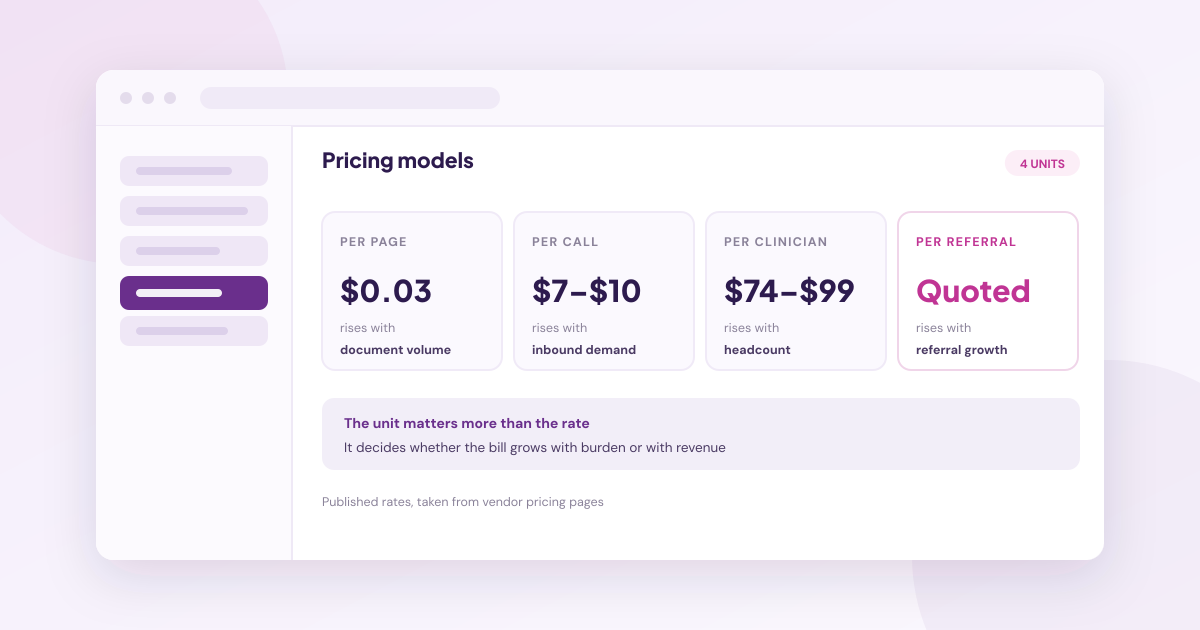
TL;DR
- Four common billing units in practice automation are per page, per call, per clinician and per referral.
- The unit decides what your bill tracks as the practice changes, which is usually harder to renegotiate later than the rate.
- On tiered per-call plans a higher tier lowers the included rate, but overage can still make a smaller tier cheaper at some volumes.
- Per-clinician pricing is predictable until you hire, then it steps with headcount whether or not the work grows.
- Promotional rates are not budgets, so model the post-promotion figure before committing.
- Only three of the fifteen vendors checked for this article publish a rate a buyer can model without contacting sales, so most budgeting starts with a sales call.
Practice automation platforms commonly price around four units: per page, per call, per clinician or per referral. The rate matters, but the unit decides what your bill tracks as the practice changes, and that is the part a quote rarely makes obvious.
How the Pricing in This Article Was Gathered
Public pricing pages were checked for fifteen vendors across four categories. Fax and document platforms: Medsender, Notifyre, Updox, Concord, Documo and Retarus. Voice and answering: Smith.ai, Hello Patient, Prosper AI, Emitrr and Simbo AI. Referral management: ReferralPoint and Proficient Health. Practice software: SimplePractice and DoctorConnect.
Three of those publish a rate a buyer can model without contacting sales, namely Notifyre, Smith.ai and SimplePractice. The other twelve quote on request, Medsender included.
The Four Units You Will Be Quoted On
| Unit | Published example | Base price | Additional usage | Bill tracks |
|---|---|---|---|---|
| Per page, sending | Notifyre fax send | $0.03 a page | Pay as you go | Outbound volume |
| Per page, receiving | Notifyre Premium | $39.90, 3,000 pages | $0.05 a page | Inbound volume |
| Per call | Smith.ai virtual receptionist | $810, 90 calls | $10.50 a call | Inbound demand |
| Per clinician | SimplePractice Plus | $99, then $74 each | None | Headcount |
| Per referral | Medsender referral automation | Quote-based | Not published | Referral volume |
Medsender's referral automation is quote-based, with a starting tier that includes up to 3,000 fax pages and 200 referrals a month.
Per Page: Simple to Shop, Easy to Optimise Wrongly
Fax platforms price pages, but sending and receiving are billed separately and should not be conflated. Notifyre publishes $0.03 a page for sending. Receiving runs on monthly plans: $4.90 for 200 pages, $7.90 for 500, $14.90 for 1,000 and $39.90 for 3,000, with excess pages from $0.05. Platforms that read and file the document bill per page as well, though they quote rather than publish.
That makes the unit easy to compare, though what the unit buys is not the same. One delivers the page, the other reads and files it.
Either way the line is not the expense. A practice receiving 3,000 pages a month pays $39.90 for a compliant receiving plan. Those pages are fewer documents than they look, because a referral packet often runs to three or four pages, so 3,000 pages might be a thousand documents. At two minutes each to read, name, index and file, that is about 33 staff hours a month. Priced at roughly $32 an hour fully loaded, using the Bureau of Labor Statistics median wage of $45,930 for medical the front office, adjusted for benefits at 31.6% of total compensation, that is roughly $1,070 of labour against $39.90 of line, before any exception or follow-up work.
So the useful question is what happens to the page after it lands. A cheaper line that delivers a PDF to a shared inbox has moved a cost, not removed one.
Per Call: Read the Overage, Not the Headline
Smith.ai publishes virtual receptionist plans at 30 calls for $300, 90 for $810 and 300 for $2,100, with overage of $11.50, $10.50 and $8.50 a call respectively. Its separately priced AI receptionist runs from a free 25-call tier to $800 for 500 calls, so check which product a quote refers to.
The included rates fall as volume rises: $10.00, then $9.00, then $7.00. The overage rates do not follow them down in step. Each sits $1.50 above its own tier's included rate, so every call beyond your allowance costs more than any call inside it, on any plan.
That changes the question from "which tier fits today" to "what happens in a busy month". Ask any voice vendor what the overage rate is, and whether you can move tiers mid-term without a new contract.
Per Clinician: Predictable Until You Hire
SimplePractice publishes solo plans at $49, $79 and $99 a month, and for group practices, Plus at $99 for the first clinician and additional clinicians “starting at $74” each, a floor that steps down at higher clinician counts. Groups of six or more are also invited to discuss custom pricing, so the published rate is a starting point and not a ceiling.
The appeal is predictability. The bill does not move with how busy the practice gets, which makes budgeting simple and the software cheaper per visit as volume rises. The cost of that is a step change every time you add a provider, whether or not the new provider generates the administrative work the tool addresses.
Watch for promotional framing. SimplePractice was showing a 50% discount for three months at the time of checking, and the promoted figure appears first. A three-month discount is a reason to start, not a number to budget on.
Per Referral: Closer to Business Value, Still Usage-Based
The fourth unit tracks something nearer to revenue. Medsender's platform pricing is quote-based and varies by monthly fax, call and referral volume and by contract length, with the referral automation starting tier including up to 3,000 fax pages and 200 referrals a month.
It is worth being precise about what this is. A referral received is still a usage measure rather than a business outcome. The outcome is a booked and completed visit. Referral volume correlates with revenue more closely than page count does, which is the argument for it, but it is not outcome pricing.
The trade cuts both ways. For some practices this aligns spend more closely with demand than a bill tied to document volume does. It also means cost grows as the practice grows, so a year of strong referral growth is a year of rising software cost. Ask what counts as a billable referral, whether duplicates and rejections count, and what happens when you exceed the allowance.
A Worked Example: One Practice, Four Units
The example below illustrates how pricing units behave as usage changes. It is not a like-for-like vendor comparison, because the products below solve different problems.
Take a four-clinician specialty practice receiving 3,000 fax pages and 200 inbound calls a month, with 60 referrals. On documents, a receiving-only plan is $39.90, and a read-and-file platform has to be quoted because none in this set publishes that rate. On headcount, four clinicians on SimplePractice Plus is $99 plus three at $74, or $321 a month, regardless of volume.
Calls are where the arithmetic surprises people. At 200 calls, Pro covers you at $2,100. Staying on Basic and paying overage costs $810 plus 110 calls at $10.50, or $1,965. On call cost alone, Pro becomes cheaper at approximately 213 calls a month. That comparison is purely on call cost, and higher tiers may include capabilities a practice needs, so compare features as well as the arithmetic.
Now grow document volume 25% and hold headcount. The receiving plan moves to about $77 and the per-clinician line does not move at all. Reverse it, hiring two clinicians with flat volume, and the per-clinician line rises by $148 a month while the document lines stay put.
What Moves the Quote Beyond the Unit
The unit sets the shape of the bill; other terms set its size. Common factors that can materially change a quote include contract length, committed minimum volume, the number of locations and annual uplift.
Beyond those, ask about setup and implementation fees, integration work, onboarding and training, support tier, data migration, any per-message charge for text or voice, and the termination terms.
Medsender states that in most cases there are no additional implementation, training or support fees, while larger implementations or customised integrations may carry additional costs. Ask every vendor the same question directly, and ask it before the discount conversation.
Working Out Which Unit Favours You
Model twelve months, not one. Take your current page volume, call volume, clinician count and referral count, project each forward at the growth you actually expect, and price the same vendor on each unit it offers, including overage.
All else equal, a practice with flat headcount and rising document volume tends to be favoured by per-clinician pricing, and a practice hiring into steady volume by per-page. Rates still decide it, so treat that as a starting hypothesis to test with real quotes.
FAQs
How Is Medical Practice Automation Usually Priced?
Common models include per page for document and fax platforms, per call for voice products, per clinician for practice software, and per referral for referral automation. Flat monthly fees and enterprise contracts combining several variables also exist. The unit determines what your bill tracks as the practice changes.
What Does Fax Cost Per Page?
Notifyre publishes $0.03 a page for outbound faxing, while inbound plans begin at $4.90 a month for 200 pages and run to $39.90 for 3,000, with excess from $0.05. Read-and-file platforms bill per page too but quote rather than publish. Sending and receiving are billed separately either way.
Is the Tier That Matches My Volume the Cheapest?
Not always. On Smith.ai's virtual receptionist plans, overage above the 90-call tier is $10.50, so 200 calls costs $1,965 there against $2,100 on the 300-call tier. On call cost alone, Pro becomes cheaper at approximately 213 calls. Features differ between tiers, so weigh those alongside the arithmetic.
Why Is Practice-Automation Pricing Often Quote-Based?
Pricing frequently varies with usage volume, locations, integrations, implementation scope and contract length, which makes a single published rate hard to state. Three of the fifteen vendors checked here publish one. When a vendor does not, ask for the billing unit and the included allowance so you can still model a year.
What Should I Ask For in a Practice-Automation Quote?
Nine things: the billing unit, the included allowance, the overage rate, implementation and setup fees, integration work, onboarding and training, annual uplift, contract term and termination terms. Those let you model twelve months rather than one month, which is where most unit choices reveal themselves.
Does Referral-Based Pricing Cost More as We Grow?
Yes, that is the trade. Pricing that tracks referral volume rises as the practice grows, which may align spending more closely with demand than document-based pricing, though it does mean software cost grows as the practice grows. Ask what counts as billable, and what happens when you exceed the allowance.

Zain Qayyum
Chief Executive Officer
Zain Qayyum is co-founder and co-CEO of Medsender. He started the company in 2015 and has spent the decade since on the front-office work that decides whether a referred patient is ever seen: inbound fax, referral backlogs, and phones nobody has time to answer. He argues that healthcare's hardest problems are operational rather than technical, and speaks and writes on where AI genuinely helps a practice and where it overpromises. He is based in New York.
Related Signals
7 Best Referral Management Software Platforms for Specialty Practices
Zain QayyumWed, Sep 23, 2026
How to Vet a Healthcare AI Vendor: BAA, Trust Center and Audit Trail
Zain QayyumTue, Sep 15, 2026