Best Brevium Alternatives in 2026
 Zain QayyumLast Updated: Nov 13, 2026
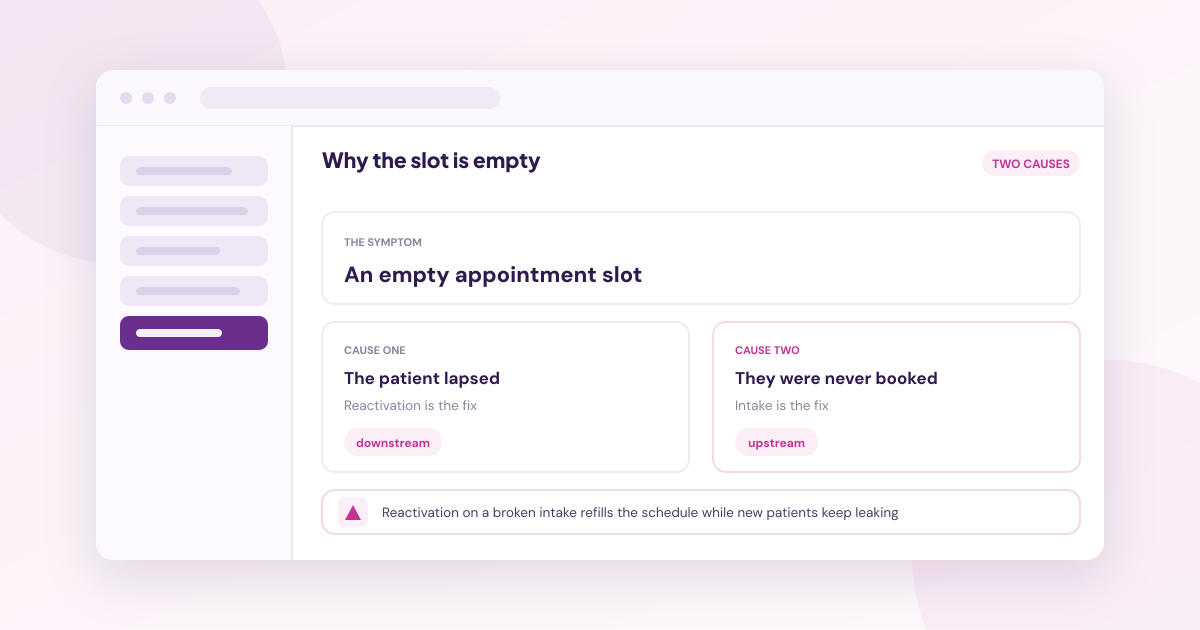
Brevium finds patients who stopped coming back and brings them in again. Before shortlisting it or anything else, work out whether your empty appointment slots come from patients who lapsed or from referrals that were never worked, because those two problems need entirely different software.
Empty slots look identical either way. The cause is not visible from the schedule, and buying the wrong category means refilling a bucket with a hole in it.
TL;DR
Brevium is a focused patient reactivation product with real electronic health record (EHR) coverage in specialty practices.
It publishes no pricing, describes itself as HITRUST-aligned rather than certified, and does not mention System and Organization Controls (SOC) 2.
Reactivation cannot fix intake. If referrals sit unworked for days, that is the first problem.
Among the six alternatives compared here, one bills on completed appointments rather than activity.
Only two publish a price at all, and only one publishes a human review step.
All vendor detail below was read on 12 November 2026 from the vendors' own pages.
What Brevium Does, and Does Well
Brevium describes itself as an intelligence layer working inside a practice's own data, workflows and clinical definitions. It identifies overdue patients and missed care, runs personalised outreach, surfaces in-visit provider alerts, analyses provider schedules for capacity, and attributes resulting appointments for return-on-investment reporting.
Focus is a genuine strength here. A product that does one job is usually better at it than a suite that lists it among twenty others, and Brevium's specialty coverage is the right shape for dermatology, ophthalmology and cardiology. It names Nextech, athenahealth, ModMed and eClinicalWorks, and claims more than fifty systems through its Stitch integration layer.
What Brevium Does Not Publish
Two gaps matter when you are comparing it against anything else. Neither is unusual in this category, but both affect how you evaluate.
No Pricing at All
The plan comparison link on Brevium's site is a placeholder, and the page says only that plans scale with the organisation. Six of the eight healthcare vendors we read publish nothing on price either, so this is a category habit rather than a Brevium failing. It still means you cannot model the spend before a sales call.
A Compliance Posture Worth Clarifying
Brevium describes a business associate agreement (BAA) backed, HITRUST-aligned ecosystem. Brevium's HITRUST-aligned is not the same as HITRUST certified, and the two are frequently read as equivalent. SOC 2 is not mentioned on its public pages. Ask what has actually been audited, and by whom.
The Question to Ask Before You Buy Reactivation
One diagnostic decides which category you are shopping. It takes a week and costs nothing.
Count Both Leaks Separately
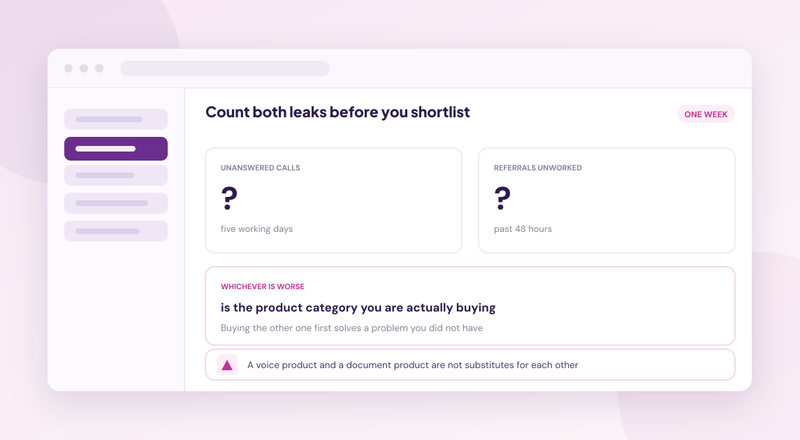
Count referrals sitting unworked for more than forty-eight hours. Separately, count patients overdue past their recall interval. Whichever number is worse is the product you should buy first; the other problem will still be there afterwards. Our guide tofinding overdue and lapsed patients in your EHRcovers the second count.
Reactivation Runs Downstream of Intake
A campaign brings back patients the practice already has. It does nothing for the referral that arrived by fax on Tuesday and is still unopened on Friday. If new patients are leaking at intake, reactivation refills the schedule while the leak continues.
The Alternatives Compared
Six options spanning both halves of the empty-slot problem. Where a vendor is silent on a criterion, that silence is recorded as such rather than read as an absence of capability.
Medsender: Best for Fixing Intake and Billing Reactivation on Results
Medsender covers both halves of the problem. Its Patient Recapture product is billed on outcomes, with the site stating that you pay for completed appointments and not for activity. That is the only outcome-based model among the six compared here, and it moves the commercial risk to the vendor rather than the practice. Upstream, it turns inbound faxes and referrals into booked appointments, reading a fax batch in under five seconds and distinguishing a referral from a result from an authorization across multi-page packets. Anything unusual is flagged as an exception for the referral coordinator, and judgment calls stay with your team. Per-unit pricing is published: eight cents per fax page at low volume sliding to 5.6 cents, and $1.20 per referral sliding to $1.00. It names thirty-four EHR integrations as available with forty-seven more on request, holds SOC 2 Type II, and includes a BAA free with every account. Contact attempts and outcomes are written back to the chart in supported EHRs. The limitations are real: reactivation is one product among several rather than the whole company's focus, there is no public status page, no published service level agreement, and its 99% accuracy figure covers fax extraction only, not referrals.
Linear Health: Best for athenahealth Practices Wanting Published Economics
Linear Health is the only alternative here that publishes both a price and a review posture. It starts from $2,000 a month as a flat fee per workflow sized to volume, and states that you pay nothing monthly until the workflow is live and processing real work. That term shifts implementation risk away from the practice, and no other vendor in this comparison publishes a comparable commitment. On the product side it covers care gap closure alongside referral coordination, converting referral faxes into structured records, running eligibility checks, contacting patients and booking appointments. Its stated review model is routine work automated and exceptions escalated, with roughly eighty per cent of coordination work automated and the team staying in the loop on the remainder. It offers native write-back on athenahealth plus established integrations with NextGen, eClinicalWorks and Greenway Health, holds SOC 2 Type 2 and executes a BAA with every customer. The constraints are scope and breadth: four named EHR integrations against Medsender's thirty-four, a $2,000 floor that sits well above per-unit pricing for a small practice, and no published definition of what actually triggers an escalation.
Assort Health: Best for Reaching Patients by Phone at Scale
Assort Health approaches reactivation from a different direction, through voice. Its platform handles outbound outreach, waitlist management and two-way texting alongside inbound call answering, intake, medication refills and lab requests, running on what the company describes as a platform trained on more than three hundred million interactions. For a practice whose recall problem is really a staffing problem on the phones, that depth is the relevant capability, and it makes a strong claim for its athenahealth integration. The gaps are what it does not publish. There is no pricing on its site, no statement of what happens when the artificial intelligence (AI) cannot resolve a request, and no described human review step before anything is actioned. It names athenahealth as one integration out of a claimed fifteen or more platforms, leaving the rest unidentified. Its trust centre exists but is not a status page, and no uptime commitment appears anywhere on the site.
Valerie Health: Best for Pairing Reactivation With Referral Intake
Valerie Health sells four products by name: Referral Automation, Fax and Document Automation, Automated Scheduling, and Growth Analytics. That combination makes it a direct like-for-like on the intake side of the problem, and it states SOC 2 Type II, which is a real commitment that several vendors in this set do not make. Customers get control to personalise patient engagement and to build custom workflows. Two things limit how far a buyer can evaluate it. It names no EHR or practice management integrations at all, saying only that it works with your systems and many more, which matters a great deal for a product whose value depends on writing into a specific EHR. And it publishes no pricing. Valerie Health also describes itself as certified under the Health Insurance Portability and Accountability Act (HIPAA); HIPAA has no certification scheme, so that claim has no referent and is worth asking about rather than assuming.
Updox: Best for Breadth Across Patient Communications
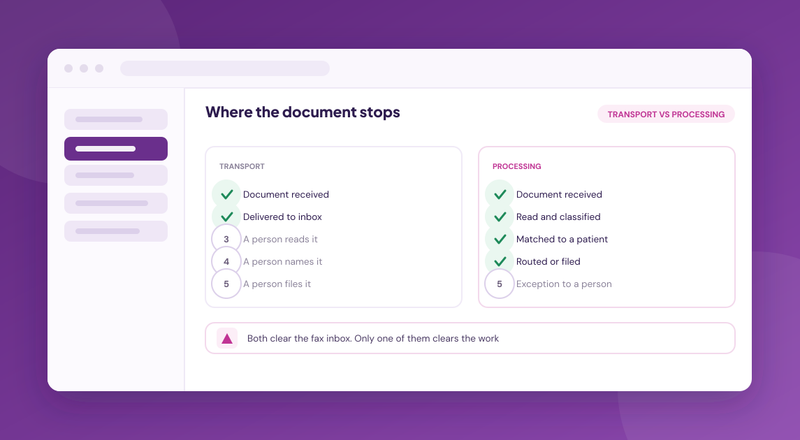
Updox is a unified communications platform rather than a reactivation tool, covering broadcast messaging, appointment reminders, forms, patient portal, secure messaging, telehealth and charge capture in one place. For a practice that would rather consolidate vendors than add another point solution, that breadth is the argument, and the reminders and broadcast messaging overlap genuinely with recall work. It holds Electronic Healthcare Network Accreditation Commission (EHNAC) DirectTrust accreditation for secure messaging, and it publishes a public status page at partnerstatus.updox.com, and no other vendor in this comparison publishes one. Against that, it publishes no pricing, names no specific EHR integrations beyond stating that it works with most systems, and makes no SOC 2 claim on its public pages. More importantly for this comparison, it moves documents and messages rather than processing them, so the staff time spent reading and filing does not go away. For a practice weighing consolidation against depth, that is the trade to think through before shortlisting it alongside a reactivation product.
Tennr: Best for Infusion, Durable Medical Equipment and Health Systems
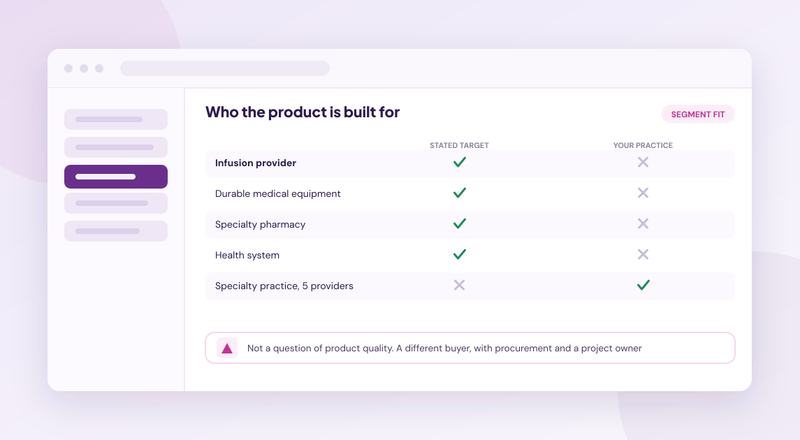
Tennr is included because practices encounter it on shortlists, not because it fits most of them. The company names its own segments plainly: fertility clinics, hospitals and health systems, infusion providers, manufacturers and durable medical equipment (DME) suppliers, physician groups and specialty pharmacies. Its named customers are consistent with that, including Palmetto Infusion, KabaFusion and Rothman Orthopaedics. It has raised a $101M Series C and states more than two hundred healthcare providers, so it has the scale and durability that matter when a vendor touches referrals. The difficulty for a specialty practice evaluating it is that almost nothing is published. There is no pricing, no stated review posture, no named EHR integrations and no security or compliance claims on its site. For an organisation with its own technology function and a long procurement cycle, that profile is workable, and the absence of public pricing matters less when procurement will negotiate anyway. For a five-provider practice with no project owner, it is the wrong shelf rather than a weak product.
How to Decide Between These
Start with the diagnostic rather than the shortlist. If referrals are sitting unworked, buy intake first and treat reactivation as the second phase. If intake is clean and the schedule still has gaps, a focused reactivation product will serve you better than a platform that lists recall among many features.
Then ask how you are billed, because the models here differ more than the features do. Per activity, per seat, flat per workflow, or per completed appointment are four different allocations of risk. Outcome billing is rare enough that it is worth asking for by name. Finally, make every vendor name your EHR specifically and describe what happens to a patient contact that fails, because those two answers separate products that feature lists do not. Our comparison ofpatient recall and no-show softwaregoes deeper on the recall side, andreactivation versus new patient marketingcovers where the budget is better spent.
FAQs
Common questions from practices comparing reactivation and intake software.
What Does Brevium Cost?
No figure is published anywhere on its site, so budgeting requires a sales conversation first. Ask for a quote at your actual patient volume rather than a list price, and ask what happens to the fee as that volume grows, because scaling terms are where reactivation contracts usually differ.
Which EHRs Does Brevium Integrate With?
Brevium names Nextech, athenahealth, ModMed and eClinicalWorks on its site, and claims more than fifty systems through its Stitch integration layer. Only those four are named publicly, so ask for written confirmation that your specific system is supported and what data the integration actually returns to you.
Is HITRUST-Aligned the Same as HITRUST Certified?
No. Alignment indicates that controls were mapped against the framework; certification means an authorised assessor validated them and issued a report. The wording is easy to read as equivalent. Ask any vendor using it what was assessed, by whom, and whether a report is available under a non-disclosure agreement.
Should a Practice Fix Referral Intake or Patient Reactivation First?
Count both leaks before deciding. Measure referrals unworked past forty-eight hours, then patients overdue past their recall interval. Buy for the larger number first. Reactivation campaigns running on top of a broken intake process refill the schedule while new patients continue to leak away unnoticed.
Which Reactivation Vendors Bill on Outcomes?
One of the six compared here. Medsender states that its Patient Recapture product is billed on completed appointments rather than activity. The others publish either a flat monthly fee, in Linear Health's case from $2,000, or no pricing model at all on their public pages as of 12 November 2026.
Which Alternative Comes Closest to Brevium?
The answer depends on which half of the problem you have. For pure reactivation, nothing in this set matches Brevium's single-purpose focus. For practices whose empty slots trace back to unworked referrals, a product covering intake and recall together, billed on appointments that actually happen, comes nearest.

Zain Qayyum
Co-Founder and Co-CEO
Zain Qayyum is co-founder and co-CEO of Medsender. His work centres on the front-office problems that decide whether a referred patient is ever seen: inbound fax, referral backlogs, and phones nobody has time to answer. He argues that healthcare's hardest problems are operational rather than technical, and speaks and writes on where AI genuinely helps a practice and where it overpromises. He is based in New York.
Related Signals