Best Healthcare AI With Built-In Staff Review
 Zain QayyumLast Updated: Nov 12, 2026
Healthcare software vendors are specific about what their artificial intelligence (AI) does and vague about what happens when it is wrong. That second question is the one a practice owner actually asks before letting software touch a patient chart, and almost nobody answers it on a public page.
So this comparison ranks on published review behaviour rather than on features. The emptiness of the result is the finding.
TL;DR
Of nine vendors read on 12 November 2026, Medsender and eight competitors, two publish anything about a human step before output reaches the chart.
None publishes the threshold at which a human is pulled in.
None documents a mechanism for overriding an action the software has already taken.
An accuracy percentage means nothing without its scope, and scope is usually missing.
A review queue only counts if somebody owns it by name.
Not published means the vendor does not say so publicly, not that the capability is absent.
What Built-In Staff Review Actually Means
The phrase gets used loosely, so it is worth pinning down before ranking anyone against it.
Review Is a Step, Not a Dashboard
A queue of flagged items only counts as review if a named person owns it. Unowned review screens become a second inbox nobody opens, and in a busy front office that is exactly what happens by week three. Ask who the queue is assigned to, not whether one exists.
The Question Is What Triggers It
Review on everything is slow enough to defeat the purchase. Review on nothing is unsafe. The useful middle is review on exceptions, which requires the vendor to have defined what an exception is. That definition is what separates products, and it is almost never published.
How These Were Ranked
Five criteria, applied to the public pages of Medsender and eight competitors on 12 November 2026.
Does the vendor publish what happens to low-confidence output
Is there a documented human step before anything reaches the chart
Can staff correct the software, and is the correction retained
Is there an audit trail of automated actions
Is any of this on a public page, or only available on request
The Vendors, Ranked on What They Publish
Six vendors, ranked by how much they disclose rather than by overall product quality. A vendor can be excellent and publish nothing, and several here are.
Linear Health: Most Detailed Published Review Model
Linear Health describes its review behaviour in more detail than anyone else here. It states that routine work is automated and exceptions are escalated, and it attaches a number: roughly eighty per cent of coordination work automated, with the team staying in the loop on the remaining twenty. Coordinators handle escalations and patient-facing work. That ratio is more than any other vendor here discloses, and it gives a buyer something to test against during a trial rather than a principle to take on trust. Linear Health converts referral faxes into structured records, runs eligibility checks, contacts patients and books appointments, with native write-back on athenahealth plus established integrations with NextGen, eClinicalWorks and Greenway Health. It holds System and Organization Controls (SOC) 2 Type 2 and executes a business associate agreement (BAA) with every customer. What it still does not say is what actually triggers an escalation, which is the question underneath the ratio. Its pricing starts from $2,000 a month flat per workflow, with nothing charged until the workflow is live.
Medsender: Clearest Published Principle on Who Decides
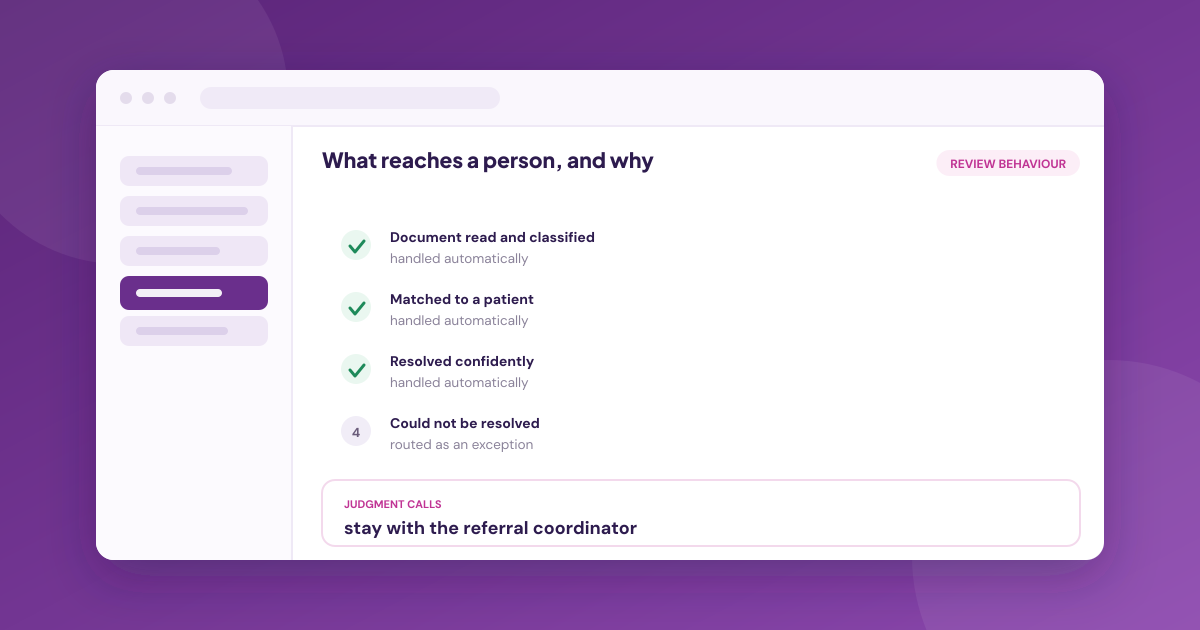
Medsender publishes the clearest statement of where authority sits. Anything unusual is flagged as an exception for the referral coordinator, items the software cannot resolve arrive with the context already gathered, and judgment calls stay with your team. An audit trail sits in the processing flow before anything posts to the chart, which happens if your electronic health record (EHR) supports chart creation and write-back. On accuracy it is unusually careful: its 99% figure covers fax extraction specifically rather than referral handling, and stating that scope is more useful than a larger unscoped number would be. It reads a fax batch in under five seconds and applies optical character recognition to typed and handwritten pages. Pricing is published per unit at eight cents per fax page at low volume sliding to 5.6 cents, and $1.20 per referral sliding to $1.00. It names thirty-four EHR integrations as available with forty-seven on request, holds SOC 2 Type II, and includes a BAA free with every account. It does not publish a confidence threshold, and no override mechanism is documented anywhere on its site.
Assort Health: Routing Described, Review Not
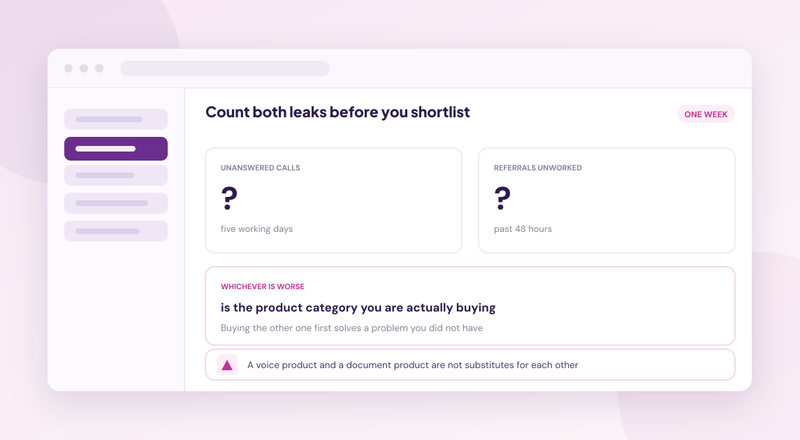
Assort Health describes routing rather than review. Requests are directed to the right provider, department or next step, and the platform handles scheduling around the clock, intake, medication refills, lab requests, waitlist management and outbound outreach. The company describes a platform trained on more than three hundred million interactions, which speaks to capability rather than to oversight. What is absent is any statement about what happens when the AI cannot resolve a request, whether a person sees it before action is taken, or whether staff corrections change later behaviour. For a voice product the distinction matters differently than for documents, since a misrouted call is recoverable in a way a misfiled chart entry is not, and that is a fair argument in its favour. It names only athenahealth among a claimed fifteen or more supported platforms, and its trust centre is not a status page with inspectable incident history. A practice buying voice should still ask what happens to a call the agent cannot complete, because routing to a queue and routing to a person are not the same outcome.
Valerie Health: Workflow Control Without a Review Step
Valerie Health gives customers control to personalise patient engagement and to build custom workflows, which is adjacent to review without being the same thing. Configuring what the software does in advance is different from catching what it got wrong afterwards, and only the second is review. It sells Referral Automation, Fax and Document Automation, Automated Scheduling and Growth Analytics, and states SOC 2 Type II, which three vendors here do not. Nothing is published about low-confidence handling, escalation, correction or audit logging. It also names no EHR or practice management integrations at all, which compounds the problem for a buyer, since you cannot evaluate how output reaches a chart without knowing which chart. Valerie Health describes itself as certified under the Health Insurance Portability and Accountability Act (HIPAA); HIPAA operates no certification scheme, so that claim warrants a question about what was assessed and by whom. Ask the same question about review behaviour while you are there.
Updox: An Audit Trail, Attached to Transport
Updox mentions an audit trail, which puts it among the minority here that reference one at all. The mention attaches to its fax product rather than to automated decision-making, so it records document movement rather than software judgement, and those are different things for this comparison. Updox is a unified communications and charge capture platform covering secure messaging, telehealth, patient portal, appointment reminders, forms and payments. It holds Electronic Healthcare Network Accreditation Commission (EHNAC) DirectTrust accreditation, and it publishes a public status page at partnerstatus.updox.com, which no other vendor in this comparison does. Because it moves documents rather than classifying and filing them, the review question is largely moot: a person reads everything anyway. That is a coherent position rather than a gap, and it should be read that way. A buyer choosing Updox is accepting that staff time stays in the process, which is a trade rather than an oversight failure, and the review question simply does not arise.
Tennr: Nothing Published on Review Behaviour
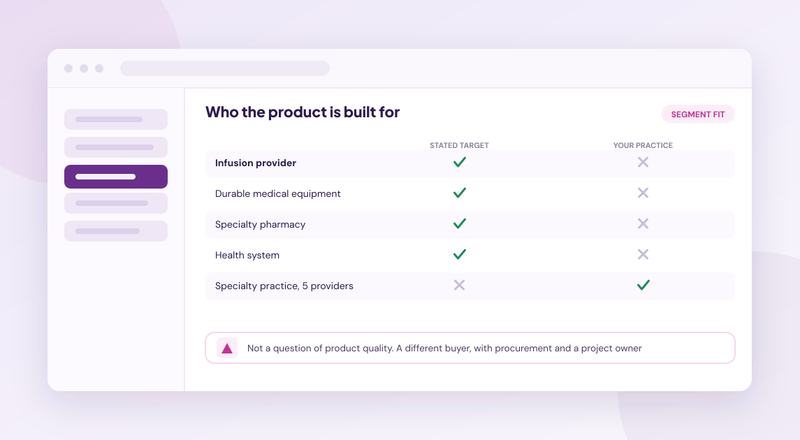
Tennr publishes no description of review, escalation, confidence handling or audit logging on its public pages. It also publishes no pricing, no named EHR integrations and no security or compliance claims, so the absence is consistent rather than selective. The company is built for fertility clinics, hospitals and health systems, infusion providers, manufacturers and durable medical equipment (DME) suppliers, physician groups and specialty pharmacies, with a $101M Series C and more than two hundred stated providers behind it. Named customers include Palmetto Infusion, KabaFusion and Rothman Orthopaedics. Enterprise buyers typically extract these answers through procurement and security review rather than from a website, so the public silence says less about the product than it would for a vendor selling to small practices directly. A smaller practice without that leverage simply has fewer ways to find out before signing, which is a practical reason to weight published behaviour more heavily than a larger organisation would need to.
How to Decide Before You Buy
Five questions separate these products in a way the published material does not. Put them in writing and compare the answers side by side.
What triggers a human review, and who is the queue assigned to by name
What exactly does your accuracy figure measure, and over what document types
What does the audit trail record, and can we export it
If a document is misread, how would we find out
Does a correction change what happens next time, or only this time
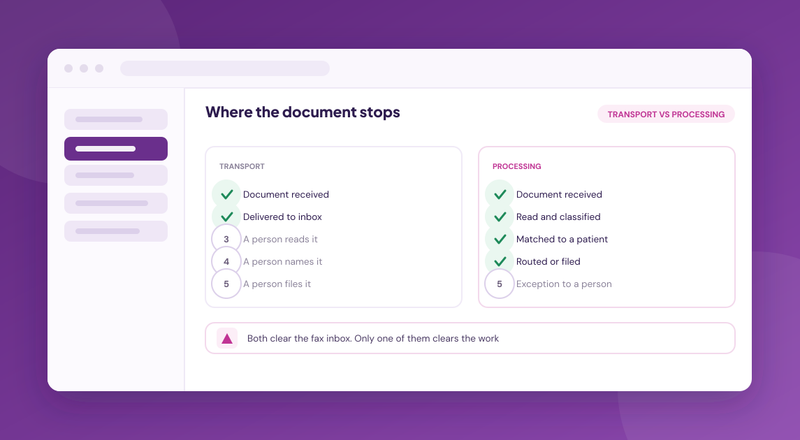
Then decide what you actually want. Sorting, labelling and routing can run without a person. Deciding that something is an exception still needs one. Returning the result to the chart happens if your EHR supports it. Our guide toverifying and overriding AI on the patient chartcovers the mechanics,vetting a healthcare AI vendorcovers the paperwork, andAI automation for practice administrationcovers the wider category.
FAQs
Common questions from practices evaluating oversight of healthcare automation.
What Does Human-in-the-Loop Mean in Healthcare AI?
Human-in-the-loop means a named person sees an item before it reaches the chart, or at minimum before an irreversible action is taken. The phrase is used loosely to describe dashboards nobody is assigned to read, so ask who owns the queue rather than whether one exists.
Should Every Automated Action on a Chart Be Reviewed?
Reviewing everything removes most of the benefit you paid for, and reviewing nothing carries risk a practice cannot see. The workable middle is review on exceptions, which only works if the vendor has defined what counts as one and will tell you what that definition is.
What Should an Audit Trail of Automated Actions Record?
Four things at minimum: which action was taken, by which actor, at what time, and against which record. Logs built when every actor was a person often cannot distinguish software actions from staff actions, so ask whether yours can and whether the log is exportable.
How Would a Practice Know if Software Misread a Document?
Usually it would not, unless low-confidence output is routed to a person or the audit log surfaces it. Those are the only two mechanisms that generate a signal. Ask which one exists, because without either the first indication is a patient calling about an appointment nobody booked.
What Does a 99% Accuracy Claim Actually Cover?
An accuracy claim depends entirely on scope, which is frequently omitted. Extraction accuracy on a typed fax is a different measurement from correctly interpreting a referral packet. Ask which document types the figure covers, how it was measured, and whether handwritten pages were included in the sample.
Can Staff Corrections Improve the Software Over Time?
Some vendors describe accuracy improving as the system learns a practice's senders and document patterns. What is rarely published is whether a specific correction feeds that process or is simply a one-time fix. Ask directly, because it is the difference between correcting software and training it.

Zain Qayyum
Co-Founder and Co-CEO
Zain Qayyum is co-founder and co-CEO of Medsender. His work centres on the front-office problems that decide whether a referred patient is ever seen: inbound fax, referral backlogs, and phones nobody has time to answer. He argues that healthcare's hardest problems are operational rather than technical, and speaks and writes on where AI genuinely helps a practice and where it overpromises. He is based in New York.
Related Signals