How Practices Backfill Same Day Cancellations Before the Slot Is Lost
 Zain QayyumLast Updated: Oct 27, 2026
TL;DR
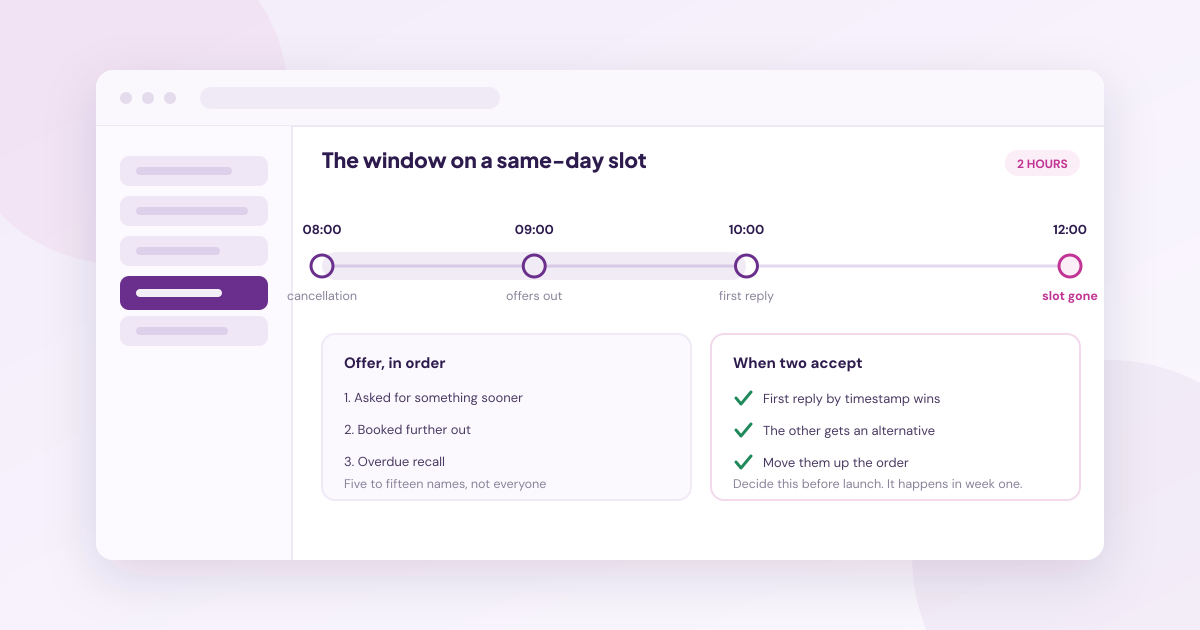
- A same-day cancellation has a useful life of about two hours. After that you are not filling today's slot, you are booking next week.
- Manual backfill misses the window not because staff are slow but because the cancellation arrives while they are doing something else.
- The list matters more than the message. A waitlist that is a list of everyone is a list of nobody.
- Offer a specific slot, to a small ordered group, with a short expiry. Broadcasting to everyone creates a race you then have to apologize for.
- Decide in advance what happens when two patients accept. This is the most common operational failure and it is entirely preventable.
- At low cancellation volume, automating this is not worth it. Work out your number before buying anything.
The Two Hour Window, and Why Manual Backfill Misses It
The economics of a same-day cancellation are unusual. The slot has a fixed expiry, the cost of leaving it empty is the full value of the visit, and the probability of filling it falls steeply with every hour that passes.
Roughly, a slot canceled at eight in the morning for a two o'clock appointment is fillable. The same slot at noon is difficult. At one o'clock it is gone, because even a patient who wants it cannot reasonably arrange to be there.
Manual backfill fails against that clock for a structural reason rather than a performance one. The cancellation arrives by phone, to a person who is checking in a patient or handling a referral. It gets noted. The backfill attempt happens when there is a gap, and the gap comes after the window. Nobody did anything wrong and the slot is still empty.
The second structural problem is that calling is serial. A front office member calls one patient, waits, leaves a voicemail, calls the next. Three calls take fifteen minutes and produce one voicemail and two no-answers. Meanwhile the window is closing.
That combination, interrupt-driven arrival plus serial outreach, is what makes this a good automation candidate. It is not that the task is hard. It is that it has to start immediately and run in parallel, and a human doing another job can do neither.
Who Is On the List, and How It Is Ordered
The instinct is to build one waitlist. That is the thing that reliably does not work, because a single undifferentiated list produces offers to patients who cannot use them.
Four groups are worth separating, and most practices need at least the first two.
Patients who asked for something sooner. These are the ones who said yes when offered an earlier slot, and they are by far the highest converting group because they have already expressed the preference. If you capture nothing else, capture this.
Patients booked further out who could move up. A patient scheduled for three weeks' time may take today. This group is large and converts moderately, and moving them up creates a gap further out that is easier to fill than today's.
Overdue recall patients. These convert less well for a same-day offer because they were not planning to come in, but they are the right group when the first two are exhausted.
Cancellations and no-shows from the recent past. Worth including with care, because a patient who no-showed last week is not obviously the right person to hand a short-notice slot.
Then order within the group. Proximity matters more than anything else for a same-day offer, because the patient has to physically get there. Appointment type has to match, since a slot of a given length with a given provider is not usable by everyone. And provider continuity matters in specialty practice in a way it does not in urgent care.
The output is a short ordered list per slot, not a broadcast list. Five to fifteen names is the right size for most practices.
The Offer, the Reply and the Race Condition
Three design choices decide whether this works.
Offer a specific slot. "We have an opening today at two fifteen with Dr. Reyes, reply YES to take it" converts far better than "we have availability today", because the second asks the patient to start a conversation and the first asks for one word.
Set an expiry and say it. A fifteen or twenty minute window to respond is normal and it is what makes sequential offering possible. Without an expiry you cannot move to the next patient without risking a double booking.
Send to a small group, not to everyone. There are two workable patterns and the choice depends on volume. Sequential offering, one or two patients at a time with a short expiry, is cleaner and slower. Small-batch offering, three to five at once with first-reply-wins stated explicitly, is faster and requires you to handle the loser gracefully.
What does not work is broadcasting to the whole waitlist and taking the first reply. It fills the slot, and it generates a cohort of patients who rearranged their day and were told the slot was gone. Those patients stop responding, and within a few cycles the waitlist is dead.
What Happens When Two Patients Accept
Decide this before launch. It will happen, usually in the first week.
Two patients accept within the same minute. One slot. The practice now has a choice it has not thought about, made by whoever is at the desk, under time pressure.
The clean version has three parts.
A deterministic rule for who gets it. First reply by timestamp is the only rule that is defensible to both patients, and it has to be the system's timestamp rather than a judgment about who seemed keener.
An immediate, specific message to the other patient. Not silence. The message should acknowledge the attempt, say the slot has gone, and offer the next available alternative in the same message. A patient who gets that stays on the list. A patient who gets nothing does not.
A record of who missed out, so they can be moved up the order next time. This is the step that keeps the list healthy over months and it is the one most implementations omit.
If you are offering in small batches, the race is designed in, so the second part is not an exception path, it is a normal outcome and should be written as one.
Deciding Whether Backfill Is Worth Automating at Your Volume
Do the arithmetic before buying anything, because the answer is sometimes no.
Three numbers. How many same-day cancellations and no-shows do you get in a typical week. What proportion currently go unfilled. What is the value of a filled slot in your practice.
Multiply and you have the annual value at stake. In a single-provider practice with four cancellations a week and a modest fill rate improvement, the figure is often smaller than the cost and effort of automating it. The better answer there is a better manual process. A short standing waitlist, a template message, and one person who owns it.
In a multi-provider or multi-site group the same arithmetic usually points the other way, because the volume scales and the manual approach does not. Somebody at each site maintaining their own list is exactly the pattern that decays.
Three prerequisites regardless of which way the number points.
Consent to contact by text, recorded and tied to the number, with a working opt-out honored across every system that might send to that patient. Automated patient texts sit under telephone consumer protection rules as well as HIPAA.
Sending hours decided deliberately. Same-day backfill pushes against quiet-hours expectations more than any other outreach, because the useful window is early morning and late afternoon. Decide the boundaries rather than discovering them.
A named owner for the exception queue. Replies that are not a clean yes, patients who accept after expiry, and the double-accept case all land somewhere, and that somewhere needs a person and allocated hours.
Whatever platform you evaluate, confirm what it documents about consent capture, opt-out propagation and send windows. Treat anything undocumented as something your practice has to operate itself.
FAQs
How Long Is a Same-Day Slot Actually Fillable?
About two hours. A slot canceled at eight in the morning for a two o'clock appointment is fillable, the same slot at noon is difficult, and by one o'clock it is gone because even a patient who wants it cannot reasonably arrange to be there.
Why Does Manual Backfill Miss the Window?
For two structural reasons rather than any performance problem. The cancellation arrives by phone to somebody who is checking in a patient, so the backfill attempt happens in the next gap, which comes after the window. And calling is serial: three calls take fifteen minutes and produce one voicemail and two no-answers while the window closes.
Who Should Be on the Backfill List?
Not one undifferentiated waitlist. Separate at least two groups: patients who asked for something sooner, who convert best because they already expressed the preference, and patients booked further out who could move up. Then order within the group by proximity, appointment type and provider, and offer to five to fifteen names rather than broadcasting.
What Happens When Two Patients Accept the Same Slot?
Decide before launch, because it will happen in the first week. Use first reply by timestamp, which is the only rule defensible to both patients. Send the other an immediate message that acknowledges the attempt and offers the next alternative in the same message. And record who missed out so they move up the order next time.
Is Automating Backfill Worth It?
Do the arithmetic first, because the answer is sometimes no. Count your same-day cancellations in a typical week, the proportion currently unfilled, and the value of a filled slot. In a single-provider practice the figure is often smaller than the cost of automating, and the better answer is a short standing waitlist, a template message and one person who owns it.

Zain Qayyum
Co-Founder and Co-CEO
Zain Qayyum is co-founder and co-CEO of Medsender. His work centres on the front-office problems that decide whether a referred patient is ever seen: inbound fax, referral backlogs, and phones nobody has time to answer. He argues that healthcare's hardest problems are operational rather than technical, and speaks and writes on where AI genuinely helps a practice and where it overpromises. He is based in New York.
Related Signals
How a Multi Location Group Rolls Out Automation One Clinic at a Time
Zain QayyumFri, Oct 16, 2026
How Practice Automation Is Priced: Per Page, Per Call, Per Clinician or Per Referral
Zain QayyumMon, Sep 21, 2026