How a Multi Location Group Rolls Out Automation One Clinic at a Time
 Zain QayyumLast Updated: Oct 27, 2026
TL;DR
- Pick the second-busiest site, not the busiest and not the quietest. The busiest has no slack to absorb a problem and the quietest will not surface one.
- A recent EHR go-live is a reason to start, not a reason to wait. A practice three months into a new system is still changing how it works.
- Groups that route through a central admin function adopt faster than groups where each site runs its own version. If you have that function, the rollout is a different and easier project.
- Running two ways of working at once is the real cost of a phased rollout, and it is mostly borne by whoever sits between the sites.
- Train the front office, not the administrator. The person who clicks the thing daily is not the person who sat in the demo.
- Define your stop conditions before site one. A rollout with no stop condition does not pause, it just gets quieter.
Picking the First Site, and Why the Busiest Is Usually Wrong
The instinct is to start where the pain is worst, which is usually the highest-volume site. That is the wrong choice for a first site and the right choice for a second.
The busiest site has the least slack. When something goes wrong in week one, and it will, there is no capacity to absorb it, and the staff who are already stretched are the ones being asked to learn a new workflow while covering the old one. A bad first week there becomes the story the whole group hears.
The quietest site has the opposite problem. It will go live smoothly and teach you nothing, because the volume never exercises the parts that break. You then arrive at site three with false confidence and discover the failure modes at scale.
The second-busiest site, or whichever has decent volume and a front office with some slack, is the useful choice. Enough traffic to surface real problems, enough room to handle them.
Two other selection criteria matter more than people expect.
The site lead. A site with somebody who is actually willing to run this is worth more than a site with better numbers. The first site generates the internal evidence for the rest of the rollout, and a reluctant lead produces evidence of the wrong kind.
Whether the site is representative. If one site uses a different EHR instance, a different phone system or a different referral mix, it is a poor template for the others regardless of how well it goes.
One counterintuitive point on timing. A site that recently went live on a new EHR is often a better starting point than a stable one, not a worse one. The staff are already in the middle of changing how they work, the old habits have been broken, and there is no established workflow to defend. Groups that defer the rollout until everything settles down usually find the settled version is harder to change.
What Has to Be True Before Site Two
Resist moving on by calendar. Move on by condition.
Four things should be true before the second site starts.
The first site has run a full cycle without the implementation team in the room. A week where somebody from the project is on hand daily proves the configuration, not the workflow. The honest test is the week after that support withdraws.
The exception queue has a named owner at the site and it is being worked. If the exceptions are being handled by the project lead rather than by site staff, the workflow has not transferred.
You know what the site actually does differently now. Specifically. Which task stopped, which changed, who does the new version. If you cannot write that in five lines, the first site has not finished.
The configuration decisions are documented, with reasons. Site two will ask why a threshold is set where it is, and the answer needs to be better than that is how site one did it.
What to measure before moving on is one number, chosen before go-live, that tells you whether this is working at all. Not a dashboard. One number, with a date. Pilot measurement in general is a topic of its own.
Running Two Ways of Working at Once
This is the hidden cost of a phased rollout and it is worth planning for explicitly, because it falls on people who are not at either site.
Anyone who works across sites now has two workflows. Referral coordinators covering multiple locations, central billing, the person who handles overflow calls, the clinical staff who rotate. Each of them is holding both the old process and the new one in their head and switching by context.
Three things reduce that cost.
Sequence by function rather than by geography where you can. If the group has a central referral function, moving that function entirely is often cleaner than moving site by site, because it eliminates the dual-running for the people most affected.
Keep the phase short. A rollout that runs one site a month across eight sites means eight months of dual-running. Two sites at a time, with a pause to absorb, usually ends faster even though it feels riskier.
Make the current state visible. A single page that says which site is live, on what, and who to ask. It sounds trivial and it removes most of the day-to-day friction.
Also decide what happens to documents and calls that cross between a live site and a non-live one. A referral that arrives at the live site for a patient seen at another location is the obvious case, and it should be answered before it occurs rather than improvised.
Training the Front Office, Not the Administrator
The most common training failure in a group rollout is that the training goes to the wrong people.
The practice administrator attended the demo, ran the evaluation and understands the rationale. They are not the person who will use it forty times a day. The front office staff who will are frequently trained second-hand, by the administrator, in a shorter session, without the context.
What works better is narrow and specific. Train on the three things each role actually does, not on the product. For a front office that is usually: what the queue looks like now, what to do when an item is flagged, and how to escalate. Fifteen minutes on those three beats an hour on everything.
Train at the site, in the week of go-live, not in a central session a month before. Training that precedes use by weeks does not survive.
Name a local person who knows slightly more than everyone else, and give them time for it. Every successful rollout has this person at each site, and in groups that do it deliberately they are identified and supported rather than emerging by accident.
And train the fallback. What happens when the system is unavailable, who notices, what the manual process is. Practices that have had a fax outage take this seriously, and a rollout that has not covered it is relying on institutional memory that newer staff do not have.
What the Rollout Looks Like at Site Five
By the fifth site the project has changed shape, and the groups that do this well recognize the change rather than running the same playbook.
Configuration should be close to standard by now. If every site is still getting bespoke settings, you do not have a rollout, you have five implementations, and the maintenance burden compounds with each one. Some local variation is legitimate, by specialty mix or phone setup. A different threshold at every site is usually drift rather than a decision.
Training should be running off internal material rather than vendor material, delivered by somebody from an earlier site. That transfer is the clearest sign the thing has taken.
The exception queue question changes from who owns it at this site to whether it should be centralized. Groups that route everything through a central admin function consistently adopt faster, and by site five there is usually enough evidence to decide whether that applies here.
And the measure should have moved from did it work to is it still working. A site that went live first and has been unattended for four months is the one most likely to have quietly reverted.
Deciding Your Sequence and Your Stop Conditions
Write both down before site one, because neither can be decided honestly under pressure.
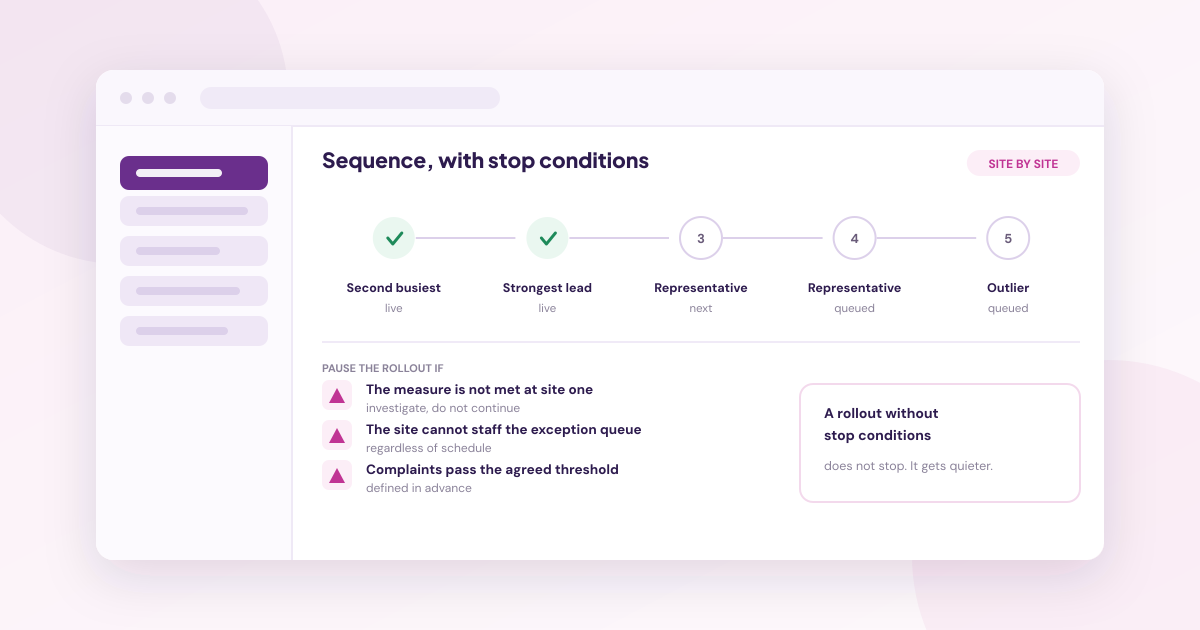
The sequence should name the sites, in order, with the reason for each position. Second-busiest first, then the site with the strongest lead, then the ones that are representative, then the outliers. The outliers go last because by then you know what normal looks like.
The stop conditions are the part that gets skipped. Three worth defining.
A measure that, if not met at site one, pauses the rollout rather than continuing while somebody investigates.
A staffing condition. If the site cannot staff the exception queue, it does not go live, regardless of schedule.
An escalation threshold. A defined level of patient or referrer complaints that triggers a pause.
A rollout without stop conditions does not actually stop when it should. It continues on momentum, the problems accumulate at the sites that went first, and nobody is responsible for calling it because no one defined what calling it would look like.
Finally, decide who owns the whole thing after the last site goes live. Rollouts have project owners and steady states have operational owners, and the handover between them is where a successful rollout most often turns into an unmaintained system.
FAQs
Which Site Should Go First?
The second busiest, or whichever has decent volume and a front office with some slack. The busiest has no capacity to absorb the problems that will appear in week one, and a bad first week there becomes the story the whole group hears. The quietest will go live smoothly and teach you nothing, because the volume never exercises the parts that break.
Should We Wait Until Things Settle Down?
Usually not. A site that recently went live on a new EHR is often a better starting point than a stable one. The staff are already changing how they work, old habits have been broken, and there is no established workflow to defend. Groups that defer until everything settles find the settled version harder to change.
What Has to Be True Before the Second Site Starts?
Move on by condition rather than by calendar. The first site has run a full cycle without the implementation team present. The exception queue has a named owner at the site and is being worked by site staff. You can write in five lines what the site actually does differently now. And the configuration decisions are documented with reasons.
Who Should Be Trained?
The front office staff who will use it forty times a day, not the administrator who attended the demo. Train on the three things each role actually does rather than on the product, at the site, in the week of go-live. Name a local person who knows slightly more than everyone else and give them time for it. And train the fallback for when the system is unavailable.
What Should Stop a Rollout?
Three conditions, written down before site one. A measure that, if not met at the first site, pauses the rollout rather than continuing while somebody investigates. A staffing condition, so a site that cannot staff the exception queue does not go live regardless of schedule. And a defined level of patient or referrer complaints that triggers a pause.

Zain Qayyum
Co-Founder and Co-CEO
Zain Qayyum is co-founder and co-CEO of Medsender. His work centres on the front-office problems that decide whether a referred patient is ever seen: inbound fax, referral backlogs, and phones nobody has time to answer. He argues that healthcare's hardest problems are operational rather than technical, and speaks and writes on where AI genuinely helps a practice and where it overpromises. He is based in New York.
Related Signals
How Practices Backfill Same Day Cancellations Before the Slot Is Lost
Zain QayyumThu, Oct 15, 2026
How Practice Automation Is Priced: Per Page, Per Call, Per Clinician or Per Referral
Zain QayyumMon, Sep 21, 2026