How Accurate Is AI at Reading Medical Documents
 Zain QayyumLast Updated: Nov 23, 2026
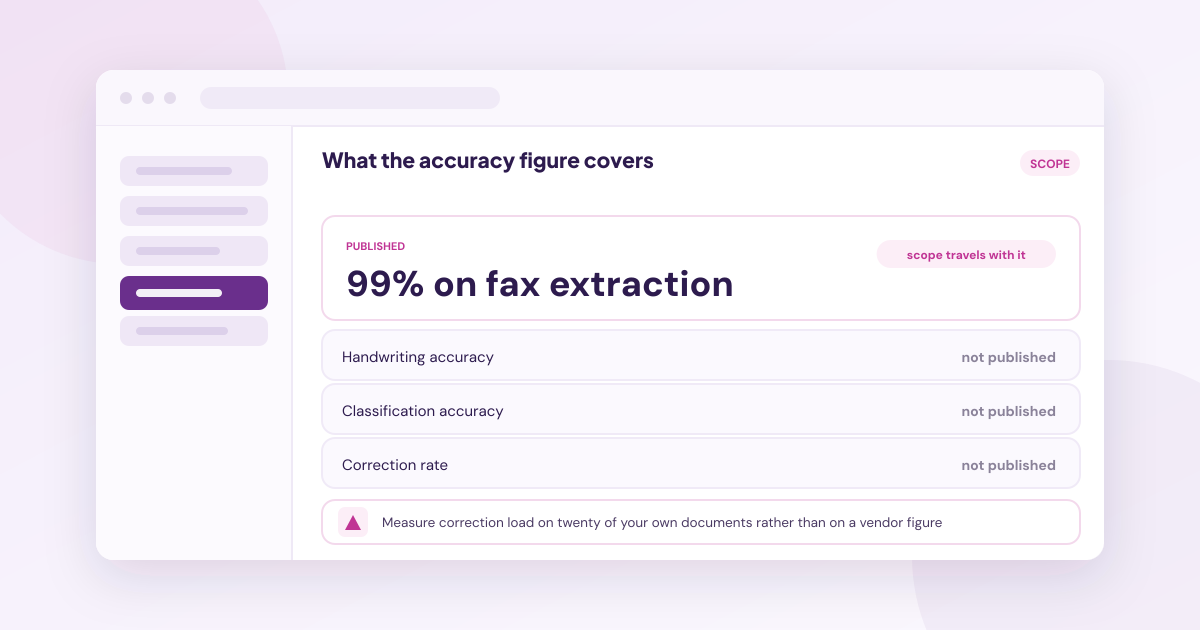
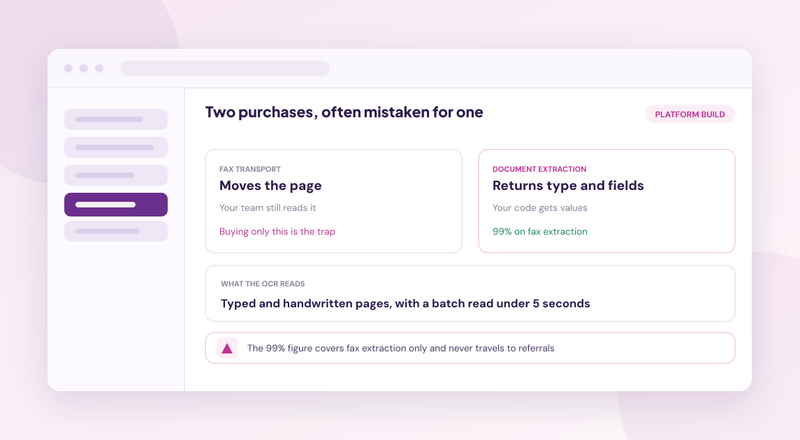
How Accurate Is AI at Reading Medical DocumentsReading medical documents accurately depends on what is being measured. The published 99% accuracy figure covers fax extraction only, and it is never a claim about reading referrals or about document reading generally. What matters more in practice is what happens to the pages the artificial intelligence (AI) cannot read.
A number without a scope is what buyers in this category already distrust. The sharper question is how much correcting a tool leaves behind on your own pages, and whether your electronic health record (EHR) can take the finished document at all.
TL;DR
- Accuracy depends on what is being measured, and the published 99% accuracy figure covers fax extraction only.
- No separate figure is published for handwriting, for classification or for correction rates, so none appears on this page.
- Optical character recognition (OCR) reads typed and handwritten pages, and a fax batch is read in under 5 seconds.
- Anything unusual is flagged as an exception for the coordinator, and judgment calls stay with the team.
- Correction load depends on your own fax quality and document mix, so measure it across 20 of your own pages.
- Filing is the conditional step, because chart creation and write-back happen if your EHR supports them.
Reading Medical Documents, Challenge Versus Solution
Reading medical documents breaks into six separate problems once you look at a real fax inbox. The table pairs each problem with what the software does about it.
| Challenge | What Medsender Does |
|---|---|
| Mixed batch of document types | classifies referral, result, authorization |
| Handwritten referral pages | OCR reads typed and handwritten |
| Slow manual sorting | reads a batch under 5 seconds |
| Pages the AI cannot read | flags an exception for the coordinator |
| Cases needing judgment | leaves the judgment with the team |
| Filing the document | if your EHR supports write-back |
The bottom row is a condition rather than a feature, and it does not soften with repetition. Filing depends on your own system, because chart creation and write-back happen if your EHR supports them, and that step stays manual where they do not.
How Accuracy Is Measured for Medical Documents
Accuracy for medical documents is measured against a document set, a field list and a definition of correct, all three chosen by whoever published the number. Reading the scope first is what makes any figure usable.
What the 99% Figure Covers
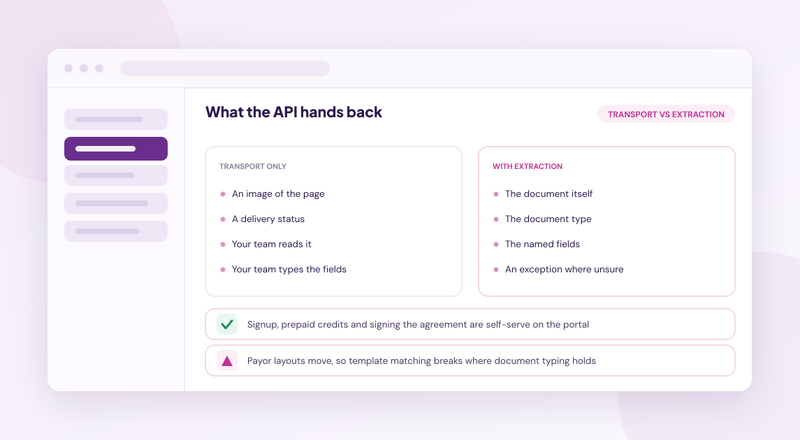
The 99% accuracy figure covers fax extraction only, and that scope is part of the claim rather than a footnote to it. Extraction means lifting named values off a faxed page, such as the referring provider, the date and the reason for the visit. The figure does not extend to referrals, and it does not stand as a verdict on reading medical documents in general.
What Accuracy Does Not Tell You
Extraction accuracy says nothing about classification, about pages that arrive skewed or faint, or about how much somebody had to fix afterwards. OCR reads typed and handwritten pages, and no handwriting percentage is published, so this page quotes none. One percentage cannot carry those four questions at once.
Why Two Vendor Numbers Do Not Compare
Every vendor picks its own document set, its own field list and its own definition of correct, which is why two published percentages sit on different scales. Read each claim on that vendor's own page and note the date you read it. Where a vendor publishes nothing, record it as not published, which means they do not state it publicly rather than that the capability is missing.
What Happens to Documents the AI Cannot Read
Documents the AI cannot read are the real test of an accuracy claim, because behaviour at the edge decides the workload. Three behaviours cover it.
Anything Unusual Becomes an Exception
Anything unusual is flagged as an exception for the coordinator, and judgment calls stay with the team. An exception is a routed task with an owner and a due point, not an error log nobody opens. The difference shows on a Friday afternoon, when an unowned queue quietly stops moving.
Classification Comes Before Extraction
The AI knows a referral from a result from an authorization, so a misread field does not turn into a misfiled document. Sorting matters more to a records manager than field-level accuracy, because a wrong field gets corrected in seconds while a document in the wrong place can be missing for weeks. Ask about sorting before asking about fields.
Speed Does Not Replace Review
A fax batch is read in under 5 seconds, which changes the queue rather than the review step. The practice still decides what gets checked and by whom, and nothing here removes review. The same split applies to calls, which our page on AI voice agents that work with your EHR covers.
Which Healthcare AI Needs the Least Manual Correction
Which healthcare AI needs the least manual correction is a question no vendor page can answer honestly, this one included. The usable answer is a test you run on your own documents, and it takes an afternoon.
Why No Page Can Answer It for You
Correction load depends on your fax quality, your referring offices and your document mix, none of which a vendor sees before a pilot. A vendor quoting a low correction rate is describing its own test set rather than your fax inbox. Treat any such figure as a hypothesis to check.
The Twenty-Document Test
Take 20 recent documents from your own fax inbox, including the two worst pages you can find. Run them through each tool in a pilot and count three things, which are fields you corrected, documents misclassified, and documents that needed a person before anything could happen. Divide each count by 20, and that is your correction load for that tool.
What to Ask For in Writing
Three answers belong in writing before a demo. Which fields are extracted, what happens to a page that fails, and who owns the exception queue. Note the date you got each answer, because a capability described on a call is not the same as a capability described in a document.
What Changes in the Front Office
Changes in the front office are measurable, and the two published results below each carry a practice name and the workflow they measure. Both measure intake work rather than reading accuracy.
- Ozark Dermatology, 5 locations and 14 providers at 250 faxes a day, reclaimed 40 staff hours a week and reached patients the same day.
- Florida Gulf Coast ENT, an ear, nose and throat (ENT) group on ModMed EMA handling up to 25,000 fax pages a month, reports a 92% reduction in triage work and three full-time staff reduced to one and a half.
- Neither figure measures document accuracy, so never merge either one with the fax extraction figure. Our guide to connecting fax and referral software to your EHR covers what intake looks like afterwards.
What This Page Does Not Claim
Five exclusions belong on the record for this page, because an accuracy claim means little without them.
- No accuracy figure is published for handwriting, so none is stated here. OCR reads typed and handwritten pages, which is the published claim in full.
- No classification figure and no correction-rate benchmark are published, which is why this page gives a test to run rather than a number.
- Extraction accuracy is not accuracy at reading medical documents generally, because the 99% figure covers fax extraction only.
- Reading a fax batch in under 5 seconds changes the queue and does not remove the review step.
- Medsender does not claim prior authorization as shipped, and does not claim insurance verification as generally available.
Where Reading Medical Documents Fits in Your EHR
Reading medical documents fits into your EHR at a single point, and the rule belongs here in full. Chart creation and write-back happen if your EHR supports them, and the filing step stays manual where they do not.
What Works in Any EHR
Reading the batch, classifying the document, raising exceptions and contacting the patient work anywhere, because none of those four steps touches your system. A practice without a supported integration still gets the sorting, the exception routing and the patient contact. Our task list for automation without an EHR integration sets out what that leaves behind.
What Depends on the EHR
Posting the finished document back into the chart is the one step that needs support on your side. Both chart creation and write-back happen if your EHR supports them, with 34 named integrations available and 47 more on request. Our comparison of fax and referral software EHR integrations lists what to confirm before signing.
FAQs
Questions records managers ask after a tool has read their documents badly once.
How Accurate Is AI at Reading Medical Documents?
Accuracy depends on what is being measured. The published 99% accuracy figure covers fax extraction only, which is pulling named fields off a faxed page, and it is not a figure for referrals or for document reading generally. No separate figure is published for classification or for handwriting.
What Does the 99% Accuracy Figure Cover?
The 99% accuracy figure covers fax extraction only, and the scope travels with the number. Extraction is one step in a chain that also includes classification, exception handling and filing, none of which the figure describes. Never let it stand in for referral accuracy, and ask any vendor which step its own percentage measures.
Can AI Read Handwritten Referral Faxes?
Yes. OCR reads typed and handwritten pages, so a handwritten referral is in scope. No accuracy percentage is published for handwriting specifically, so none is quoted here, and a page the system cannot read is flagged as an exception for the coordinator rather than guessed at.
Which Healthcare AI Needs the Least Manual Correction?
No page can rank healthcare AI by manual correction load for you, including this one, because the work a tool leaves behind depends on your fax quality, your referring offices and your document mix. Measure it yourself with a twenty-document pilot, counting field edits, wrong classifications and pages that stalled until a person stepped in.
What Happens When the AI Cannot Read a Document?
The page stops with a person rather than being guessed at. Anything unusual is flagged as an exception for the coordinator, and judgment calls stay with the team, so an unreadable page becomes a task somebody owns. Classification happens before extraction, so a page nobody can read does not end up in the wrong place.
Does the Document Get Filed Into the Chart?
Chart creation and write-back happen if your EHR supports them, so the document is filed automatically where that support exists. Where it does not, the filing step stays manual and a person files it, while the reading, the classification and the exception routing run either way. 34 named integrations are available and 47 on request.

Zain Qayyum
Co-Founder and Co-CEO
Zain Qayyum is co-founder and co-CEO of Medsender. His work centres on the front-office problems that decide whether a referred patient is ever seen: inbound fax, referral backlogs, and phones nobody has time to answer. He argues that healthcare's hardest problems are operational rather than technical, and speaks and writes on where AI genuinely helps a practice and where it overpromises. He is based in New York.
Related Signals