Audit Trails for AI Actions on Patient Charts, Common Questions Answered
 Zain QayyumLast Updated: Nov 13, 2026
When software writes to a patient chart, the audit trail is the only record of what it did and why. Among nine vendors read on 12 November 2026, Medsender and eight competitors, two mention an audit trail on a public page and none describes what it records, so the questions below are the ones a buyer has to ask directly.
What a Healthcare Software Audit Trail Should Record
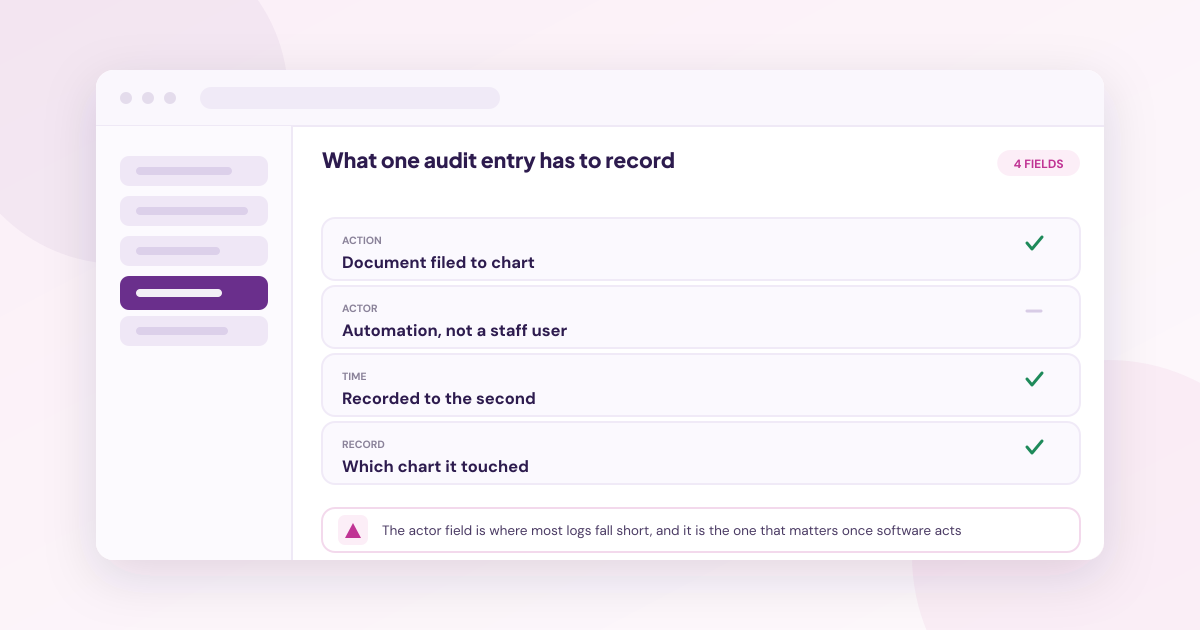
Four elements form the usable minimum: which action was taken, by which actor, at what time, and against which record. The actor field is where most logs fall short, because many were designed when every actor was a person with a username. Without it you can see that a chart entry was created but not what created it, which is precisely the question that matters once software is acting on its own. Ask to see a sample log entry rather than a feature bullet.
Whether an Audit Trail Covers Automated Actions or Only Staff Actions
Automated actions are the gap the category has not caught up with. A log built around human users may record software activity under a generic service account, or under the credentials of whoever configured the integration, which makes automated and manual actions indistinguishable after the fact. Ask whether an entry created by automation is identifiable as such, and whether the log names the specific process that acted. If the answer is that everything appears under one system user, the trail cannot answer the question you will eventually need it for.
How a Practice Would Know if Software Misread a Document
In most cases it would not, because only two mechanisms produce a signal at all. Either low-confidence output is routed to a person before anything is written, or the audit trail surfaces the action in a way somebody actually reviews. Without either, the first indication is usually a patient calling about an appointment nobody booked, or a referring office chasing a consult note for a patient who was never entered. Ask which of the two mechanisms the vendor provides, because a product with neither is relying on luck.
Whether Staff Can Override What Automation Did to a Chart
No vendor among the nine read for this page documents an override mechanism on its public pages, so this has to be asked directly of every one of them. What good looks like is specific: the action can be reversed, the reversal is attributed to the person who made it, and it is recorded as its own event rather than silently replacing the original. A correction that overwrites the record without trace is worse than no correction, because it removes the evidence that something went wrong.
Who Should Be Able to Read the Audit Trail
Role-based permissions should govern the log as well as the chart, and the two are not the same question. The people who investigate an incident are rarely the people who deliver care, so an access model that ties log visibility to clinical role will either block the investigation or over-expose the records. Ask whether log access is a separate permission, who holds it by default, and whether it can be granted without also granting access to the underlying patient records.
Whether You Can Export the Audit Trail
Three moments make export matter: a breach investigation, a compliance audit, and leaving the vendor. In all three you need the record in a form somebody else can read, on a timescale that is not set by the vendor's support queue. Ask what format the export produces, whether it is self-service or a support request, how far back it reaches, and what it costs. An export that requires a ticket and a week is not available during an incident.
How Long Audit Logs Should Be Retained
The Health Insurance Portability and Accountability Act (HIPAA) requires documentation to be retained for six years, which is frequently confused with record retention periods set by state law and with the vendor's own operational retention. Those three are different numbers and only one of them is the vendor's choice. Get the vendor's retention window in writing, confirm whether it changes if you downgrade or cancel, and check whether logs are purged on termination alongside the records themselves.
What HIPAA Actually Requires in an Audit Log
The Security Rule requires mechanisms that record and examine activity in systems containing electronic protected health information. It does not prescribe fields, formats or retention for the log itself. That absence explains why vendor practice varies so widely and why nothing in this area is standardised. The practical consequence is that the buyer has to specify what they need rather than assume a baseline exists, and your own compliance officer or counsel should confirm what applies to your organisation.
Whether a SOC 2 Report Tells You About Audit Logging
Partly, and less than buyers assume. Logging and monitoring sit within the common criteria, so a System and Organization Controls (SOC) 2 Type II report is evidence that controls in that area were tested over a period. What it will not tell you is what a particular product's chart-level log records, who can read it, or whether automated actions are distinguishable. Ask for the report and ask the product questions separately, because the two answer different things.
What to Ask a Vendor About Audit Trails
Five questions cover the ground, and they work better in writing than in a demo. What does the log record, field by field. Are automated actions distinguishable from staff actions. Who can read the log, and is that a separate permission. Can we export it ourselves, in what format, reaching how far back. How long is it retained, and what happens to it when we leave. A vendor that answers all five in writing is a materially different proposition from one that answers none.
Related Reading
Our guide toverifying and overriding AI on the patient chartcovers the review mechanics in more depth.Vetting a healthcare AI vendorcovers the compliance paperwork that sits alongside these questions.What happens to patient data when you leave a vendorcovers the export and termination side.

Zain Qayyum
Co-Founder and Co-CEO
Zain Qayyum is co-founder and co-CEO of Medsender. His work centres on the front-office problems that decide whether a referred patient is ever seen: inbound fax, referral backlogs, and phones nobody has time to answer. He argues that healthcare's hardest problems are operational rather than technical, and speaks and writes on where AI genuinely helps a practice and where it overpromises. He is based in New York.
Related Signals