Evaluating Referral Automation Vendors: Reviews, Trials and What to Ask
 Zain QayyumLast Updated: Nov 23, 2026
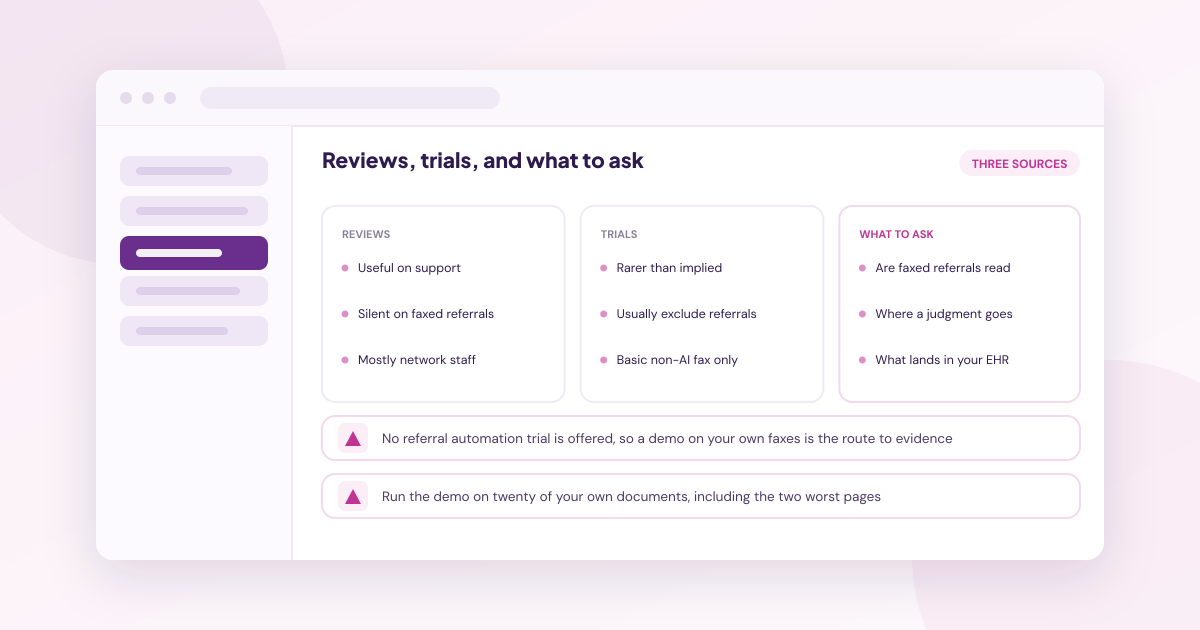
Evaluating Referral Automation Vendors: Reviews, Trials and What to AskReferral automation vendors are hard to compare from reviews, because most reviews in this category never mention a faxed referral. Trials are rarer than the category implies, and the ones that exist usually exclude referral processing. Your own evidence comes from a demo run on your own documents.
Medsender does not offer a referral automation trial. A free trial exists and it is basic non-AI fax only, with no referral processing and no electronic medical record (EMR) integration, which makes a demo on real faxed documents the only route to evidence.
TL;DR
- Reviews of referral automation vendors are useful on support responsiveness and close to useless on referral intake.
- Much of this category's review volume is written by health system and network staff rather than by specialty practices.
- Medsender does not offer a referral automation trial, and the free trial that exists covers basic non-AI fax only.
- Per-unit pricing means a small paid run can serve the purpose a trial would, at $1.20 per referral at low volume sliding to $1.00 as published by Medsender.
- Six demo questions produce more evidence than any star rating, starting with whether faxed referrals are read at all.
- A scoring sheet with one dated source per cell beats a ranking, and "not published" is a legitimate entry.
What Reviews Say About Referral Automation Software
Reviews of referral automation software cluster on two subjects and go quiet on the rest. Knowing which is which turns a review site from an hour wasted into an hour of useful signal. The pattern holds across the category rather than at any one site.
What Reviews Are Genuinely Good For
Three things show up reliably in review text and are hard to learn any other way. Whether support answers at all, and how fast. Whether the front office found the product usable once training finished. Whether the vendor shipped what the salesperson described. Reviewers are candid about all three.
What Reviews Rarely Cover
Three gaps run through the category, and each one is central to a specialty practice.
- Whether faxed referrals are read, or only documents a person uploads by hand
- What happens to a referral that needs a judgment before anything can move
- What the electronic health record (EHR) connection actually reached at that reviewer's practice
Who Writes Them, and Why It Matters
Much of the review volume in this category comes from health system and network staff. A review about tracking referrals across a network does not describe a specialty practice's intake problem. The product being praised may be a different product from the one you are buying.
How to Read a Review in This Category
Search the review text for the word fax before reading anything else. A review that never mentions the document is a review of a different job, however detailed it is about dashboards. Two minutes of that filter removes most of the reading.
Which Referral Automation Vendors Offer a Free Trial
Free trials across referral automation vendors are narrower than the category's marketing suggests, and the narrowing is almost always in the same two places. A trial without referral processing and without the EHR connection tests the login screen. Ask about both exclusions by name.
The Question Behind the Question
Two exclusions decide whether a trial is worth the setup effort. A trial that excludes referral processing does not test referral automation. A trial that excludes the EHR connection does not test what happens after the decision. Both exclusions are normal here, so neither is a scandal and both need asking about directly.
What Medsender Offers, Stated Honestly
Medsender does not offer a referral automation trial. A free trial exists and it is basic non-AI fax only, with no referral processing and no EMR integration, and its advertised length is conflicted across published sources so no figure appears here. That makes the sales demo the place where a practice gets its own evidence, which changes how the demo should be run. Send a batch of your own paperwork in advance, invite the coordinator who will use the product, and ask for the screen rather than the slide deck. A session run that way produces more signal than a fortnight of self-serve clicking around an empty account.
What Other Vendors Publish
Every trial term belongs to the vendor that publishes it, so read it on their page and write down the date you read it. Where a vendor publishes nothing, record "not published", which means they do not state it publicly rather than that no trial exists. Vendors worth checking directly are Tennr, ReferralMD, LeadingReach, Linear Health, Assort Health, Plena Health and Valerie Health. Our roundup of ReferralMD alternatives lists where each one publishes.
The Paid Pilot Alternative
Per-unit pricing makes a small paid run a practical substitute for a trial, because you can cap the spend at a known number of documents. Medsender publishes referrals at $1.20 each at low volume sliding to $1.00, and fax at $0.08 per page sliding to $0.056. Patient Recapture is billed on outcomes, so you only pay for completed appointments, not activity. See how practice automation is priced for the full structure.
What to Test Instead of Reading Reviews
Three tests give a practice its own evidence inside one week of evaluation, and none of them uses the vendor's sample files. Each test targets a different failure mode. Run all three against every shortlisted product so the answers are comparable.
Send Your Own Fax Batch
Use real faxed referrals, including the handwritten pages and the scans that came through crooked. Optical character recognition (OCR) that reads typed and handwritten pages is a claim to verify rather than accept. Medsender reads a fax batch in under 5 seconds, which is a figure you can time yourself with a stopwatch.
Hand It Something Ambiguous
Mix a result and an authorization into the batch without warning the vendor. The behaviour to look for is that the software knows a referral from a result from an authorization, and that anything unusual is flagged as an exception for the coordinator with judgment calls left to the team. A product that classifies everything confidently is failing this test rather than passing it.
Ask What Lands in the EHR
Chart creation and write-back happen if your EHR supports them, and not every EHR does. Get the answer for your own EHR by product name, in writing, before signing anything. The published 99% accuracy figure covers fax extraction only and carries that scope every time it is quoted.
What to Ask in a Referral Automation Demo
Six questions make a demo useful, and each one has a weak answer worth recognising on the spot. Write the weak answers down as given rather than paraphrasing them. A vendor that produces four strong answers and two blanks is still a clearer proposition than one that produces six sales lines.
The Six Questions
Read each question as written and note which column the answer lands in.
| Question | What a weak answer looks like |
|---|---|
| Does it read faxed referrals | only uploaded files |
| Where do exceptions go | no named owner |
| Which outreach channels | a portal message only |
| What happens in our EHR | a logo, no mechanism |
| What does it cost per unit | a quote after a call |
| Is a BAA included | an upcharge, or silence |
The Follow-Up That Matters
Ask for the answer about your own EHR by product name, not by category. A logo strip on a web page is not an integration and should never be read as one. The follow-up takes ten seconds and it separates a published connection from a marketing asset.
What Not to Accept as an Answer
Three answers should not survive the demo without a written correction.
- Prior authorization is not automated, and no vendor should describe it as shipped
- Medsender does not claim insurance verification as a generally available capability
- A business associate agreement (BAA) is included free with every Medsender account, so a vendor that cannot match that in writing is answering a narrower question
Scoring the Shortlist Without Star Ratings
A scoring sheet replaces the star rating with six criteria you fill in yourself, applied identically to every vendor including Medsender. One dated source per cell is the rule. The sheet is dull to complete and it survives a board question, which a star average does not.
The Six Criteria
Six criteria cover what a practice actually buys.
- What arrives and what the software can read, including faxed referrals
- Where the referral goes when it needs a judgment
- What reaches the patient, and on which channels, under your own consent and opt-out policy
- What happens in the EHR, and under what condition
- What the vendor publishes about price
- What the vendor publishes about security and a business associate agreement
How to Fill It In
One source per cell, which is the vendor's own page, read and dated in the margin. Record "not published" wherever nothing is stated, because it is more useful than a guess and it is honest about where the evidence stops. Medsender goes on the same sheet under the same rule, including its real limitations.
Medsender's Honest Limitations on This Sheet
Five entries belong in Medsender's own limitation column, and each one is a limitation rather than a nuance.
- Chart creation and write-back happen if your EHR supports them, and some EHRs do not
- Never score prior authorization as a shipped capability, because it is not one
- Never score insurance verification as generally available, because it is not
- Microsoft SSO is the only single sign-on supported
- No contractual uptime commitment is published, so no availability figure belongs in the cell
Human support runs 9AM to 5PM EST, which belongs on the sheet next to the support criterion. Our guide to what to expect from a healthcare software vendor covers the onboarding side of the same conversation, and Tennr and ReferralMD compared with Medsender works the six criteria through named vendors.
FAQs
Questions from practices at final shortlist stage with two or three vendors in front of them.
What Do Reviews Say About Referral Automation Software?
Reviews land on two subjects and skip a third. Reviewers are candid about whether support replies, whether the front office could use the product after training, and whether shipped features matched the pitch. They rarely say what happened to a faxed referral, where an exception went, or what the integration reached in their own system.
Which Referral Automation Vendors Offer a Free Trial?
Fewer than the category implies, and the terms belong to each vendor's own page rather than to any roundup. Read the trial page, write down the date you read it, and record "not published" where nothing is stated. Check whether referral processing and the EHR connection are inside the trial or excluded from it.
Does Medsender Offer a Free Trial for Referral Automation?
No. Medsender does not offer a referral automation trial. The free trial on the site is limited to basic non-AI fax, and it excludes referral processing and EMR integration. Practices assessing the referral side book a demo instead, bringing real scanned referrals so the coordinator can judge what comes back.
What Should We Ask in a Healthcare Software Demo?
A healthcare software demo should cover six things, in this order. Does it read faxed referrals. Where do exceptions go and who owns them. Which outreach channels reach the patient. What happens in our EHR by product name. What does it cost per unit. Is a business associate agreement included. Record every answer verbatim.
Are Software Review Sites Reliable for Healthcare Products?
Reliable on support and usability, unreliable on document intake. Much of the review volume in this category comes from health system and network staff describing a different job from specialty practice intake. Filter the review text for the word fax before you read, and treat the rest as background.
How Much Does Referral Automation Cost Per Referral?
Medsender publishes $1.20 per referral at low volume, sliding to $1.00 as volume rises, and fax at $0.08 per page sliding to $0.056. Patient Recapture is billed on outcomes, so you only pay for completed appointments, not activity. Most vendors in the category publish no per-unit figure at all.
Can We Run a Paid Pilot Instead of a Trial?
Often yes, and per-unit pricing is what makes it workable. Cap the run at a known number of documents and you have a bounded spend with real evidence at the end. Agree in writing which documents are in scope and what happens to them if you do not proceed.

Zain Qayyum
Co-Founder and Co-CEO
Zain Qayyum is co-founder and co-CEO of Medsender. His work centres on the front-office problems that decide whether a referred patient is ever seen: inbound fax, referral backlogs, and phones nobody has time to answer. He argues that healthcare's hardest problems are operational rather than technical, and speaks and writes on where AI genuinely helps a practice and where it overpromises. He is based in New York.
Related Signals