When a Fax Fails or Goes Missing
 Zain QayyumLast Updated: Nov 23, 2026
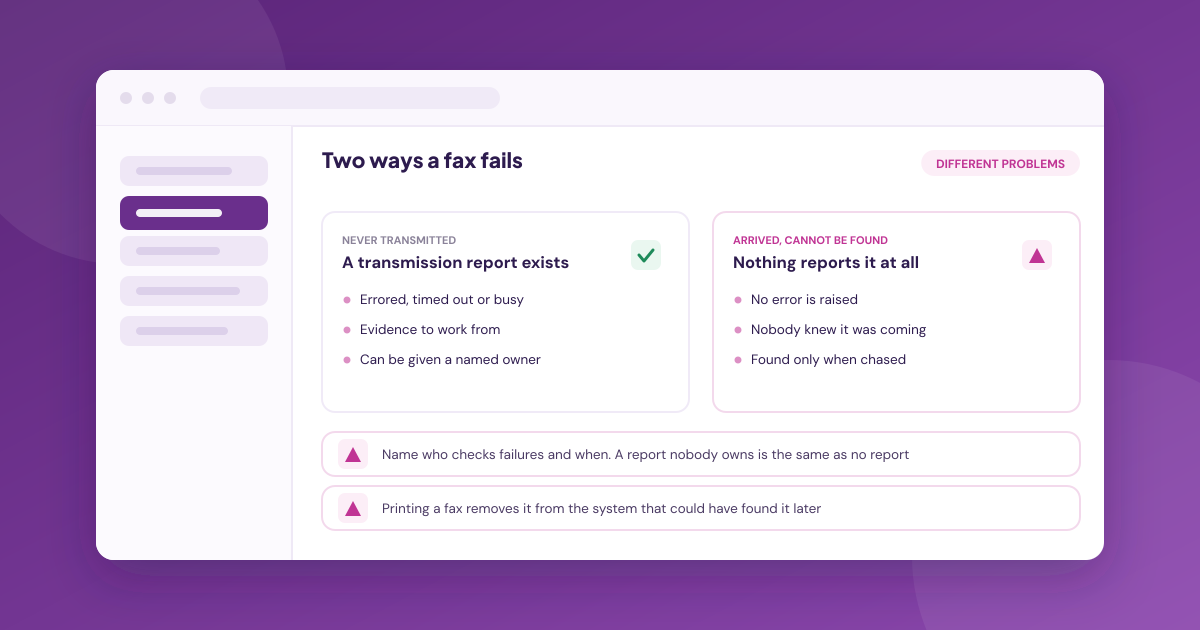
When a Fax Fails or Goes MissingA failed fax delivery covers two problems under a single name. Either the fax never transmitted, which produces an error somebody can act on, or it transmitted and nobody can find it, which produces nothing at all and surfaces weeks later during an audit.
The first is a technical problem with an owner and a report behind it. The second is a custody problem with no error state, which is why it is found during a records request rather than on the day it happens.
TL;DR
- A failed fax delivery is either a fax that never transmitted or a fax that arrived and cannot be found.
- An outbound failure leaves a transmission report, so it has evidence and can be assigned to a named person.
- An inbound fax that goes missing produces no error, because nothing reports a fax you never knew was coming.
- A fax confirmation proves the receiving machine answered, not that a person read the document.
- Audit retrieval needs search by patient, sender and date, because those are the three things a records request gives you.
- Retention is set by the practice's own policy and by state law.
What a Failed Fax Delivery Actually Is
A failed fax delivery covers two failures that look nothing alike in the front office. One of them reports itself. The other one does not.
The Fax That Never Transmitted
An outbound send that errored, timed out or hit a busy line is a transmission failure. It leaves a transmission report, which makes it the easier of the two problems to own.
The report exists whether or not anybody reads it, and that distinction matters more than the error code printed on it.
The Fax That Arrived and Disappeared
A fax can transmit cleanly, print, and then go into a pile, a drawer or a scanner queue instead of the electronic health record (EHR). No error fires, no report flags it, and nobody knows to look for it.
Documents lost after arrival are more frequent than sends that never completed.
Why Outbound Faxes Fail
Outbound faxes fail for three kinds of reason, and only one of them is anybody's fault. Sorting the three apart is what makes a retry rule possible.
The Receiving End
A busy line, no answer, a machine out of paper or a number that now rings to a phone all produce the same unhelpful result. Nothing on your side is broken, so retrying blind becomes the default response.
The Document Itself
Page count and line quality interact, and long sends drop part way through. Dark scans, skewed pages and oversized attachments are the ordinary culprits.
A 60-page record sent in one go carries a different risk from six 10-page sends, and splitting it is usually quicker than diagnosing it.
The Number
A misdial sends protected health information (PHI) to a stranger, which is a disclosure rather than a delivery failure. Keep the two categories separate in the practice's own log, because they call for different responses.
A wrong number also keeps returning clean confirmations, so nothing in the fax record will ever tell you it happened.
How to Handle a Failed Fax Delivery
Handling a failed fax delivery is a procedure rather than a product. Four decisions made in advance remove the judgment calls from the busiest hour of the day.
Decide the Retry Rule Before It Happens
Write down how many attempts, how far apart, and what happens after the last one. Three attempts twenty minutes apart, then a phone call to the recipient, is a rule anybody can follow.
An undefined retry rule turns every failure into a fresh decision at the worst possible moment.
Give the Failure an Owner, Not a Queue
Name the person who checks failures and the time of day they check them. A report nobody is assigned to read is the same as no report at all.
Task it to someone by name, because roles rotate and a named person does not get confused with a job title.
Tell the Referring Office Before They Call You
Call the office that is waiting on the document before it calls you. The waiting office tends to notice first otherwise.
One call out protects the relationship that sends you work. Our guide to connecting fax and referral software to your EHR covers the inbound half of the same relationship.
Separate Delivery Failure From Disclosure
A wrong number belongs in the practice's incident process, not in the retry queue. Route it that way in writing now.
Deciding the route during an incident goes badly, because the people deciding are usually the people who made the misdial.
How to Catch an Inbound Fax That Went Missing
An inbound fax that went missing will not be found by looking harder at your own records. The only reliable check runs against what the sender says it sent.
The Silent Failure Has No Error to Find
You cannot audit what you never knew arrived. Nothing alerts on a document that was never logged, so your own system is not a witness to its own gap.
Reconcile Against the Sender
Pick one high-volume referring office and compare their send log against your month. Twenty documents and an afternoon will tell you whether you have a custody problem.
Repeat the exercise with a second office before concluding anything, because one quiet month on its own proves very little.
Printing Is the Step That Loses It
Every fax that becomes paper leaves the system that could have found it later. Practices running at volume feel that hardest.
Florida Gulf Coast ENT, an ear, nose and throat (ENT) practice on ModMed EMA, handles up to 25,000 fax pages a month. Ozark Dermatology, with 5 locations and 14 providers, handles 250 faxes a day.
Where a Practice Finds a Fax Needed for an Audit
An audit request for a fax asks for one named document on one named date. Whether a practice can produce it was settled months earlier.
What the Request Actually Asks For
One named document, for one patient, on or around one date, with some indication of when it arrived. A pile of scanned files in a shared drive cannot answer the date half of that.
The Health Insurance Portability and Accountability Act (HIPAA) governs the safeguard side of retrieval, and our guide to HIPAA compliant faxing covers what the rule asks for.
Search by Patient, Sender and Date
Patient, sender and date are the three fields a request hands you, so they are the three a practice has to be able to search. A fax that was read, classified and kept in the fax inbox stays findable on all three.
A fax that was printed is findable only if a person filed it correctly. Our guide to filing faxes to the chart covers that decision in detail.
Who Is Allowed to Retrieve It
Role-based user permissions decide who can open which documents, and an audit makes that matter more rather than less. Any vendor in the retrieval path needs a business associate agreement, and Medsender includes one free with every account.
How Long to Keep It
Retention is set by the practice's own policy and by state law. This page names no number of years and offers no legal advice, so put the question to your own counsel.
What to Put in Place This Quarter, and What to Decide First
Three things close most of the gap, and the first is a decision rather than a purchase. Decide where faxes land, then decide who owns the exceptions.
One Place Where Every Fax Lands
A single destination beats four good habits. If a fax can arrive in three places, retrieval will fail in at least one of them.
Groups with several sites should settle this before the second site goes live. Our guide to a multi-location rollout one clinic at a time covers the sequencing.
A Named Owner for Failures and Exceptions
Name the person, not the role. Anything unusual is flagged as an exception for the coordinator, and judgment calls stay with the team.
Give that owner a stated time of day for the check, so the queue is worked on a schedule instead of whenever somebody notices it.
Where Automation Helps and Where It Does Not
Receiving, reading, classifying, routing and keeping a searchable record can all run without a person. Medsender reads a fax batch in under 5 seconds, and its optical character recognition (OCR) reads typed and handwritten pages.
Medsender publishes 99% accuracy for fax extraction, and that figure covers fax extraction only. Chart creation and write-back happen if your EHR supports them, and the filing step stays manual where your EHR does not support them.
Ozark Dermatology reclaimed 40 staff hours a week and reached patients the same day. Florida Gulf Coast ENT reports a 92% reduction in triage work, going from three full-time staff to one and a half. Deciding what a damaged or ambiguous document is still needs a person.
FAQs
Common questions from the people who own the fax inbox.
What Causes a Fax to Fail to Send?
Most send failures come from the far end rather than from your own equipment. A busy line, no answer, a machine out of paper or a reassigned number all produce the same result. Document problems account for the rest, usually dark scans, skewed pages, or a send too long to complete in one attempt.
How Should a Practice Handle a Failed Fax Delivery?
A practice should write its failed-fax rule before it needs it. Set the number of attempts and the interval, name the person who reviews failures and when they do it, and call the waiting office rather than letting it call you. Send a wrong number to the incident process instead of the retry queue.
How Do We Find Out an Inbound Fax Never Arrived?
By reconciling with the sender, because nothing on your side reports a document you never knew about. Ask one busy referring office for its send log and compare it against your own month. Twenty items and an afternoon are usually enough to show whether documents are going astray.
Where Does a Practice Find a Fax Needed for an Audit?
A fax needed for an audit sits in whichever system holds the document with its arrival date attached. Searching by patient, sender and date answers a records request, while a shared drive of scanned files answers only part of it. Faxes that were printed are retrievable only if somebody filed them where the policy said.
Does a Fax Confirmation Prove the Document Was Received?
No. A confirmation records that the receiving machine answered and accepted the pages, which is not the same as a person reading them. A document can confirm, print and then sit in a tray for a week. Treat confirmation as proof of transmission and nothing beyond that.
How Long Should a Practice Keep Faxed Records?
As long as the practice's own retention policy and state law require, which this page deliberately does not specify. Write the policy down, confirm that the system you use can honour it, and check who is able to delete a document. Have your own counsel confirm the period.
Can Staff Retrieve a Fax Without Seeing Every Patient's Documents?
Yes, if the system sets permissions per person rather than per practice. Role-based user permissions limit each login to the records that person's job requires, so a biller searching for one patient's fax never opens the rest. A shared login defeats that, and Medsender supports Microsoft single sign-on for the practices that want it.

Zain Qayyum
Co-Founder and Co-CEO
Zain Qayyum is co-founder and co-CEO of Medsender. His work centres on the front-office problems that decide whether a referred patient is ever seen: inbound fax, referral backlogs, and phones nobody has time to answer. He argues that healthcare's hardest problems are operational rather than technical, and speaks and writes on where AI genuinely helps a practice and where it overpromises. He is based in New York.
Related Signals