What HIPAA Compliant Faxing Is, and Why Practices Still Fax
 Zain QayyumLast Updated: Nov 23, 2026
What HIPAA Compliant Faxing Is, and Why Practices Still FaxFaxing under the Health Insurance Portability and Accountability Act (HIPAA) was never prohibited, and HIPAA compliant faxing is sending and receiving protected health information (PHI) by fax with the safeguards the rule requires and a signed business associate agreement covering every vendor in the path.
Compliance is a property of the whole path rather than a badge on a product. A practice can buy a compliant service and still run a process that is not compliant.
TL;DR
- HIPAA compliant faxing is fax handling of protected health information under the safeguards the HIPAA Security Rule requires.
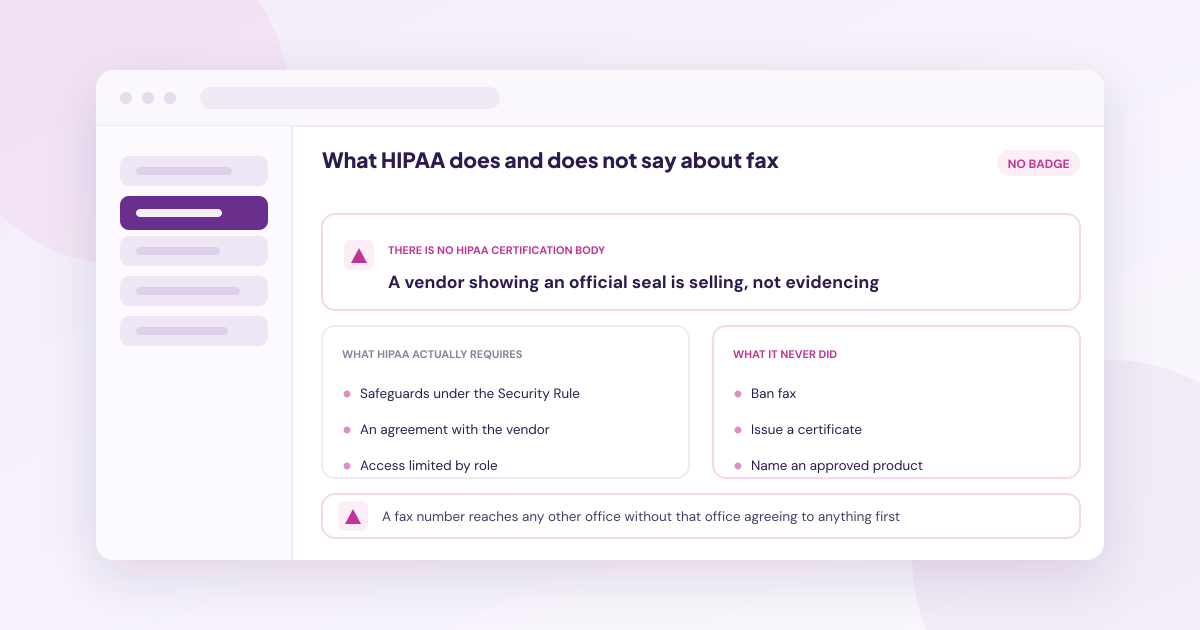
- HIPAA never banned fax, and there is no HIPAA certification body, so a vendor claiming an official seal is selling rather than evidencing.
- Practices still fax because a fax number reaches any other office without that office agreeing to anything first.
- Healthtech companies still handle faxes because the sender picks the channel, and refusing fax means refusing the work.
- A business associate agreement is required for any vendor that handles the practice's protected health information, and Medsender includes one free with every account.
- Compliance usually breaks after the fax arrives, on the printed page and the shared login, not on the line.
What HIPAA Compliant Faxing Means
HIPAA compliant faxing describes a practice's own process, not a purchase. Nothing in the rule names a particular machine, a particular brand or a particular deployment model.
The Definition, Stated Plainly
HIPAA compliant faxing is fax handling of protected health information under the administrative, physical and technical safeguards the Security Rule requires. The definition covers the whole path rather than one link in it.
A cloud fax account with a signed agreement does not make the hallway printer compliant. A locked fax room does not help if the vendor holding the document has no agreement in place.
What the Rule Asks For and What It Does Not
The Security Rule asks for access controls, protection of electronic protected health information in transmission, and an agreement with any vendor that handles it. The technical safeguards sit at section 164.312 of Title 45 of the Code of Federal Regulations (CFR), and the Department of Health and Human Services publishes its own Security Rule guidance.
What the rule does not provide is a certification. There is no HIPAA certification body and no official seal, so treat any claim of one as marketing rather than evidence. Nothing on this page is legal advice, and a practice should have its own counsel review its own setup.
Why Medical Practices Still Use Fax Machines
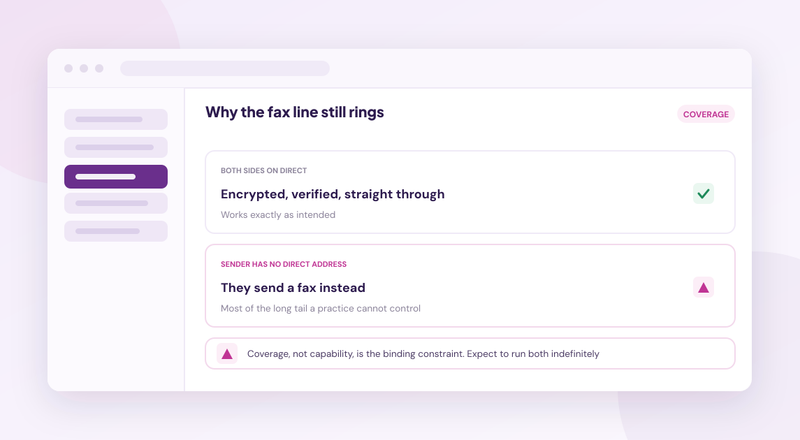
Fax machines persist in medical practices for one structural reason, which is that a fax number works without the other side agreeing to anything. Every alternative asks the referring office to adopt something new. Fax asks nothing.
The Fax Reaches Any Office Without Setup
A fax number works whether the office on the other end runs a modern electronic health record (EHR), a legacy system nobody has upgraded, or a filing cabinet. Nothing has to be provisioned, licensed or supported on the far end.
The sender needs a number and a document, which is why the channel has outlasted several generations of intended replacement.
The Portal Needs an Account on Both Sides
Portal delivery assumes the referring office will log in to somebody else's system, remember which one, and keep a password for it. A practice with twelve referral sources is asking twelve front offices to adopt a thirteenth login.
Every practice that has tried this has a story about the portal nobody checks. For the integration side of that problem, see our guide to connecting fax and referral software to your EHR.
Fax Is a Habit the Whole Market Shares
Leaving fax is not a decision one practice gets to make on its own. A practice that turns off its fax number is asking every referring office to change how it sends work, and referral sources tend to respond by sending the work somewhere easier.
The pattern is a general one rather than something measured here, and no figure is attached to it. Our list of referral management software for specialty practices covers the tooling side of the same dependency.
Why Healthtech Companies Still Handle Faxes
Healthtech companies inherit fax traffic whether or not they planned for it. The sender chooses the channel, and in healthcare the sender frequently chooses fax. Product roadmaps meet that fact late.
The Document Arrives However the Sender Chooses
A product can offer structured intake, a clean application programming interface (API) and a partner portal, and still receive most of its document volume as a faxed PDF. Refusing fax means refusing the work.
Fax support therefore turns up in roadmaps that never planned for it.
Building Fax Is Not the Same as Building the Fax Inbox
Transport is the easy half of the problem, and a developer-facing fax API covers it. The hard half is reading the page, working out what it is, and getting it to the right place.
Medsender reads a fax batch in under 5 seconds, and its optical character recognition (OCR) reads typed and handwritten pages, which is the half that gets underestimated. Medsender publishes fax at $0.08 per page at low volume, sliding to $0.056 per page at higher volume.
What Makes a Fax Service HIPAA Compliant in Practice
A fax service earns the word compliant through contracts, encryption and access control, roughly in that order. Each one is a question a practice can put to a vendor in writing. The answers become easy to compare once they are on paper.
The Business Associate Agreement Comes First
Any vendor that creates, receives, maintains or transmits the practice's protected health information needs a business associate agreement. Medsender includes a business associate agreement free with every account.
Ask every vendor on a shortlist whether the agreement is included or billed, because the answer says something about how the vendor views the obligation.
Encryption in Transit and at Rest
Medsender uses 256-bit Secure Sockets Layer (SSL) encryption in transit and 2048-bit encryption at rest. Hosting is on Google Cloud with United States servers, browser only, with no on-premise install to patch or back up.
Medsender also holds System and Organization Controls (SOC) 2 Type II, with controls tested continuously by an independent auditor. The report is available through the Trust Center on request.
Who Can Open the Document
Role-based user permissions decide who sees which faxes, and they are the control that survives staff turnover. Microsoft single sign-on is what Medsender supports, so a practice should confirm what its own vendor offers rather than assume more.
Where Fax Compliance Actually Breaks in a Practice
Compliance failures around fax are rarely technical. The encryption holds, the agreement is signed, and the exposure sits in the twenty feet between the machine and the chart.
The Printed Page Nobody Owns
The riskiest moment for a faxed document is usually after it has safely arrived. A page sitting on a shared tray has left every control the practice paid for, and no record exists of who read it.
Treat the print step as the point where custody ends.
The Shared Inbox Everyone Can See
One login for the whole front office defeats role-based user permissions before anyone configures them, and no question about who opened a document can be answered afterwards.
The fix is an account per person, not a stronger password on the shared one. Our guide to faxes that fail or go missing covers what happens when nobody owns the inbox.
The Fax That Went to the Wrong Number
A misdial is the ordinary failure in a fax process, and it is a disclosure rather than a delivery problem.
Decide now who is told, how it is recorded, and who contacts the unintended recipient. Deciding during the incident goes badly.
What to Put in Place This Quarter, and Where to Start
Three decisions close most of the gap, and none of them requires a purchase. Name the destination, name the owner, and know which steps a person keeps.
Decide Where Faxes Live After They Arrive
Name the destination for every inbound fax before touching any product question. The fax inbox, the chart, or a task for a named person, and nothing else.
A document that can arrive in three places will go missing in at least one of them. Our guide to filing faxes to the chart covers what the destination choice depends on.
Ask Every Vendor Three Questions
Three questions separate vendors quickly. Will you sign a business associate agreement, where is the data held, and who on my team can open a document.
A vendor that answers all three in writing is a vendor the practice can audit later.
Where Automation Helps and Where It Does Not
Receiving, reading, classifying and routing an inbound fax can all run without a person. Chart creation and write-back happen if your EHR supports them, and the filing step stays manual where your EHR does not support them.
Deciding that something is wrong with a document still needs a person. Anything unusual is flagged as an exception for the coordinator, so judgment calls stay with the team.
FAQs
Common questions from practices and healthtech teams that still run on fax.
What Is HIPAA Compliant Faxing?
HIPAA compliant faxing means every step that touches a patient document meets the Security Rule, from the desk that sends it to the contract behind the service that carries it. A tray of printed pages in a corridor undoes an otherwise sound setup, so the real question is custody.
Does HIPAA Allow a Practice to Send Patient Records by Fax?
Yes. The rule permits fax and sets conditions on it, which is why fax remains common in healthcare. A practice has to apply access controls, protect the transmission and hold an agreement with any vendor handling the documents. Nothing in the rule bans paper.
Why Do Medical Practices Still Use Fax Machines?
Because a fax number reaches any other office without that office agreeing to anything first. Portals need an account on both sides, and interface projects need both vendors to cooperate. Fax needs a number and a document, so a practice cannot leave the channel while its referral sources still use it.
Why Do Healthtech Companies Still Handle Faxes?
Because the sender picks the channel. A product can offer structured intake and still receive most of its document volume as a faxed PDF, so refusing fax means refusing the work. Transport is the easy half, and reading the page then routing it correctly is the part that gets underestimated.
Is a Business Associate Agreement Required for a Fax Service?
Yes. Any company that stores or transmits your patients' documents on your behalf falls inside the definition, and a cloud fax provider plainly does. Medsender supplies the business associate agreement free with every account. Put the same question to each shortlisted supplier before the quote arrives.
Is a Cloud Fax Service Safer Than a Fax Machine?
A cloud fax service moves the risk rather than removing it. Transmission gains 256-bit encryption, role-based user permissions decide who opens a document, and nothing sits on a tray in a corridor. A machine in a shared room offers none of that, though a cloud account the whole front office signs into with one login gives much of it back.
Is There a HIPAA Certification for Fax Vendors?
No. There is no HIPAA certification body and no official seal, so no vendor can be certified compliant by anyone. What a vendor offers instead is evidence, meaning a signed business associate agreement, a System and Organization Controls (SOC) 2 Type II report, and written answers on where data is held.

Zain Qayyum
Co-Founder and Co-CEO
Zain Qayyum is co-founder and co-CEO of Medsender. His work centres on the front-office problems that decide whether a referred patient is ever seen: inbound fax, referral backlogs, and phones nobody has time to answer. He argues that healthcare's hardest problems are operational rather than technical, and speaks and writes on where AI genuinely helps a practice and where it overpromises. He is based in New York.
Related Signals