Tracking Referral Status Across Locations, and What to Report
 Zain QayyumLast Updated: Nov 23, 2026
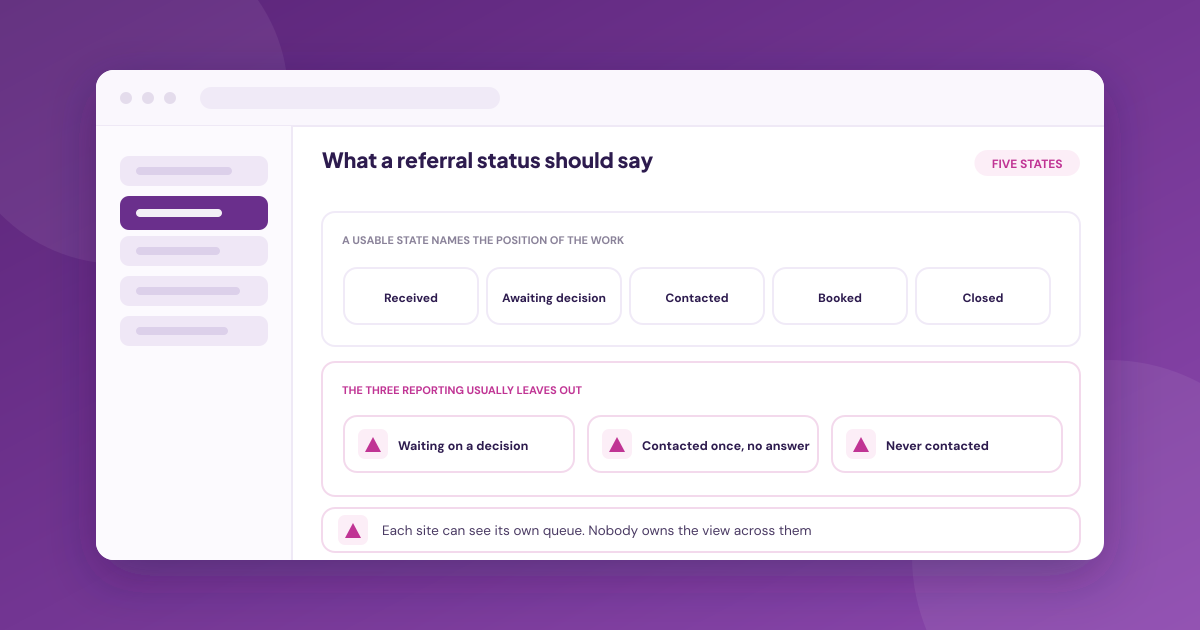
Tracking Referral Status Across Locations, and What to ReportReferral status is easy to read in one office and hard to read across six. A single queue is legible to whoever works it, and nobody owns the view across sites, which is why group reporting usually counts arrivals and bookings and leaves out the states in between.
Three of those in-between states are where referrals are actually lost. Waiting on a decision, contacted once with no answer, and never contacted at all. None of the three produces an error, so none of them appears in an exception report.
TL;DR
- Referral status should express where the referral is, not who last opened it, and five or six states is enough for a group.
- Status tracking breaks at the group level because each site can see its own queue and nobody owns the view across them.
- The three states most reporting omits are waiting on a decision, contacted once with no answer, and never contacted.
- Measure time to first patient contact in hours from receipt, per location, rather than time to filing.
- Report the never-contacted figure as a count per location per month, and treat an inability to produce it as the finding.
- Central intake buys one process and one place to look, and costs local knowledge about providers and referral sources.
What Referral Status Is Supposed to Tell You
Referral status answers one question for an operations lead. Where is this referral now, and what has to happen next. A status model that answers a different question, such as which member of staff touched it last, produces a log rather than a report, and a group cannot act on a log.
Status Describes the Referral, Not the Staff
A useful state names the position of the work. Received, awaiting a decision, patient contacted, booked, seen, closed unbooked. Five or six states is enough to run a group of any size, while a model with twenty becomes a filing exercise that coordinators learn to route around, and the states they skip are the ones you most needed.
The States Most Reporting Leaves Out
Three states go missing from almost every referral report.
- Waiting on a decision
- Contacted once, no answer
- Never contacted
None of the three is an error, nothing is misfiled and no field is blank, so exception reporting is blind to all of them. A referral sitting in any of the three looks identical in a monthly total to a referral that is progressing normally.
Why Tracking Breaks at More Than One Location
Multi-location groups rarely have a tracking problem inside a location. The breakage is at the seams, where one site's queue ends and another's begins, and where a referral that belongs to the group belongs to nobody in particular. Adding sites changes the shape of the problem rather than its size.
Every Site Can See Itself
A coordinator working one queue knows what is in it, which referrals are old and which patients have been chased. That knowledge lives in a person rather than in a report, and it does not aggregate. Put six such sites together and the group has six accurate local pictures and no accurate shared one.
Volume Is Not the Variable, Ownership Is
Adding a location multiplies handoffs rather than work. A referral that arrives at the wrong site, names a provider who moved, or needs a service only 2 of your clinics offer has to cross a boundary, and boundaries are where ownership lapses. Two sites running what is written as one process will generally diverge, because each resolves ambiguity in its own way.
What to Measure, Per Location
Three measures tell a group most of what it needs, and all three are reported per location rather than as a group average. An average across sites hides the site that is struggling, which is the only site the number was supposed to help you find.
Time to First Patient Contact
Measure hours from receipt to the first outbound attempt, at each site, and compare them. Time to filing is easier to produce from any electronic health record (EHR) and it flatters the group, because filing is entirely inside your control. First contact is the step the patient and the referring office experience, so it is the one that predicts whether a referral converts.
Referrals Received Per Source, Over Time
Track referrals received per referring office per month, as a trend rather than a total. A source sending 12 referrals a month that sends 7 this month and 4 the next is telling you something before any group-level number moves. Per-source tracking is rare in practice groups, and it is the measure that gives earliest warning of a referring office tapering off.
The Never-Contacted Count
Report never-contacted referrals as a count, not a rate, per location per month. A rate invites argument about the denominator and a count does not, and a count of 9 at one site and 31 at another starts a useful conversation immediately. If the number cannot be produced at all, that is itself the finding, and it usually means status is being recorded against staff activity rather than against the referral.
Central Intake or Local Intake
Centralising referral intake is the structural decision behind most of this, and it is a genuine trade-off rather than a best practice. Groups go both ways for defensible reasons, and the right answer depends on how different your sites really are.
What Central Intake Fixes
Central intake gives a group one process, one set of states and one place to look. Cover is easier, because 2 or 3 people covering one queue absorb holidays better than 6 individuals each covering their own. Reporting becomes a by-product rather than a monthly collection exercise, and new starters learn one way of working.
What It Costs
Local knowledge is the price of centralising referral tracking. A coordinator who has worked one clinic for 5 years knows which provider takes which cases, which referring office always omits the insurance detail, and who to call at the hospital. Centralising moves that into documentation that is never quite complete, so state the trade-off to your partners and let them choose it rather than discover it.
Where Reporting Comes From, and Which Numbers to Trust
Referral reporting has two possible sources and most groups use only the first. The EHR reports on records it holds, and the intake layer reports on work that passed through it. Knowing which system can answer which question saves a quarter of pointless report requests.
What the EHR Reports and What It Does Not
Most electronic health records report accurately on what was filed and poorly on what was never actioned, because a referral that nobody worked leaves no record to count. Ask your own vendor directly, whether that is ModMed, athenahealth or another system, which of the three missing states its standard reports can produce. The answer is often one of the three, and knowing which one tells you what has to come from somewhere else.
Where Automation Helps
Acknowledgment to the referring office, status updates and patient outreach can all be generated without a person, which means the status trail exists whether or not anybody remembers to update it. Creating or updating the chart happens if your EHR supports chart creation and write-back, so confirm that before assuming the filing step disappears. A 110-location group with 325 providers reports referral conversion moving from 20% to 62% on that basis.
Deciding that a referral cannot be served still needs a person, and so does any case flagged as an exception. Our guide to a multi-location rollout one clinic at a time covers sequencing across sites, patient outreach for multi-location groups covers the contact side, and what referral leakage is covers the three missing states in more depth.
FAQs
Common questions from operations leads reporting on referral status across sites.
How Do Practices Track Referral Status Across Locations?
With a shared state model and one place to look. Each site keeps working its own queue, but the states are defined once for the group so the same referral means the same thing everywhere. Without that, a group ends up with several accurate local pictures and no reliable shared one. See referral management software for specialty practices.
What Referral Metrics Should a Practice Group Report?
Three per location each month. Time to first patient contact in hours from receipt, referrals received per referring office as a trend, and the never-contacted count as a raw number. Report all three by site rather than as a group average, because an average conceals the one site that needs attention.
Are Referral Metrics Built Into Practice Management Reporting?
Partly, and the gap is predictable. Standard reporting counts referrals received and appointments booked because both leave records. Referrals nobody actioned leave nothing to count, so they rarely appear. Ask your vendor which of waiting on a decision, contacted once, and never contacted its reports can produce today.
What Is a Referral State Model?
A referral state model is the agreed list of positions a referral can occupy between arrival and closure. Five or six states is usually enough, such as received, awaiting a decision, patient contacted, booked, seen and closed unbooked. Each state describes where the referral is rather than who last handled it.
Should a Multi-Location Group Centralise Referral Intake?
Centralising buys one process, easier cover and reporting as a by-product. It costs local knowledge about providers and referring offices that is hard to write down. Groups whose sites genuinely differ in services and referral sources often keep intake local and standardise only the state model and the reporting.
How Do You Measure Time to First Patient Contact?
Take the timestamp the referral arrived and the timestamp of the first outbound attempt to the patient, and report the difference in hours per location. Use the first attempt rather than the first successful contact, so the measure reflects what your team did rather than whether the patient answered.

Zain Qayyum
Co-Founder and Co-CEO
Zain Qayyum is co-founder and co-CEO of Medsender. His work centres on the front-office problems that decide whether a referred patient is ever seen: inbound fax, referral backlogs, and phones nobody has time to answer. He argues that healthcare's hardest problems are operational rather than technical, and speaks and writes on where AI genuinely helps a practice and where it overpromises. He is based in New York.
Related Signals