What Referral Leakage Is and Where Referrals Actually Go
 Zain QayyumLast Updated: Nov 23, 2026
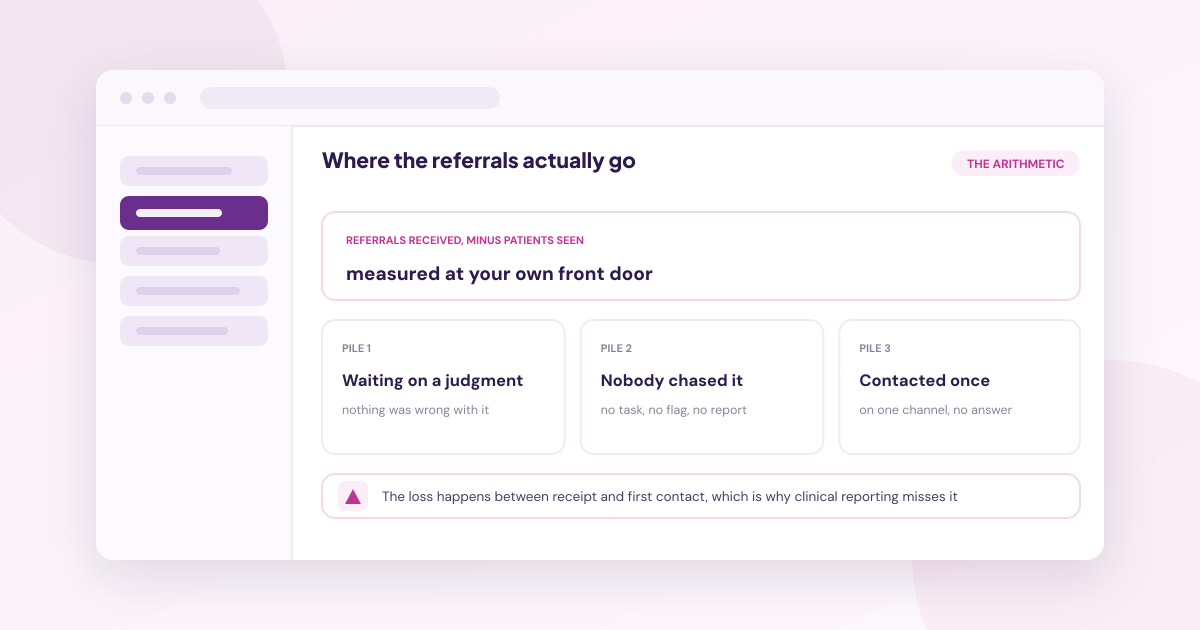
What Referral Leakage Is and Where Referrals Actually GoReferral leakage is the gap between the referrals a practice receives and the patients it actually sees. For a specialty practice on the receiving end it is an intake problem rather than a network problem, and it happens between the moment a referral arrives and the moment somebody first contacts the patient.
Most practices can state exactly how many referrals arrived last month. Very few can state how many were never contacted at all, and the distance between those two answers is the whole problem.
TL;DR
- Referral leakage is referrals received minus patients seen, measured at your own front door rather than across a network.
- The loss happens between receipt and first patient contact, not at the clinical visit, which is why clinical reporting never shows it.
- Three piles account for most of it: the referral waiting on a judgment, the referral nobody chased, and the patient contacted once on one channel.
- Twenty referrals from two months ago, each traced to an outcome, will produce your own number in an afternoon.
- Count the cost in patients rather than dollars, because your practice already knows what one visit is worth to it.
- Time to first patient contact is the one number worth adding to a monthly report, because it is what the patient experiences.
What Referral Leakage Means for a Specialty Practice
Referral leakage for a receiving practice is a different quantity from the one health systems talk about. The system version is about where a referral is sent. The practice version is about what happened to a referral that already arrived, which is a question your own front office can answer and nobody else can.
The Definition, Stated Plainly
Referral leakage is referrals received minus patients seen. Nothing in that arithmetic requires a benchmark or a market study, which is why it is worth measuring locally before reading anybody's industry figure. The referrals are already in your fax inbox, your portal and your electronic health record (EHR), and the patients are already in your schedule.
Why the Health System Definition Does Not Fit
Network retention, the health system framing, assumes you decide where a referral goes. A specialty practice decides almost nothing about that. It controls one stretch of the journey, from the document landing in an inbox to a patient holding an appointment time, and every loss it can actually fix sits inside that stretch.
Where Referrals Actually Go
Referrals that never become patients fall into three recognisable piles, and none of the three produces an error state. No system alarm fires, no exception report lists them, and no vendor dashboard turns red. The common feature is silence rather than failure.
The Referral That Needs a Decision First
Some referrals cannot be actioned until somebody rules on them. Out of network, wrong service line, missing information, or no capacity with the provider named on the page. Nothing is wrong with the document itself, so nothing flags it, and it waits on a judgment that was never assigned to a person by name.
The Referral Nobody Chased
Outbound contact is structurally weaker than inbound contact because nobody is waiting on the other end. An unanswered call creates no complaint and no follow-up task. Deferring it generates no flag and appears in no report, so a referral can sit for 3 weeks without a single system in the building noticing.
The Patient Who Was Contacted Once
One attempt on one channel is generally where a busy front office stops, and that single attempt is where the record of the referral usually ends. A patient who did not pick up looks identical, in every log you have, to a patient who answered and declined. Those two people need entirely different follow-up.
Why Referred Patients Do Not Book
Patients who never book are rarely patients who changed their minds. Two mechanics explain most of it, and both are about timing and effort rather than intent. Neither requires assuming the patient was unwilling.
Nobody Reached Them in a Useful Window
A referral is freshest in the patient's mind on the day their doctor made it. At that point the specialist visit is an expected next step. Two weeks later the same call arrives as an unexpected interruption from a practice the patient may not remember being sent to, and it competes with everything else in their week.
They Were Asked to Do the Work
A voicemail asking the patient to call the office back moves the effort from the practice onto the patient. Every extra step after that loses some share of people who were entirely willing to attend. Reversing the direction, so the practice sends a time the patient can accept, removes most of those steps.
How to Find the Referrals That Were Never Scheduled
Finding your own leakage takes an afternoon and a sample, not a reporting project. The method below needs no new software and produces a number you can defend in a partners' meeting, because every case in it is one your own team can look up.
Trace Twenty, Not Two Thousand
Pull 20 referrals received 2 months ago and follow each one to an outcome. Two months back matters, because anything more recent is still legitimately in progress and will flatter the result. Pick them at random across sources rather than choosing the ones a coordinator remembers.
Sort Them Into Four Outcomes
Four piles cover every referral in the sample.
- Seen in clinic
- Booked and not yet seen
- Contacted and declined
- Never contacted at all
The fourth pile is your leakage. In most practices it is larger than the people running intake expect, and it is the only pile that nobody has a story ready for.
The Question That Produces the Number
Ask two questions in the same meeting. How many referrals arrived last month, which any practice answers precisely from its own systems. Then, how many were never contacted, which usually gets an estimate or a pause. The gap between a precise answer and an estimate is the diagnosis.
What a Missed Referral Costs
The cost of a missed referral is specific to your practice, which is why no benchmark belongs in this calculation. You already hold both numbers the arithmetic needs. State the method and your own figures will do the rest.
Count It in Patients, Not Dollars
Take the never-contacted count from your sample of 20, scale it to a month of referral volume, and multiply by what a new patient episode is worth in your specialty. The practice knows that second figure and a vendor does not. Running it in patients first also tells you whether the gap is a staffing question or a process question.
The Cost That Compounds
A referring office that stops hearing back generally sends fewer referrals, and it rarely announces the change. There is no complaint, no meeting and no cancelled relationship, just a slow decline in volume from one source that looks like market noise. By the time it is visible in a monthly total, the habit at the other end has already moved.
What to Put in Place This Quarter, and Where to Start
Closing the referral loop needs three changes, and two of them cost nothing but a decision. Start with measurement, then ownership, then automation, in that order, because automating an unowned process simply produces failures faster.
Measure Time to First Patient Contact
Time to filing is easy to produce from any EHR and it flatters the practice, because filing is the step your team controls completely. Time to first patient contact, measured in hours from receipt, is what the patient and the referring office actually experience. Report it monthly, per location if you have more than one, and see our guide to a multi-location rollout one clinic at a time.
Give Every Referral an Owner at the Decision Point
The referral waiting on a judgment is the one that disappears, so name the person who makes that judgment rather than the role. A rota of two named people beats a queue owned by the front office in general. Write the name on the process document and put a date on when the decision is due.
Where Automation Helps and Where It Does Not
Acknowledgment to the referring office, status updates and patient outreach all run without a person. Outreach goes out as text and email carrying a self-booking link, and the patient chooses the time, so the practice is not writing into its own calendar on the patient's behalf. Piedmont Plastic Surgery and Dermatology, 10 locations and 50 providers, reports 50% of referred patients scheduled within minutes on that mechanism.
Two things stay human. Deciding that a patient cannot be served, and anything flagged as an exception because the document was unusual. Chart creation and write-back happen if your EHR supports them, so check that before assuming filing disappears, and see whether to automate or hire in the front office alongside referral management software for specialty practices.
FAQs
Common questions from practice owners and administrators measuring referral leakage for the first time.
What Is Referral Leakage?
Referral leakage is the gap between the referrals a practice receives and the patients it actually sees. For a practice on the receiving end, the loss happens between receipt and first patient contact rather than at the clinical visit, which is why it does not appear in clinical reporting or in a no-show rate.
How Do You Calculate Referral Leakage?
Count referrals received in a month, then count the patients from that cohort who were seen, and the difference is your leakage. Sort the shortfall into never contacted, contacted and declined, and still in progress. Only the first of those three is a process failure you can fix this quarter.
Why Do Referred Patients Never Book an Appointment?
Usually because nobody reached them while the referral was still fresh, or because the first contact asked them to call back. A referral made last Tuesday is an expected next step for the patient. The same call three weeks later competes with everything else in their week and often loses.
How Can a Practice Find Referrals That Were Never Scheduled?
Pull 20 referrals from two months ago and trace each to an outcome. Sort them into seen, booked, contacted and declined, and never contacted. The last pile is the answer, and two months back is the right window because more recent referrals are still legitimately in progress.
What Does a Missed Referral Cost a Practice?
Count it in patients first. Scale the never-contacted count from your sample to monthly referral volume, then apply what a new patient episode is worth in your specialty, a figure your practice holds and no vendor can supply. The compounding cost is a referring office that quietly sends fewer.
Is Referral Leakage the Same as a No-Show?
No. A no-show is a patient who held an appointment and did not attend, so the practice knows their name and can reschedule them. A leaked referral never reached an appointment at all, so there is no booking to chase and usually no record that anybody tried twice.

Zain Qayyum
Co-Founder and Co-CEO
Zain Qayyum is co-founder and co-CEO of Medsender. His work centres on the front-office problems that decide whether a referred patient is ever seen: inbound fax, referral backlogs, and phones nobody has time to answer. He argues that healthcare's hardest problems are operational rather than technical, and speaks and writes on where AI genuinely helps a practice and where it overpromises. He is based in New York.
Related Signals