What Has to Be True Before a Referral Becomes a Booked Appointment
 Zain QayyumLast Updated: Nov 23, 2026
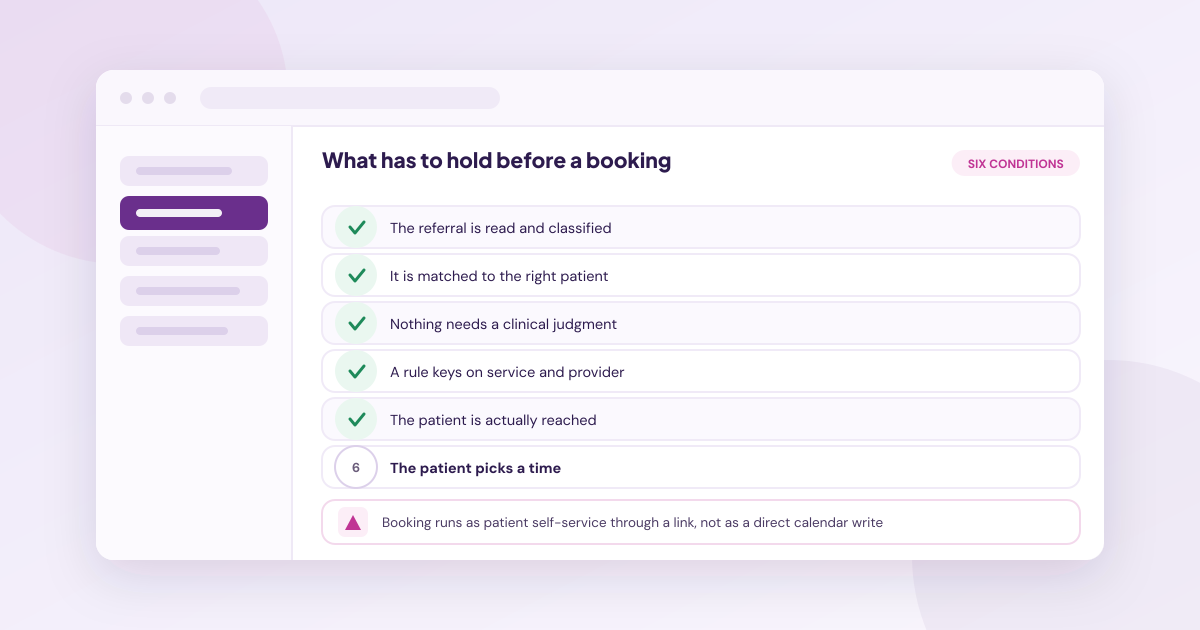
What Has to Be True Before a Referral Becomes a Booked AppointmentReferral booking ends with the patient choosing a time. Automation can read the referral, route it, and reach the patient by text and email carrying a self-booking link, and call automation can also schedule on a call, but the final step belongs to the patient.
Six conditions have to hold before any of that produces an appointment. Automation can carry four of them. Two still need a person, and the one that fails most often is the one no practice has given to anybody by name.
TL;DR
- A referral becomes a booked appointment when six conditions hold, and the final condition is the patient picking a time.
- Scheduling runs as patient self-service through a booking link rather than as a direct calendar write, and call automation can also schedule during a call.
- Booking rules can key safely on service, provider and appointment type, and should never key on anything that needs a clinical judgment.
- A referral with missing information is flagged as an exception for the referral coordinator, and the judgment call stays with your team.
- Sorting by the stated reason for referral is a different operation from judging clinical urgency, which belongs to clinical staff.
- Fit with your existing processes turns on the channel the work arrives in and on your electronic health record (EHR), because chart creation and write-back happen if your EHR supports them.
Can Referred Patients Be Scheduled Without Staff Phoning Them?
Yes, and the mechanism matters more than the answer. Outreach goes out as text and email carrying a self-booking link, the patient opens it and picks from real availability, and the appointment exists because the patient selected it. Call automation can also schedule a patient during a call, which covers people who will not use a link.
What does not happen is software writing an appointment into the calendar on the patient's behalf. That distinction looks academic until a demo, where the question worth asking is who performs the booking action. Ask any vendor to show that step on screen, because the answer decides what your front office stops doing and what it keeps doing.
For a practice, the practical consequence is that the schedule only fills as fast as patients respond. Outreach that runs the same day the referral lands converts better than outreach that runs a fortnight later, and your own consent and opt-out policy governs how often and when those messages go out.
What Has to Be True Before Any Referral Can Be Booked
Six conditions have to hold, in roughly this order, before a referral can turn into an appointment. The list is worth keeping as a checklist, because a stalled referral has almost always failed at exactly one of them.
- The referral has arrived in a channel the practice reads
- It is complete enough to act on
- Somebody has matched it to the right provider and appointment type
- Urgency has been judged by clinical staff
- The patient has been reached
- The patient has chosen a time, or has been scheduled during a call
Automation can carry arrival, completeness checking, patient contact and the booking link. Provider matching and the urgency judgment are the two that stay with people, which is why a practice that automates without assigning those two just reaches the same bottleneck sooner. Our note on what referral leakage is covers what happens to the referrals that fail one of the six.
Can We Set Rules for Which Referrals Get Booked Automatically?
Rules can key on service, provider and appointment type, which covers most of what a referral coordinator does by habit. A rule that sends every colonoscopy request to a named list of providers with a 30 minute slot type is safe, auditable and easy to explain to a new starter.
What a rule cannot safely key on is anything requiring a clinical judgment. Diagnosis severity, suspected malignancy, whether a patient should be seen this week, and whether a referral is appropriate at all are decisions with clinical consequences, and encoding them in a rule moves liability somewhere nobody intended it to sit.
Practically, write the rules the coordinator already follows and stop there. Anything the coordinator currently thinks about before answering is a signal that the case belongs with a person rather than in a rule, and the volume of those cases is usually smaller than a practice fears.
How Does a Practice Handle a Referral With Missing Information?
Incomplete referrals are a category problem rather than a product problem, and most arrive missing one of four things. An insurance detail, a legible date of birth, the reason for referral, or a usable phone number. Each one blocks a different downstream step, so sorting them by which field is absent is more useful than counting them.
The operational answer is an exception. Anything unusual is flagged as an exception for the referral coordinator, and the judgment call stays with the team, which means the system is deciding that it cannot decide rather than guessing. Medsender works that way, and the pattern is worth asking any vendor to demonstrate on a deliberately bad document.
Who owns the exception queue is where practices lose time. In a great many practices the exception pile has no named owner, so it accumulates during busy weeks and is worked when somebody notices. Naming one person and one review time per day fixes more leakage than any configuration change.
Can Referral Software Triage by Diagnosis Urgency?
Software can sort by the reason for referral as written on the page, and that is not the same thing as judging clinical urgency. Reading the stated reason, matching it to a service line and flagging the words a practice has asked to be flagged is text handling. Deciding how quickly a patient needs to be seen is clinical work.
The line sits at that boundary, and it is worth drawing explicitly in a vendor conversation. Ask what the system does with a referral whose stated reason suggests something serious. An honest answer routes it to clinical staff with the relevant text surfaced, rather than assigning it a priority score and booking accordingly.
Practices that want speed on urgent cases usually get it from a flag plus a named reviewer, not from automation making the call. The flag arrives in minutes, which is the part automation is good at, and a clinician rules on it the same morning.
How Do We Avoid Scheduling a Patient Before the Referral Arrives?
The reverse failure is common and it starts with the patient. A patient leaves their primary care appointment, calls the specialist that afternoon, and asks for a slot that nobody has a referral for yet. Booking it creates a visit that may not be payable and a chart with no referring document behind it.
One condition prevents it. The referral has to be on file before the appointment is confirmed, which in practice means a provisional hold with an expiry rather than a confirmed booking. Hold the slot, tell the patient what has to arrive, and chase the referring office rather than the patient.
Automation helps here by closing the loop outward. A request back to the referring office for the missing document goes out without a person, and the hold either converts when the referral lands or expires and releases the slot. Our guide to connecting fax and referral software to your EHR covers the document side.
Will Referral Automation Work With Our Existing Processes?
Two questions decide it, and neither is about how your team likes to work. First, does the work arrive in a channel the system reads, which for most specialty practices means the fax inbox, a portal, email and direct messages. Second, does your EHR support the filing step, because chart creation and write-back happen if your EHR supports them.
Where an EHR does not support it, intake, classification, routing, exception handling and patient outreach all still run, and somebody on your team files the result by hand. That is a real difference in staff time and belongs in the evaluation rather than in week one of going live. Medsender names 34 EHR integrations as available with 47 more on request.
Existing process habits matter less than practices expect. What breaks a rollout is an undefined owner for exceptions or a provider matching rule nobody will commit to, not the order in which your coordinator currently works the queue. Our automation without an EHR task list sets out what to do when the filing step stays manual.
What Still Needs a Person, and Which Steps Automation Can Carry
Three things stay human in every honest version of this. Provider matching, because it depends on who is taking which cases this month. Exceptions, because an unusual document needs somebody to look at it. Clinical judgment, because urgency and appropriateness carry consequences that software should not own.
Everything else is mechanical and can run unattended. Reading the document, classifying it, acknowledging receipt to the referring office, sending text and email with a self-booking link, and reporting status per source. A practice that assigns the three human steps by name before going live gets the benefit of the mechanical ones immediately.
Weigh the two halves separately when you shortlist, and see referral management software for specialty practices for how vendors differ on the mechanical half. On the human half, the question to ask is narrower. Which step does your product hand back to us, and what does it look like when it does.
FAQs
Common questions from referral coordinators and administrators evaluating referral booking.
What Has to Be True Before a Referral Can Be Booked?
Six conditions. The referral has arrived, it is complete enough to act on, somebody has matched it to a provider and appointment type, urgency has been judged by clinical staff, the patient has been reached, and the patient has chosen a time. Automation covers four of the six, and the other two stay with people.
Can Referred Patients Be Scheduled Without Staff Phoning Them?
Yes. Outreach runs as text and email carrying a self-booking link, and the patient picks a time from real availability, so the booking happens because the patient made it. Call automation can also schedule a patient during a call. No software writes an appointment into the calendar on the patient's behalf.
Can Referral Software Triage by Diagnosis Urgency?
Software can sort by the reason for referral as written on the document and flag terms you ask it to flag. Judging how urgently a patient needs to be seen is clinical work and stays with clinical staff. Ask any vendor to show what happens to a referral whose stated reason looks serious.
What Still Needs a Person in Referral Booking?
Provider matching, exception handling and clinical judgment. Matching depends on who is accepting which cases this month, exceptions need somebody to read an unusual document, and urgency carries clinical consequences. Assign all three by name before going live, because automation reaches those three steps faster than a manual process did.
Does the Practice Still Control Which Provider a Patient Sees?
Yes, and that control is a configuration rather than a default. Booking rules are written by the practice and key on service, provider and appointment type, so the available slots a patient sees are the ones you allowed. Anything outside those rules arrives as an exception for the referral coordinator instead.
What Happens When a Referred Patient Does Not Respond?
A sequence continues across text and email rather than stopping after one attempt, and call automation can reach people who ignore links. Set the number of attempts and the stopping point against your own patient consent and opt-out policy. Unresponsive patients should end up in a reportable state, not simply absent from the queue.

Zain Qayyum
Co-Founder and Co-CEO
Zain Qayyum is co-founder and co-CEO of Medsender. His work centres on the front-office problems that decide whether a referred patient is ever seen: inbound fax, referral backlogs, and phones nobody has time to answer. He argues that healthcare's hardest problems are operational rather than technical, and speaks and writes on where AI genuinely helps a practice and where it overpromises. He is based in New York.
Related Signals