Switching Fax Vendors: What It Actually Takes
 Zain QayyumLast Updated: Nov 23, 2026
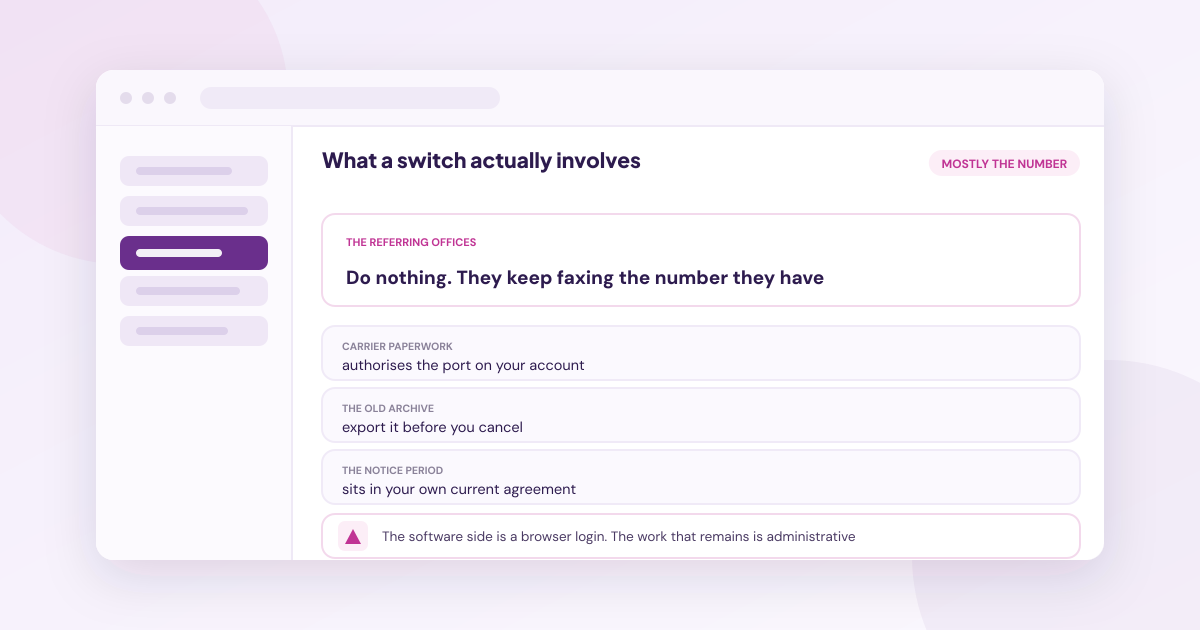
Switching Fax Vendors: What It Actually TakesSwitching fax vendors is mostly a phone number problem. The number ports, the referring offices keep faxing the number they already have, and the software change is invisible to everybody outside the practice. Three things do need attention, and all three are answered below.
Is It Hard for a Practice to Switch Fax Vendors?
Switching fax vendors is not usually hard, because your existing number ports across and the software side is a browser login with no on-premise install. The work that remains is administrative rather than technical. Three items need attention, which are the carrier paperwork that authorises the port, the fax archive sitting at your current vendor, and the notice period in the agreement you are still on. None of the three is a technical project, and none of them reaches the referring offices that send you work.
Can We Keep Our Fax Number When Switching Fax Automation Software?
Your existing fax number comes with you, because Medsender ports it rather than issuing a replacement. That matters more than it first sounds. The number sits on referral pads at every referring office, in the practice directory listing, in the hospital address book and on cover sheets other offices keep in a drawer. Changing the number instead of porting it means correcting every one of those, and the ones you miss keep sending to a line nobody reads. Porting removes that whole problem.
What Does the Practice Have to Supply to Port a Fax Number?
Three items come from the practice rather than from the vendor. Carrier account details for the account that actually holds the number, a named contact who can authorise the port on that account, and the full list of numbers being moved. The third item is where multi-location groups tend to slow down, because a group that has absorbed a clinic or moved an office often has numbers still live that nobody has listed in years. Gather that list before anybody files paperwork.
What Happens to Our Old Fax History When We Switch?
Your old fax history stays with your current vendor until you export it. Export the archive before you cancel rather than after, because access normally ends with the account. Medsender does not claim to import another vendor's fax archive, so treat your own export as the record you are keeping. Ask any vendor in writing whether historical faxes migrate, and get the answer as a sentence you can keep. Treat silence on that question as a no rather than as a yes.
What About the Contract We Are Still On?
The notice period on your current fax agreement sits in that document, so read your own contract before fixing a cutover date. It sets how far ahead you have to tell your current vendor, and it is the item most likely to decide your timing. Nothing here states Medsender's own contract terms. Overlapping one billing period across the two vendors generally costs less than a rushed cancellation, because a missed notice window can carry a further full term you did not plan for.
Can We Run Both Fax Vendors in Parallel?
Running two fax vendors in parallel works, and it is the lower-risk way to switch. The old inbox stays readable while the new one takes live traffic, which lets the front office compare the two on the same documents before anybody commits. Pick the cutover point yourself rather than letting the port date pick it for you. The overlap also gives you a window to finish the archive export while you still hold an account at the old vendor.
Do Referring Offices Have to Do Anything When We Switch?
Referring offices do nothing at all. They keep faxing the number they already have, and nothing about the way they send changes. There is no new number to circulate, no form for them to sign and no notice for you to give them. For a practice that depends on referral volume, that is the whole point of porting the number rather than replacing it. The switch is visible inside the practice and invisible outside it.
What Does the Front Office Have to Learn After Switching?
The front office learns three things after switching. What arrives in the fax inbox and what has already been read from it, since optical character recognition (OCR) reads typed and handwritten pages and a batch is read in under 5 seconds. What to do with an item flagged as an exception for the coordinator, where judgment calls stay with the team. And what reaches the electronic health record (EHR), remembering that chart creation and write-back happen if your EHR supports chart creation and write-back.
What Does Fax Automation Cost Per Page?
Medsender publishes fax at $0.08 per page at low volume, sliding to $0.056 as volume rises. Referrals are priced separately at $1.20 each at low volume, sliding to $1.00. Compare vendors on your own pages a month rather than on an example volume in a brochure, because a sliding rate means the quote that looks cheaper at one volume may not be cheaper at yours. Pull three months of your own fax counts before asking anybody for a number.
Can We Try Fax Automation Before Switching?
A free trial exists, and it is deliberately limited in scope. It covers basic non-AI fax only, with no referral processing and no electronic medical record (EMR) integration, so it does not exercise the part of the product a switching practice is actually buying. For anything past basic fax, ask for a demo run on your own faxed documents, including the two worst pages you can find in the inbox, and judge the result on those rather than on a vendor's sample set.
Related Reading
Four pages cover the parts of a switch that sit outside the fax number itself.

Zain Qayyum
Co-Founder and Co-CEO
Zain Qayyum is co-founder and co-CEO of Medsender. His work centres on the front-office problems that decide whether a referred patient is ever seen: inbound fax, referral backlogs, and phones nobody has time to answer. He argues that healthcare's hardest problems are operational rather than technical, and speaks and writes on where AI genuinely helps a practice and where it overpromises. He is based in New York.
Related Signals